


















Lesson 29 of 48 · Gene Regulation
The lac Operon: Negative and Positive Control
Understand how E. coli switches lactose genes on and off with a repressor and CAP-cAMP, and learn to solve operon mutant problems with a logic table.
Escherichia coli can live on glucose, and it can live on lactose, but it prefers glucose. If you give it both, it eats the glucose first, pauses, and only then switches to lactose. The cell does this by controlling three genes with a tiny circuit made of one DNA site, one repressor protein and one helper protein. The lac operon was the first gene-regulation system worked out in detail, and it is still the best way to learn how regulatory logic works.
What you will learn
- The parts of the lac operon and what each does.
- How lactose (through allolactose) removes the repressor.
- How low glucose turns on CAP-cAMP and strengthens transcription.
- How to predict the behavior of operon mutants, including partial diploids.
Key terms
Operon: genes with a shared promoter and regulatory sites, transcribed as one mRNA.
Operator (O): the DNA site where the repressor binds.
Inducer: a molecule (allolactose in nature) that switches an operon on by inactivating the repressor.
CAP (catabolite activator protein): a protein that, bound to cAMP, helps RNA polymerase start transcription.
cis-acting: affecting only the DNA molecule it sits on.
The parts
The lac operon contains three structural genes transcribed together from one promoter, and a regulatory gene nearby.
- lacZ encodes β-galactosidase, which splits lactose into glucose and galactose (and makes allolactose in a side reaction).
- lacY encodes lactose permease, a membrane protein that brings lactose into the cell.
- lacA encodes a transacetylase whose role in lactose use is less clear.
- lacI encodes the repressor. Its own promoter is separate and it is made at a low constant level.
- P is the promoter where RNA polymerase binds, and O is the operator. The operator overlaps the promoter region, so a repressor sitting there blocks the polymerase.
Negative control: the repressor
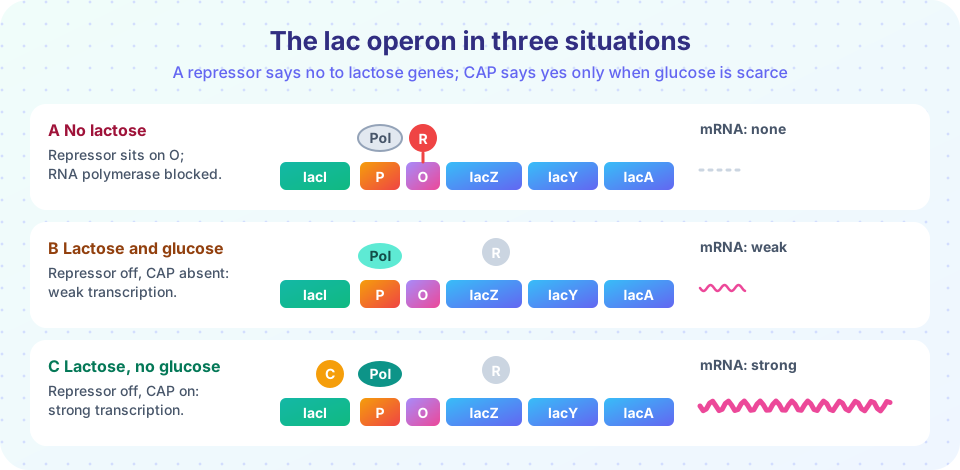
With no lactose around, the LacI repressor, a tetramer, binds the operator tightly. RNA polymerase cannot proceed, so the three genes are almost silent. When lactose appears, a few molecules enter the cell and a little β-galactosidase (always present at a low basal level) converts some to allolactose. Allolactose binds the repressor and changes its shape, so it lets go of the operator. Now polymerase can transcribe the operon, the cell makes much more permease and β-galactosidase, and the cell is ready to eat lactose. Because the system is switched on by a signal, it is called inducible, and because the regulator is a repressor, it is negative control. When lactose is used up, allolactose disappears and the repressor reclaims the operator.
In the lab, researchers use IPTG, a molecule that binds the repressor like allolactose but is not broken down by β-galactosidase. It keeps the operon on, and is a standard tool for inducing a cloned gene in bacteria.
Positive control: CAP and glucose
Releasing the repressor is not enough to make a lot of mRNA. The lac promoter is a weak promoter that RNA polymerase binds poorly on its own. It needs CAP, which works as a positive regulator, and CAP works only when it has bound cAMP. When glucose is abundant, the cell's cAMP level is low, so CAP is inactive. When glucose runs out, cAMP rises, CAP-cAMP binds next to the promoter and helps recruit polymerase, and transcription rises strongly. The result is a two-input logic gate:
| Lactose | Glucose | Repressor | CAP-cAMP | lac mRNA |
|---|---|---|---|---|
| absent | present | bound | no | almost none |
| absent | absent | bound | yes | almost none |
| present | present | released | no | low |
| present | absent | released | yes | high |
This explains Monod's observation of diauxic growth: in a mixed medium, bacteria first consume glucose, then lag briefly while the lac operon switches on, then grow on lactose.
Mutants and logic
Jacob and Monod used mutants to deduce the circuit. The main classes behave as follows.
- lacI⁻ (no functional repressor): the operon is on all the time (constitutive).
- lacIˢ (a super-repressor that cannot bind allolactose): it stays on the operator, so the operon is never induced.
- lacOᶜ (operator-constitutive): the operator cannot bind the repressor, so the operon is on all the time.
- lacZ⁻ or lacY⁻: the corresponding protein is missing, even when the operon is on.
The key idea is the difference between cis and trans effects. The repressor is a diffusible protein, so a good lacI⁺ gene anywhere in the cell can repress both operons: it acts in trans. The operator is a DNA site, so a lacOᶜ mutation affects only the genes on the same DNA molecule: it acts in cis. Partial diploids (merodiploids), with a second copy of the operon on a plasmid called F′, allowed the researchers to test this.
Examples:
- lacI⁻ / lacI⁺ partial diploid: repression is restored because the wild-type repressor acts in trans.
- lacOᶜ lacZ⁺ / O⁺ lacZ⁻: the cell makes functional β-galactosidase, because the constitutive operator drives the good lacZ copy on the same DNA.
- lacOᶜ lacZ⁻ / O⁺ lacZ⁺: the constitutively expressed copy has a defective lacZ and the working copy is still repressed, so there is no β-galactosidase without lactose.
Beyond lac
The trp operon works the other way round. It encodes enzymes that make tryptophan and is a repressible operon: the repressor binds the operator only when it has bound tryptophan. Extra tryptophan therefore shuts the pathway down, which makes sense for a biosynthetic pathway. Another layer, attenuation, uses the speed of ribosomes on a leader peptide to stop transcription early. The lac and trp operons show a design rule: catabolic pathways are usually induced by their substrate, and biosynthetic pathways are repressed by their product.
Common misconceptions
"Lactose itself binds the repressor." The true inducer is allolactose, an isomer made from lactose by β-galactosidase. IPTG is a lab substitute.
"The operon is off in the presence of glucose no matter what." It is only weakly on if lactose is present with glucose; the repressor is already released.
"Operators and repressors are both proteins." The operator is a DNA sequence; the repressor is a protein.
Try it
The first example is a logic simulator for partial diploids. Each copy of the operon has an operator type (O⁺ or Oᶜ) and a lacZ type (Z⁺ or Z⁻); the cell has a repressor type (I⁺, I⁻ or Iˢ). The numbers are an illustrative model of the logic, not measured activities.
Press Run (or Ctrl + Enter) to see the result here.
Program input · what you'd type while the program runs
Type the answers before you press Run, one per line. Each time the program reads a line (with input()), it gets the next line from this box.
The second example plots an illustrative induction curve: the fraction of operators free of repressor as the inducer concentration rises. The steepness (Hill coefficient) and midpoint are chosen for illustration.
Press Run (or Ctrl + Enter) to see the result here.
Program input · what you'd type while the program runs
Type the answers before you press Run, one per line. Each time the program reads a line (with input()), it gets the next line from this box.
The third example is an interactive operon. Tick the boxes and watch the repressor, CAP and mRNA output change.
Check your understanding
Quick check · 5 questions
of 5 answered You scored / 5 · perfect!
-
1. What is the natural inducer of the lac operon?
Allolactose, made from lactose by β-galactosidase, binds the repressor. IPTG is a laboratory substitute. -
2. In a cell with lactose but plenty of glucose, the lac operon is
The repressor is released, but CAP-cAMP is inactive because cAMP is low, so transcription stays low. -
3. A lacOᶜ mutation acts in cis because
The operator is part of the DNA, so a mutation there only affects its own operon copy. -
4. A cell has the genotype lacI⁻ lacZ⁺ and no other copies. Without lactose, it makes β-galactosidase because
Without a functional repressor the operon is constitutively on. -
5. The trp operon is described as repressible because
Tryptophan acts as a corepressor, so the pathway is shut down when the product is plentiful.
Summary
- The lac operon has genes lacZ, lacY and lacA, a promoter, an operator and a nearby regulatory gene lacI.
- The repressor blocks transcription (negative control); allolactose releases it.
- CAP-cAMP boosts transcription when glucose is scarce (positive control), so full expression needs lactose and low glucose.
- Operators act in cis; the repressor acts in trans, which lets you solve partial diploid puzzles.
- The trp operon shows the opposite design: a repressible biosynthetic pathway.
Next: Eukaryotic control: chromatin, enhancers and epigenetics
Track your progress
Create a free account to tick off lessons and pick up where you left off on any device.
of Molecular Biology lessons completed