


















Lesson 32 of 48 · Gene Regulation
Chapter 6 Review: Gene Regulation
Review the six levels of gene regulation with a one-page picture, a recap table, a steady-state expression calculator and a ten-question quiz.
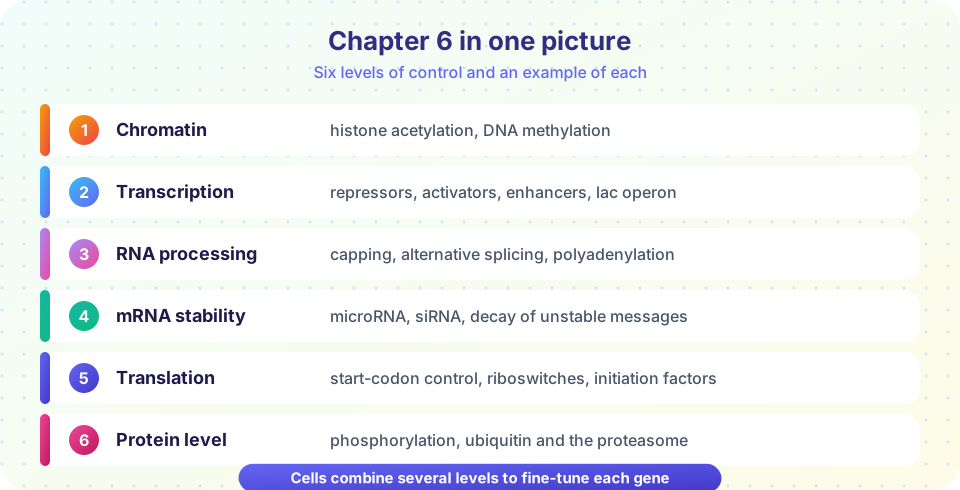
Regulation is the part of molecular biology where logic meets chemistry. Whether you consider an operon in a bacterium or an enhancer in a human cell, the questions are the same: what is the input, which molecule senses it, what does that molecule bind, and what is the output? This review ties together the chapter and lets you check how much a change at one level (a promoter, an mRNA half-life) alters the amount of protein.
What you will learn
- How to recognize which level of control a mechanism acts on.
- How synthesis and decay rates set the steady-state amount of mRNA and protein.
Recap table
| System | Level | Key idea |
|---|---|---|
| lac operon, repressor | Transcription (bacteria) | Negative control; allolactose releases the repressor |
| CAP-cAMP | Transcription (bacteria) | Positive control, active when glucose is low |
| trp operon | Transcription (bacteria) | Repressible: the product tryptophan activates the repressor |
| Histone acetylation / methylation | Chromatin | Acetylation opens; H3K27me3 and H3K9me3 repress |
| DNA methylation | Chromatin | CpG island methylation silences; DNMT1 maintains it |
| Enhancers, Mediator | Transcription (eukaryotes) | Act at a distance by looping; combinatorial control |
| Alternative splicing | RNA processing | Many isoforms from one gene |
| mRNA half-life, NMD | mRNA stability | Short half-life, fast response |
| miRNA, siRNA, RISC | mRNA stability and translation | Seed pairing with the 3′ UTR |
| Riboswitch | Transcription or translation | RNA structure binds a small molecule |
| Phosphorylation, ubiquitin | Protein level | Activate, move or destroy proteins |
Common misconceptions
"Regulation means transcription." Transcription is the biggest dial, but splicing, decay, translation and protein modification all matter.
"Bacteria have no regulation beyond operons." They also use small RNAs, riboswitches, attenuation and global regulators such as CAP.
"A repressed gene makes no product." Repression usually lowers expression by orders of magnitude, but a small basal amount remains, which is how an operon gets started.
Try it
The first example uses the simplest model of expression. A gene makes mRNA at rate k_tx; mRNA decays with rate d_m = ln 2 / half-life; each mRNA makes protein at rate k_tl, and protein decays with rate d_p. At steady state, the amount of mRNA is k_tx / d_m and the amount of protein is k_tl × mRNA / d_p. The default numbers are illustrative.
Press Run (or Ctrl + Enter) to see the result here.
Program input · what you'd type while the program runs
Type the answers before you press Run, one per line. Each time the program reads a line (with input()), it gets the next line from this box.
The second example plots protein output as an activator concentration rises, for three mRNA half-lives, combining the binding curve of the previous lessons with the steady-state formula. It shows that the half-life scales the whole curve without changing its shape.
Press Run (or Ctrl + Enter) to see the result here.
Program input · what you'd type while the program runs
Type the answers before you press Run, one per line. Each time the program reads a line (with input()), it gets the next line from this box.
Check your understanding
Quick check · 10 questions
of 10 answered You scored / 10 · perfect!
-
1. In the lac operon, which condition gives the highest expression?
The repressor is released by lactose and CAP-cAMP is active when glucose is low. -
2. A lacOᶜ mutation is cis-dominant because
A site on DNA cannot act on another molecule. -
3. Which histone modification is typically associated with repressed chromatin?
H3K27me3, laid down by Polycomb complexes, marks repressed regions; acetylation and H3K4me3 mark active regions. -
4. Which enzyme maintains DNA methylation patterns during replication?
DNMT1 methylates the new strand opposite methylated cytosines on the old strand. -
5. How can an enhancer act on a promoter that is 50 kb away?
Looping brings the enhancer and promoter into contact. -
6. A pre-mRNA has two constitutive and four optional exons. How many isoforms are possible if each optional exon is independently in or out?
2^4 = 16. -
7. A gene's mRNA half-life is shortened from 60 to 15 minutes with no other change. At steady state the mRNA amount is
Steady state is synthesis rate divided by decay rate; the decay rate is four times higher. -
8. RISC finds its target mRNA mainly through
The small RNA is the guide; Argonaute holds it. -
9. Which statement about riboswitches is correct?
Riboswitches are common in bacterial mRNAs and control expression of the genes on that message. -
10. The 2024 Nobel Prize in Physiology or Medicine was awarded for the discovery of
Victor Ambros and Gary Ruvkun received it for the discovery of microRNA and its role in gene regulation.
Summary
- Gene expression can be regulated at six levels; each lesson in this chapter looked at one or more of them.
- The lac operon shows negative and positive control; eukaryotes add chromatin, enhancers and epigenetic memory.
- Splicing, mRNA stability and small RNAs refine expression after transcription.
- Steady-state amounts depend on both synthesis and decay rates.
Track your progress
Create a free account to tick off lessons and pick up where you left off on any device.
of Molecular Biology lessons completed