


















Lesson 9 of 48 · The Molecules of Life
RNA: Types, Structure and Functions
Understand how RNA differs from DNA, how single strands fold into hairpins, and what mRNA, tRNA, rRNA and regulatory small RNAs do, with runnable folding and wobble examples.
If DNA is the archive, RNA is everything that happens between the archive and the cell's work. RNA copies genes, carries amino acids, builds the ribosome, switches genes off and even speeds up chemical reactions. It can do so many jobs because, unlike DNA, it usually exists as a single strand that folds back on itself into three-dimensional shapes.
This lesson starts with how RNA differs chemically from DNA, then explores its four major families and how folding gives each its function.
What you will learn
- Three chemical differences between RNA and DNA and why they matter.
- How a single RNA strand forms hairpins and complex 3D shapes.
- The roles of mRNA, tRNA, rRNA and small regulatory RNAs.
- How wobble pairing lets fewer tRNAs read all codons.
Key terms
Ribose: the five-carbon sugar of RNA, with a hydroxyl group at the 2′ carbon.
Uracil (U): the pyrimidine base that replaces thymine in RNA and pairs with adenine.
Hairpin (stem-loop): a structure formed when one strand folds back and pairs with itself.
Anticodon: the three bases of a tRNA that pair with a codon on mRNA.
Ribozyme: an RNA molecule that catalyzes a chemical reaction.
How RNA differs from DNA
RNA is built from nucleotides like DNA, with three differences. Its sugar is ribose, which has a hydroxyl (−OH) group on the 2′ carbon. Its fourth base is uracil in place of thymine; uracil lacks thymine's methyl group but pairs with adenine in the same way. And it is usually single-stranded.
The 2′ hydroxyl has important effects. It makes RNA chemically more reactive: under alkaline conditions the hydroxyl can attack the neighboring phosphate and cut the backbone, so RNA degrades much more easily than DNA. That is useful for messages that should be short-lived, and it explains why RNA samples need careful handling in the lab. The hydroxyl also helps RNA adopt compact shapes different from the DNA double helix; double-stranded RNA forms an A-form helix, wider and shorter than B-DNA.
Folding: structure from sequence
Because an RNA strand is single, one part can pair with a complementary part further along the same strand. Pairing between A and U and between G and C is standard, and G-U wobble pairs (two hydrogen bonds) are also common in RNA. A paired stretch is a stem and the unpaired turn at its end is a loop, so the whole motif is a hairpin or stem-loop.
Hairpins then pack against each other into tertiary structures held by extra contacts. This is why RNA can have shapes that bind specific molecules or position other molecules for reactions. In bacteria, some mRNAs even contain folded regions called riboswitches that bind a small molecule and change gene expression directly.
The four major families
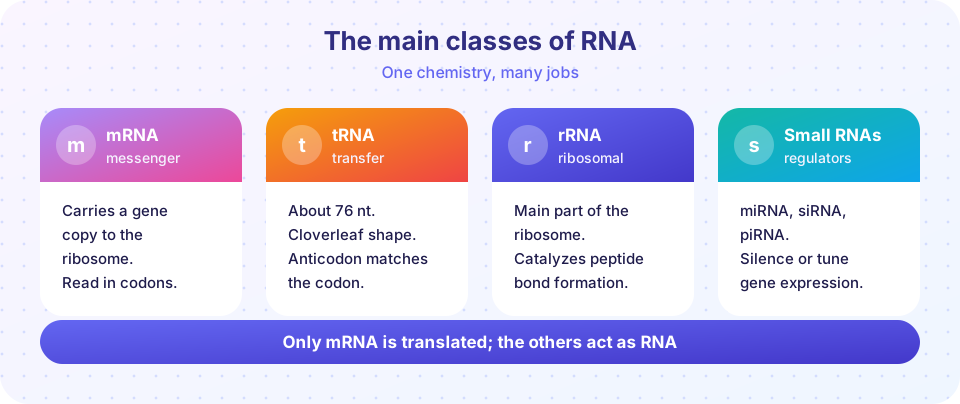
Messenger RNA (mRNA) carries the information of a gene from DNA to the ribosome. Its protein-coding region is read in codons. Eukaryotic mRNA also has a 5′ cap, untranslated regions (UTRs) on each side of the coding region, and a poly-A tail (chapter 4).
Transfer RNA (tRNA) is an adaptor, typically about 76 nucleotides long. A cloverleaf-shaped secondary structure folds into an L-shaped 3D structure. One end has the anticodon, which pairs with an mRNA codon; the other end, a 3′ CCA sequence, carries the matching amino acid. Enzymes called aminoacyl-tRNA synthetases attach each amino acid to the right tRNA, which is the step that makes the genetic code real (chapter 5).
Ribosomal RNA (rRNA) is the main component of the ribosome. In bacteria, the 70S ribosome has a small 30S subunit (containing 16S rRNA) and a large 50S subunit (23S and 5S rRNA). Eukaryotic 80S ribosomes have a 40S subunit (18S rRNA) and a 60S subunit (28S, 5.8S and 5S rRNA in humans). The 2009 Nobel Prize in Chemistry honored structures showing that the reaction that forms peptide bonds is catalyzed by rRNA itself, not by a protein, so the ribosome is a ribozyme.
Small and regulatory RNAs control gene expression. MicroRNAs (miRNAs, about 22 nucleotides) pair with target mRNAs and reduce their translation or stability. Small interfering RNAs (siRNAs) trigger cutting of matching mRNAs. Piwi-interacting RNAs (piRNAs) guard the germline against jumping genes. Long non-coding RNAs (lncRNAs, over 200 nucleotides) have a range of roles, including shaping chromatin. Andrew Fire and Craig Mello showed in 1998 in the roundworm C. elegans that double-stranded RNA can silence a matching gene, a process called RNA interference (RNAi), for which they received the 2006 Nobel Prize.
RNA as catalyst and the RNA world
In the early 1980s Thomas Cech discovered that a ciliate intron could splice itself out of RNA with no protein present, and Sidney Altman found that the RNA part of the enzyme RNase P is the catalytic part. They shared the 1989 Nobel Prize. Because RNA can both carry information and catalyze reactions, many researchers propose an RNA world: an early stage of life in which RNA did both jobs, before DNA and proteins specialized. It is a leading hypothesis but remains debated.
Wobble: fewer tRNAs than codons
There are 61 sense codons but fewer than 61 distinct tRNAs in a cell. This works because the third codon position is read loosely. In 1966 Francis Crick proposed the wobble rules: the first base of the anticodon (position 34) can pair with more than one base at the third codon position. G can pair with C or U, U with A or G, and inosine (a modified adenine) with U, C or A. So one tRNA can read several synonymous codons.
Common misconceptions
"RNA is only a messenger." mRNA is one family. tRNA, rRNA and many regulatory RNAs act directly as RNA and are never translated.
"RNA is a single straight strand." It folds extensively through self-pairing, and its 3D shape is what determines function.
"Uracil and thymine are completely different." They differ only by a methyl group; both pair with adenine.
Try it
This program looks for hairpins in an RNA sequence. It checks whether the 5′ end of a window can pair with its 3′ end (allowing A-U, G-C and G-U), then prints the result in dot-bracket notation, where matching parentheses mark paired bases. It is a teaching model, not a real folding algorithm, which would compare energies.
Press Run (or Ctrl + Enter) to see the result here.
Program input · what you'd type while the program runs
Type the answers before you press Run, one per line. Each time the program reads a line (with input()), it gets the next line from this box.
Second, a wobble calculator. Give an anticodon written 5′ to 3′ and it lists the codons that anticodon can read under the standard wobble rules.
Press Run (or Ctrl + Enter) to see the result here.
Program input · what you'd type while the program runs
Type the answers before you press Run, one per line. Each time the program reads a line (with input()), it gets the next line from this box.
Check your understanding
Quick check · 5 questions
of 5 answered You scored / 5 · perfect!
-
1. Which is a chemical difference between RNA and DNA?
RNA's ribose has a 2' hydroxyl group, and uracil replaces thymine. -
2. What is the role of the anticodon on a tRNA?
The anticodon base-pairs with a codon, ensuring the right amino acid is added. -
3. Which RNA catalyzes peptide bond formation?
The peptidyl transferase center of the ribosome is made of rRNA. -
4. Why is RNA less stable than DNA?
The 2' hydroxyl makes the neighboring phosphodiester bond prone to cleavage. -
5. Wobble pairing means
The loose pairing at the third codon position allows one tRNA to read several synonymous codons.
Summary
- RNA has ribose, uracil and is usually single-stranded; the 2′ hydroxyl makes it reactive and flexible.
- Self-pairing creates stems and loops; folded shapes give RNA its functions, including catalysis (ribozymes).
- The major families are mRNA (message), tRNA (adaptor), rRNA (ribosome) and small regulatory RNAs such as miRNA and siRNA.
- Wobble pairing lets fewer tRNAs read all 61 sense codons.
Track your progress
Create a free account to tick off lessons and pick up where you left off on any device.
of Molecular Biology lessons completed