


















Lesson 3 of 48 · Getting Started
Prokaryotes and Eukaryotes: Where the Genome Lives
Compare bacterial and eukaryotic cells: nucleoid versus nucleus, plasmids, organelle genomes, operons and introns, and why cell size limits how a cell works.
Molecular biology happens inside cells, and the cell's architecture decides how its molecular machinery is organized. Biologists sort all cellular life into three domains: Bacteria, Archaea and Eukarya. Bacteria and archaea are prokaryotes, cells without a membrane-bound nucleus. Eukarya, which include yeasts, plants, animals and you, are eukaryotes, cells whose DNA sits in a nucleus.
This lesson compares the two cell plans through the lens of the genome: where the DNA is, how it is packaged, how much there is and how gene expression is organized. These differences explain why bacteria are such fast, simple experimental systems and why eukaryotes need extra steps such as RNA splicing.
What you will learn
- The structural differences between prokaryotic and eukaryotic cells that matter for gene expression.
- How genomes are organized in each: circular chromosome, linear chromosomes, plasmids and organelle DNA.
- Why transcription and translation can overlap in bacteria but not in eukaryotes.
- Why cell size is limited by the surface-area-to-volume ratio.
Key terms
Nucleoid: the irregular region of a bacterial cell where the chromosome sits, with no surrounding membrane.
Plasmid: a small, circular, extra DNA molecule that can replicate independently.
Operon: a group of genes transcribed together into one mRNA under shared control.
Intron: a non-coding stretch inside a eukaryotic gene that is removed from the RNA.
Organelle: a membrane-bound compartment with its own job, such as the nucleus or mitochondrion.
The prokaryotic plan
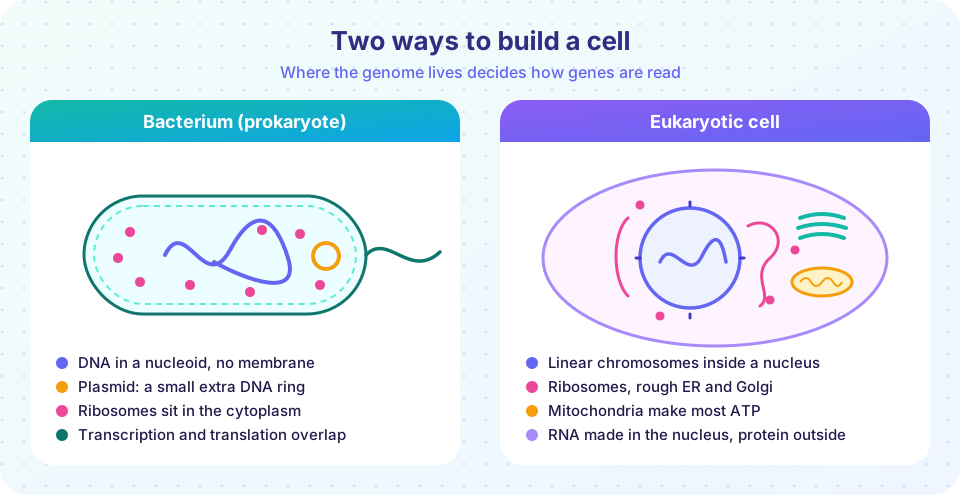
A typical bacterium is a cell 1 to 5 micrometers (µm) long. Its chromosome is usually a single circular DNA molecule, for example about 4.6 million base pairs (Mb) in Escherichia coli. The DNA is folded and supercoiled into the nucleoid with the help of proteins, but no membrane separates it from the rest of the cell.
Many bacteria also carry plasmids, small circles of DNA from a few thousand to hundreds of thousands of base pairs. Plasmids often carry genes for antibiotic resistance and can pass between bacteria. They are also the workhorses of genetic engineering (chapter 7).
Bacterial genes are packed tightly, with little non-coding DNA between them. Related genes are often grouped into an operon and transcribed into a single long messenger RNA called a polycistronic mRNA. A famous example is the lac operon, which controls lactose digestion (chapter 6).
Because there is no nucleus, ribosomes can attach to an mRNA while RNA polymerase is still making it. Transcription and translation are coupled. A bacterial mRNA is typically short-lived, lasting minutes, so bacteria can change which proteins they make very quickly.
Archaea look like bacteria under a microscope, but their gene-expression machinery is more like that of eukaryotes: their RNA polymerase and their DNA-packaging proteins resemble eukaryotic ones. This is one clue to how eukaryotes arose.
The eukaryotic plan
Eukaryotic cells are usually 10 to 100 µm across. They have a nucleus enclosed by a double membrane with pores, and organelles including mitochondria, an endoplasmic reticulum (ER) and a Golgi apparatus. Plants add chloroplasts.
The genome is split into several linear chromosomes. Baker's yeast has 16, fruit flies have 4 pairs and humans have 23 pairs (46 chromosomes) in most body cells. The DNA is wrapped around histone proteins to form chromatin (chapter 2).
Eukaryotic genomes are bigger and looser. A human gene is mostly non-coding: coding sequences (exons) are interrupted by introns, which are cut out of the RNA after transcription. Between genes lie long stretches of regulatory and repetitive DNA.
Mitochondria and chloroplasts carry their own small genomes, a leftover from their bacterial ancestors. Human mitochondrial DNA is a circle of 16,569 base pairs that encodes 13 proteins, 22 tRNAs and 2 rRNAs. Most mitochondrial proteins are encoded in the nucleus and imported.
Because the nucleus separates the genome from the ribosomes, a gene's RNA must be made, processed (capped, spliced, tailed) and exported before it can be translated. This takes time but gives the cell extra points of control.
Side by side
| Feature | Bacterium (prokaryote) | Eukaryotic cell |
|---|---|---|
| Typical size | 1 to 5 µm | 10 to 100 µm |
| DNA location | Nucleoid, no membrane | Nucleus, double membrane |
| Chromosomes | Usually one circular | Several linear |
| Extra DNA | Plasmids | Mitochondrial (and chloroplast) DNA |
| Gene layout | Dense, operons | Sparse, introns, long regulatory regions |
| mRNA | Polycistronic, short-lived | Monocistronic, processed |
| Transcription and translation | Coupled | Separated in space and time |
| Ribosomes | 70S | 80S in the cytoplasm |
Why cells stay small
A cell must supply its whole volume through its surface. A sphere of radius r has a surface area of 4πr² and a volume of (4/3)πr³, so the ratio of surface to volume is 3/r. Doubling the radius halves this ratio. A cell that grows too large cannot import nutrients or shed waste fast enough. Eukaryotes get around the limit by adding internal membranes (the ER, for instance), which increase surface area, and by dividing work among organelles.
Common misconceptions
"Prokaryotes are primitive and simple." Bacteria are highly evolved and extremely efficient. They are simpler in layout, not in biochemistry, and they have had as long to evolve as we have.
"All bacterial DNA is one circle." Some bacteria, such as Vibrio cholerae, have two circular chromosomes, and a few have linear ones. A single circular chromosome is typical, not universal.
"Eukaryotic means complicated genome." Genome size does not track complexity: some amoebas and plants have genomes far larger than ours.
Try it
The first program shows why size matters. It plots surface-area-to-volume ratio against cell radius and marks where a bacterium, a yeast cell and a large animal cell sit. The radii are typical round numbers; real cells vary.
Press Run (or Ctrl + Enter) to see the result here.
Program input · what you'd type while the program runs
Type the answers before you press Run, one per line. Each time the program reads a line (with input()), it gets the next line from this box.
The second block is a small calculator that compares how long a bacterium and a human cell could take to read the same gene, using typical speeds. It is an estimate, not a measurement. Change the gene length and the rates.
Press Run (or Ctrl + Enter) to see the result here.
Program input · what you'd type while the program runs
Type the answers before you press Run, one per line. Each time the program reads a line (with input()), it gets the next line from this box.
Check your understanding
Quick check · 5 questions
of 5 answered You scored / 5 · perfect!
-
1. Which feature distinguishes a prokaryotic cell?
Prokaryotes lack a membrane-bound nucleus; their DNA sits in a nucleoid. -
2. Why can transcription and translation overlap in bacteria?
Without a nuclear membrane, ribosomes can attach to an mRNA still being made. -
3. What is an operon?
An operon is a cluster of genes transcribed as one mRNA under a common promoter. -
4. A spherical cell doubles its radius. What happens to its surface-area-to-volume ratio?
The ratio equals 3/r, so doubling r halves it. -
5. Where does human mitochondrial DNA come from, evolutionarily?
Mitochondria descend from bacteria taken up by an ancestral cell and keep a small genome of their own.
Summary
- Prokaryotes keep DNA in a nucleoid and usually have one circular chromosome plus plasmids; eukaryotes keep DNA in a nucleus on several linear chromosomes.
- Bacterial genes are dense and often arranged in operons; eukaryotic genes have introns and long regulatory regions.
- Bacterial transcription and translation are coupled; eukaryotic gene expression is separated into nucleus and cytoplasm with RNA processing between.
- Mitochondria and chloroplasts have their own small genomes inherited from bacteria.
- The surface-area-to-volume ratio (3/r for a sphere) limits cell size.
Track your progress
Create a free account to tick off lessons and pick up where you left off on any device.
of Molecular Biology lessons completed