


















Lesson 21 of 48 · Transcription
RNA Processing: Capping, Splicing and Polyadenylation
Follow a eukaryotic pre-mRNA to a mature mRNA: the 5' cap, intron removal by the spliceosome, alternative splicing and the poly-A tail, with splicing simulations.
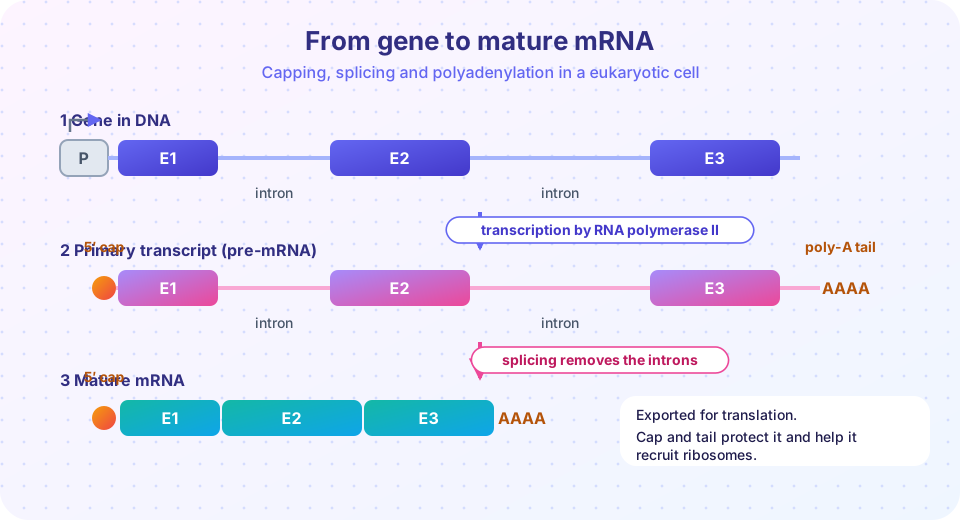
When RNA polymerase II finishes a gene, the RNA it releases is not yet ready to be translated. In eukaryotes the primary transcript, or pre-mRNA, is modified in three steps before it leaves the nucleus: a cap is added at the 5′ end, introns are cut out and exons are joined, and a tail of adenines is added at the 3′ end. These steps happen largely while transcription is still going on, helped by the polymerase's CTD tail.
Processing explains a surprising fact: most eukaryotic genes are interrupted by non-coding stretches. It also explains why one gene can make several different proteins. This lesson follows the steps in order.
What you will learn
- How the 5′ cap and poly-A tail are added and what they do.
- How the spliceosome recognizes and removes introns.
- How alternative splicing makes several proteins from one gene.
- Why bacteria mostly do not need these steps.
Key terms
Exon: a part of the gene that remains in the mature RNA.
Intron: a part that is removed by splicing.
Spliceosome: a large RNA-protein machine that performs splicing.
snRNP: a small nuclear ribonucleoprotein particle (an snRNA with proteins).
Poly-A tail: a run of adenine nucleotides added to the 3′ end.
The 5′ cap
Shortly after transcription starts, once the RNA is about 20 to 30 nucleotides long, enzymes add a cap: a modified guanine, 7-methylguanosine, joined to the first nucleotide through an unusual 5′-to-5′ triphosphate bond. The cap protects the RNA from 5′ exonucleases, helps export from the nucleus and is recognized by translation factors that recruit the ribosome. Tail and cap together also mark the RNA as complete.
Splicing: removing introns
Many human genes have several exons separated by introns. Average human exons are short, around 150 nucleotides, while introns can be thousands of nucleotides long or far longer. Phillip Sharp and Richard Roberts discovered in 1977 that genes are in pieces, a finding that earned them the 1993 Nobel Prize.
Cells recognize introns by short consensus signals. A typical intron begins with GU (the 5′ splice site), ends with AG (the 3′ splice site) and has an adenine, the branch point, near its 3′ end, followed by a stretch rich in pyrimidines.
The spliceosome is built from five snRNPs (U1, U2, U4, U5 and U6) and many other proteins. U1 base-pairs with the 5′ splice site and U2 with the branch point. Splicing then proceeds through two transesterification reactions:
- The branch-point adenine's 2′ hydroxyl attacks the 5′ splice site, cutting the RNA there and linking the intron's 5′ end to the branch point, forming a loop called a lariat.
- The freed 3′ hydroxyl of the upstream exon attacks the 3′ splice site, joining the two exons and releasing the lariat intron, which is degraded.
Because the chemistry swaps bonds without a net energy loss, the spliceosome uses ATP for rearrangements and proofreading rather than for the bond changes themselves. Some introns in other organisms are self-splicing ribozymes (group I and II), the ones Cech's work revealed (chapter 2).
Alternative splicing
Cells do not always include every exon. In alternative splicing, exons are skipped, alternative 5′ or 3′ splice sites are used or introns are retained, so a single gene yields several mRNAs and proteins. This is one reason humans have about 20,000 protein-coding genes yet produce many more distinct proteins. Alternative splicing occurs in most human multi-exon genes (estimates are around 90 percent or more) and is regulated by splicing factors that differ between tissues.
A striking example is the fruit fly gene Dscam, which has four clusters of alternative exons. The cluster counts are 12, 48, 33 and 2 options, so the gene can make up to 12 × 48 × 33 × 2 = 38,016 different proteins from a single gene, used to give each neuron a molecular identity.
Errors in splicing cause disease: mutations that change a splice site or a regulatory sequence can lead to exon skipping or intron retention. Some well-known genetic diseases involve splice defects.
The poly-A tail
At the 3′ end of the coding region, the RNA contains a signal, usually AAUAAA, followed by a G/U-rich element. A protein complex including CPSF and CstF recognizes them and cuts the RNA about 10 to 30 nucleotides downstream of AAUAAA. The enzyme poly(A) polymerase then adds a tail of adenines without a template, up to about 200 in mammals. Poly-A binding protein coats the tail. The tail protects the mRNA, aids export and helps translation, and its gradual shortening in the cytoplasm is one way an mRNA's lifetime is controlled. Histone mRNAs are a notable exception without poly-A tails.
Why bacteria skip all this
Bacterial genes have no introns in most cases, there is no nucleus and mRNA is translated while being made. The bacterial mRNA has no cap, and a bacterial mRNA is short-lived. The extra steps in eukaryotes cost time, but they add quality control, regulation and diversity.
Common misconceptions
"Introns are junk that is simply thrown away." Many introns contain regulatory sequences, produce small RNAs or enable alternative splicing.
"Alternative splicing means errors." It is a regulated mechanism that creates protein diversity; errors are different.
"The poly-A tail is encoded in the gene." It is added after transcription by poly(A) polymerase, with no DNA template.
Try it
A splicing simulator. It takes a pre-mRNA with marked exon boundaries, removes the introns, adds a cap symbol and a poly-A tail, and shows the mature message. The sequence is invented for demonstration.
Press Run (or Ctrl + Enter) to see the result here.
Program input · what you'd type while the program runs
Type the answers before you press Run, one per line. Each time the program reads a line (with input()), it gets the next line from this box.
Second, an alternative-splicing calculator. Enter the number of options in each variable exon cluster and see how many mRNA isoforms are possible. This includes the Dscam example.
Press Run (or Ctrl + Enter) to see the result here.
Program input · what you'd type while the program runs
Type the answers before you press Run, one per line. Each time the program reads a line (with input()), it gets the next line from this box.
Check your understanding
Quick check · 5 questions
of 5 answered You scored / 5 · perfect!
-
1. Which sequences mark the ends of a typical intron?
Introns begin with GU and end with AG (the GU-AG rule). -
2. What is the lariat?
The intron's 5' end joins the branch-point adenine, creating a lariat that is released and degraded. -
3. What does the 5' cap do?
The 7-methylguanosine cap protects from exonucleases, aids export and recruits translation factors. -
4. How many isoforms could the Dscam gene make from its exon clusters?
12 x 48 x 33 x 2 = 38,016. -
5. Which signal triggers cleavage before polyadenylation?
The AAUAAA poly-A signal and a downstream element direct cleavage and tail addition.
Summary
- Eukaryotic pre-mRNA is capped at the 5′ end (7-methylguanosine), spliced and polyadenylated at the 3′ end.
- The spliceosome (snRNPs U1, U2, U4, U5, U6) removes introns in two steps, forming a lariat.
- Alternative splicing lets one gene make several proteins, so protein diversity exceeds gene number.
- The poly-A tail (about 200 A in mammals) is added after cleavage at the AAUAAA signal.
- Bacteria mostly lack introns, caps and tails, and translate mRNA while it is made.
Next: Chapter 4 Review
Track your progress
Create a free account to tick off lessons and pick up where you left off on any device.
of Molecular Biology lessons completed