


















Lesson 4 of 48 · Getting Started
How We Learned DNA Is the Genetic Material
Follow the experiments that showed DNA carries heredity: Miescher, Griffith, Avery, Chargaff, Hershey and Chase, Watson and Crick, and Meselson and Stahl.
Today it is a fact in every school textbook that genes are made of DNA. A century ago it was a serious open question. Chromosomes were known to carry heredity, and chromosomes contain both DNA and protein. Many biologists favored protein, because proteins come in 20 building blocks and seemed able to store more information than DNA with its four bases.
The story of how that question was settled is the best introduction to how molecular biologists think: design an experiment where only one factor changes, and let the result decide. This lesson walks through the key experiments in order.
What you will learn
- What each classic experiment tested and what it showed.
- Why the evidence for DNA was convincing only after several independent lines of proof.
- How Chargaff's rules and X-ray data led to the double helix model.
- How the Meselson-Stahl experiment proved semiconservative replication.
Key terms
Transformation: a bacterium taking up DNA from outside and changing its traits.
Bacteriophage (phage): a virus that infects bacteria.
Chargaff's rules: in DNA, the amount of A equals T, and G equals C.
Isotope: a form of an element with a different number of neutrons, useful as a label.
Nuclein and the protein problem (1869)
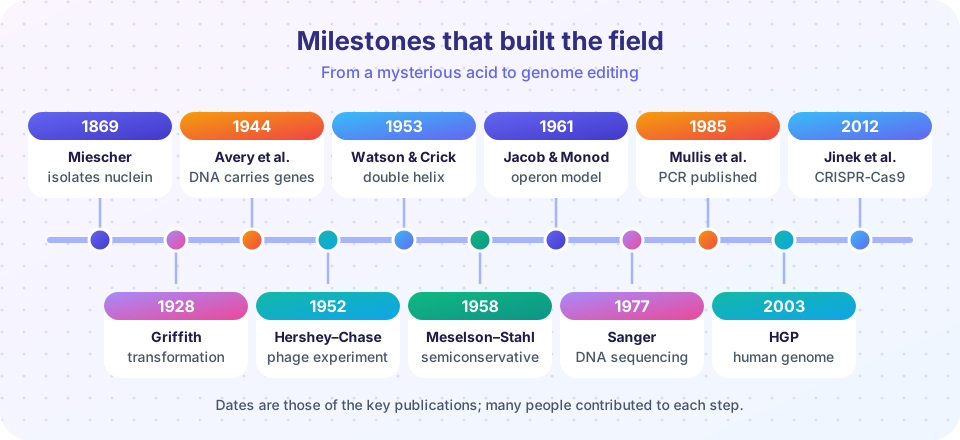
In 1869 the Swiss physician Friedrich Miescher washed pus-soaked bandages and isolated a phosphorus-rich substance from the nuclei of white blood cells. He called it nuclein. It was DNA, but nobody knew what it did. By the early 1900s, Phoebus Levene had described its components (sugar, phosphate, bases) but proposed a short repeating "tetranucleotide" structure, which made DNA look too dull to carry information. That mistaken view delayed acceptance for decades.
Griffith: a transforming principle (1928)
Frederick Griffith studied Streptococcus pneumoniae, which comes in two strains. The S strain forms smooth colonies and has a capsule that makes it deadly to mice. The R strain is rough, lacks the capsule and is harmless.
| Injected into mice | Result |
|---|---|
| Live R | Mouse lives |
| Live S | Mouse dies |
| Heat-killed S | Mouse lives |
| Live R + heat-killed S | Mouse dies, and live S bacteria are recovered |
The last row is the surprise. Dead S cells somehow gave live R cells the ability to become S. Something heat-stable carried the trait across. Griffith called it the transforming principle.
Avery, MacLeod and McCarty: the principle is DNA (1944)
Oswald Avery, Colin MacLeod and Maclyn McCarty fractionated heat-killed S cells and tested each fraction. They found that the purified transforming activity behaved like DNA: it contained phosphorus and nitrogen in the ratio expected for DNA, and it lost activity when treated with an enzyme that destroys DNA (DNase) but not when treated with enzymes that destroy protein or RNA. Their conclusion was careful, but many scientists remained doubtful that a trace of protein could not explain the result.
Chargaff: a rule hidden in the data (about 1950)
Erwin Chargaff analyzed the base composition of DNA from many species. Two patterns stood out. The composition differs between species, so DNA is not a boring repeat. And within each species, the amount of adenine is nearly equal to thymine, and guanine to cytosine. These are Chargaff's rules. They were a crucial clue to base pairing, though Chargaff did not use them to propose a structure.
Hershey and Chase: the blender experiment (1952)
Alfred Hershey and Martha Chase studied the phage T2, which consists only of DNA and protein. DNA contains phosphorus but no sulfur; proteins contain sulfur but almost no phosphorus. They grew phage in one of two radioactive labels: ³²P to mark the DNA, or ³⁵S to mark the protein. Then they let the phage attach to E. coli, shook the mixture in a kitchen blender to detach the empty phage coats, and spun the bacteria to the bottom of a tube.
The ³²P label went into the bacteria; most of the ³⁵S label stayed outside. So what enters the cell and directs the making of new phage is DNA. Together with Avery's work, this convinced most of the field.
Structure: Franklin, Wilkins, Watson and Crick (1953)
Rosalind Franklin, working with Raymond Gosling at King's College London, took X-ray diffraction images of DNA fibers. Her "Photo 51" showed an X-shaped pattern that signals a helix and let her measure its dimensions. Maurice Wilkins' group worked on the same problem. James Watson and Francis Crick, at Cambridge, built a model that fit the X-ray data and Chargaff's rules: two antiparallel strands, bases paired A with T and G with C. Their short paper in Nature in April 1953 ended with the famous sentence noting that the pairing suggests a copying mechanism. Papers by Franklin and Gosling, and by Wilkins and colleagues, appeared in the same issue.
Meselson and Stahl: replication is semiconservative (1958)
If DNA is copied, there were three possibilities: conservative (the old double helix stays intact and a new one is made), semiconservative (each daughter keeps one old and one new strand) and dispersive (daughters are mixtures of old and new pieces). Matthew Meselson and Franklin Stahl grew E. coli for many generations in heavy nitrogen (¹⁵N), then moved the cells to ordinary light nitrogen (¹⁴N). They separated DNA by density in a cesium chloride gradient.
After one generation all the DNA formed a single band at an intermediate density: ruling out the conservative model. After two generations there were two bands, one intermediate and one light. That matches only the semiconservative model. You will see this logic again in chapter 3.
Common misconceptions
"Griffith discovered that DNA is the genetic material." He discovered transformation, but he did not know the principle was DNA. Avery's team showed that.
"Hershey and Chase found that no protein enters the cell." Some protein stayed with the DNA; the key result was that most radioactive sulfur remained outside, while phosphorus went in.
"Watson and Crick discovered DNA." DNA was isolated in 1869. They proposed its structure in 1953, building on data from others, especially Franklin.
Try it
The first demo lets you inject different bacteria into a virtual mouse, repeating Griffith's four experiments. It encodes the published outcomes only.
The second block tests Chargaff's rules on approximate base percentages in the spirit of his tables. The values are rounded illustrations, not a replication of his data.
Press Run (or Ctrl + Enter) to see the result here.
Program input · what you'd type while the program runs
Type the answers before you press Run, one per line. Each time the program reads a line (with input()), it gets the next line from this box.
Check your understanding
Quick check · 5 questions
of 5 answered You scored / 5 · perfect!
-
1. In Griffith's experiment, which mixture killed the mouse and yielded live S bacteria?
Live R plus heat-killed S killed mice and live S cells were recovered, showing transformation. -
2. Which result of Avery, MacLeod and McCarty pointed to DNA?
Only the enzyme that degrades DNA removed transforming activity, and the purified fraction had the elemental ratio of DNA. -
3. Why did Hershey and Chase use 35S and 32P?
Proteins contain sulfur but little phosphorus; DNA contains phosphorus but no sulfur, so each label tags one molecule. -
4. After one generation in light nitrogen, Meselson and Stahl found a single band of intermediate density. Which model does this rule out?
A conservative model would give one heavy and one light band. A single intermediate band fits semiconservative or dispersive models. -
5. What does Chargaff's rule say?
Adenine equals thymine and guanine equals cytosine, while the A+T versus G+C proportion varies by species.
Summary
- Griffith showed that a stable substance can transform bacteria; Avery, MacLeod and McCarty identified it as DNA.
- Hershey and Chase's labeling experiment showed that DNA, not protein, enters the bacterium to direct new phage.
- Chargaff's rules (A = T, G = C) and Franklin's X-ray data guided Watson and Crick's 1953 double helix.
- Meselson and Stahl's density experiment showed that DNA replication is semiconservative.
- Each conclusion rested on an experiment where one variable was changed at a time.
Track your progress
Create a free account to tick off lessons and pick up where you left off on any device.
of Molecular Biology lessons completed