


















Lesson 8 of 48 · The Molecules of Life
DNA Structure: Nucleotides, Base Pairs and the Double Helix
Learn how nucleotides link into strands, why A pairs with T and G with C, what the double helix looks like, and how heat melts DNA, with runnable calculators.
DNA looks simple on paper: a long chain with four kinds of beads. Yet the way those beads are joined and paired gives DNA properties no other molecule shares. It is chemically stable for years, can be copied faithfully by a pairing rule, and carries information in a sequence that is unlimited in length. This lesson builds the molecule up from its smallest part, the nucleotide, to the full double helix.
Everything about replication, transcription and PCR rests on the facts here: the direction of a strand, the pairing rules and the strength of the bonds between strands.
What you will learn
- The three parts of a nucleotide and the four DNA bases.
- How the phosphodiester bond links nucleotides and gives a strand a direction.
- Why bases pair as A-T and G-C and how many hydrogen bonds hold each pair.
- The dimensions of the B-form helix and what melting temperature means.
Key terms
Nucleotide: a phosphate, a five-carbon sugar and a nitrogenous base joined together.
Purine / pyrimidine: double-ring bases (A, G) and single-ring bases (C, T, U).
Phosphodiester bond: the link between the 3′ carbon of one sugar and the 5′ phosphate of the next.
Antiparallel: running in opposite directions, as the two strands of DNA do.
Melting temperature (Tm): the temperature at which half of the DNA is single-stranded.
The nucleotide
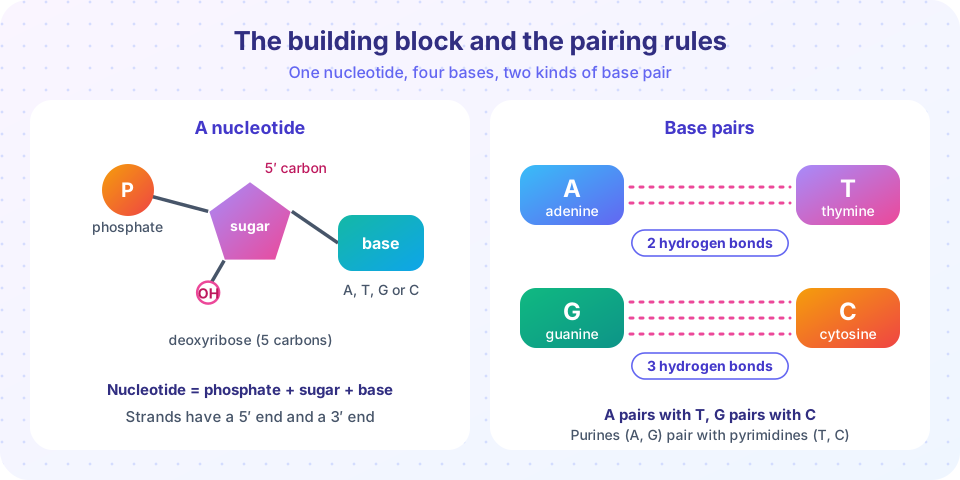
A DNA nucleotide has three parts. The sugar is 2′-deoxyribose, a ring of five carbons numbered 1′ to 5′; "deoxy" means the 2′ carbon carries a hydrogen where ribose has a hydroxyl. A phosphate group is attached at the 5′ carbon, and a nitrogenous base is attached at the 1′ carbon.
There are four bases. Adenine (A) and guanine (G) are purines with two fused rings. Cytosine (C) and thymine (T) are pyrimidines with a single ring. A purine always pairs with a pyrimidine, so the width of the helix stays constant.
Building a strand
Nucleotides link when the 3′ hydroxyl of one sugar bonds to the 5′ phosphate of the next, forming a phosphodiester bond. Repeating this builds a chain with a sugar-phosphate backbone and bases projecting from it. One end of the chain has a free 5′ phosphate (the 5′ end), and the other has a free 3′ hydroxyl (the 3′ end). By convention a sequence is written from 5′ to 3′, and enzymes that build DNA add new nucleotides only to the 3′ end. This one-way rule will matter in replication.
The backbone phosphates carry a negative charge at cell pH. That is why DNA migrates toward the positive electrode in a gel and why it binds positively charged histone proteins.
Base pairing
Adenine pairs with thymine and guanine pairs with cytosine, held by hydrogen bonds between the bases. A-T forms two hydrogen bonds, G-C forms three. The pairs are the same width, so any sequence can fit inside a regular helix.
This rule explains Chargaff's finding that A equals T and G equals C in double-stranded DNA. It also means that one strand specifies the other: if you know the sequence 5′-ATGCCA-3′, the partner strand must be 3′-TACGGT-5′, which is written 5′-TGGCAT-3′ and is called the reverse complement.
Hydrogen bonds are individually weak, but thousands in a row hold the strands firmly together while still letting enzymes pull them apart when needed. Stacking interactions between neighboring bases (the flat rings pile up like coins) contribute as much stability as the hydrogen bonds do.
The double helix
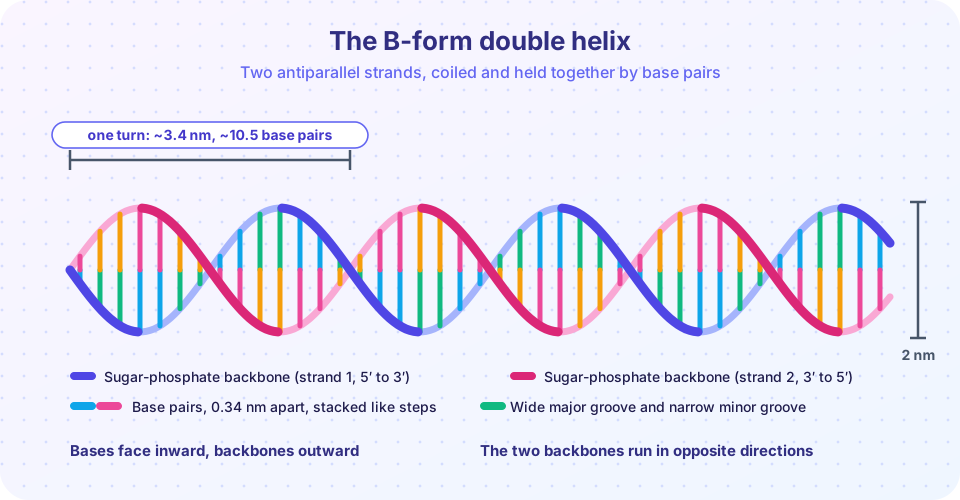
The most common form in cells is B-DNA, a right-handed helix. Its main numbers are worth remembering:
| Feature | B-DNA value |
|---|---|
| Diameter | about 2 nm |
| Rise per base pair | about 0.34 nm |
| Base pairs per turn | about 10.5 |
| Length of one turn (pitch) | about 3.4 nm |
The two strands are antiparallel: one runs 5′ to 3′ while its partner runs 3′ to 5′. Because the backbones attach to the bases off-center, the surface shows two grooves of different width. The major groove is wide enough for proteins to read the edges of the bases without unwinding the DNA, which is how transcription factors find their target sequences. The minor groove is narrow.
Other forms exist. A-DNA is a shorter, wider right-handed helix seen in dehydrated DNA and in RNA-DNA hybrids. Z-DNA is a left-handed zigzag that can form in certain alternating GC sequences under some conditions. These variants may have regulatory roles, but B-DNA is the standard cellular form.
Melting DNA
Heating breaks the hydrogen bonds and unstacks the bases, so the two strands separate in a process called denaturation or melting. When the solution cools slowly, strands with matching sequences pair again (annealing). The midpoint of melting is the Tm. A GC-rich DNA melts at a higher temperature than an AT-rich one because of its extra hydrogen bond per pair and stronger stacking. A classic estimate for long DNA is Tm = 81.5 + 16.6 log₁₀[Na⁺] + 0.41 (%GC) − 675/N, where [Na⁺] is in molar and N is the length in base pairs. It is a rule of thumb, not an exact formula.
Common misconceptions
"The base pairs are held together by covalent bonds." They are held by hydrogen bonds and base stacking, which are much weaker than the covalent phosphodiester backbone. That is why strands can separate without breaking.
"DNA is always a B-form helix." B-DNA is typical, but DNA can adopt other forms, and it is often bent, looped, supercoiled or wrapped around proteins.
"G-C and A-T pairs are equally strong." G-C has three hydrogen bonds and stacks more strongly, so GC-rich regions melt at higher temperatures.
Try it
First, a calculator for the reverse complement, GC content and an approximate Tm of a long DNA fragment at different GC contents. The plot shows how strongly GC content raises the melting temperature, using the formula above with 0.05 M Na⁺ and a length of 1,000 base pairs.
Press Run (or Ctrl + Enter) to see the result here.
Program input · what you'd type while the program runs
Type the answers before you press Run, one per line. Each time the program reads a line (with input()), it gets the next line from this box.
Second, a pairing tool: enter a DNA strand 5′ to 3′ and see its antiparallel partner, with hydrogen-bond counts.
Check your understanding
Quick check · 5 questions
of 5 answered You scored / 5 · perfect!
-
1. Which bond joins neighboring nucleotides in one DNA strand?
The 3' hydroxyl of one nucleotide bonds to the 5' phosphate of the next, forming a phosphodiester bond. -
2. How many hydrogen bonds hold a G-C pair and an A-T pair?
G-C has three; A-T has two. -
3. What is the reverse complement of 5'-ATGC-3'?
Complement gives TACG; reading that backwards gives GCAT, written 5' to 3'. -
4. Why does a GC-rich DNA melt at a higher temperature?
Extra hydrogen bonding and stronger stacking make G-C pairs harder to separate. -
5. About how many base pairs make one full turn of B-DNA?
B-DNA has about 10.5 base pairs per turn; the 3.4 nm is the length of the turn.
Summary
- A nucleotide is a phosphate, deoxyribose and a base (A, T, G or C); strands run from a 5′ end to a 3′ end.
- Phosphodiester bonds make the backbone; hydrogen bonds and stacking hold the two strands together.
- A pairs with T (two bonds) and G pairs with C (three bonds); strands are antiparallel and complementary.
- B-DNA is about 2 nm wide with 0.34 nm per base pair and about 10.5 base pairs per turn.
- Melting temperature rises with GC content and length.
Next: RNA Types and Structure
Track your progress
Create a free account to tick off lessons and pick up where you left off on any device.
of Molecular Biology lessons completed