


















Lesson 7 of 48 · The Molecules of Life
Chapter 2 Overview: The Molecules of Life
Preview chapter 2: the structures of DNA, RNA, proteins and chromatin, how they relate, and a calculator for how long the human genome really is.
Three kinds of large molecule carry out almost everything molecular biology studies: DNA, RNA and proteins. They are all polymers, long chains built from small repeating units, and their chemistry explains their jobs. DNA is chemically stable and good at storing information. RNA is a more versatile single-stranded cousin that can carry messages, fold into shapes and even catalyze reactions. Proteins have the widest chemical vocabulary of all, so they build, move and regulate.
A fourth topic completes the picture: how the very long DNA molecule is packaged with proteins into chromatin so it fits inside a cell and can still be read. This overview previews the chapter and gives you the numbers you need to keep it all in scale.
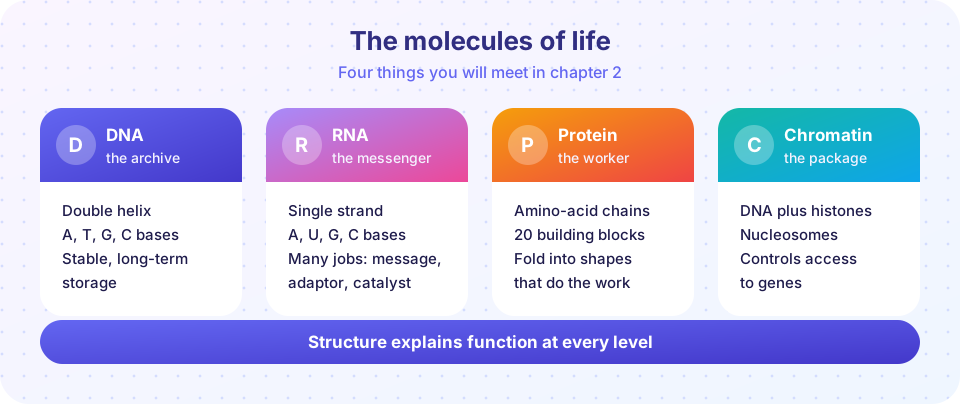
What you will learn
- The monomers and bonds that make up nucleic acids and proteins.
- How the four molecular topics of chapter 2 connect.
- The sizes involved, from a 2-nanometer helix to a meter of DNA.
Key terms
Polymer: a large molecule made of many repeated small units.
Monomer: one such unit; a nucleotide in nucleic acids, an amino acid in proteins.
Macromolecule: a very large molecule such as DNA, RNA or a protein.
Chromatin: DNA packaged with histone and other proteins in a eukaryotic nucleus.
The chapter at a glance
Four molecules, four jobs
Monomers and bonds
Structure sets function
Shape is what molecules recognize.
Lessons in this chapter
- DNA Structure and Nucleotides: the helix, base pairing, grooves and melting.
- RNA Types and Structure: mRNA, tRNA, rRNA, small RNAs and how RNA folds.
- Amino Acids and Protein Structure: the 20 building blocks, the peptide bond and four levels of structure.
- Chromatin and Chromosomes: nucleosomes and the packaging of DNA.
- Chapter 2 Review: a one-page summary and a ten-question quiz.
Three big comparisons
Nucleic acids and proteins are both chains, but they differ in a way that matters. A nucleic acid has a uniform backbone of sugar and phosphate that repeats identically along the whole chain; the information is in the order of the four bases that stick out of it. A protein also has a uniform backbone, but its side chains differ chemically in 20 ways: some are charged, some are oily, some can make a covalent bridge. Folding the chain buries the oily groups and exposes the charged ones, which is why proteins adopt compact, specific shapes.
DNA and RNA differ by one oxygen atom and one base. RNA's sugar, ribose, has an extra hydroxyl group at the 2′ carbon. That group makes RNA less stable (it can attack its own backbone) and lets it fold into diverse shapes. RNA also uses uracil in place of thymine.
Finally, size. A human cell's DNA is long compared with the cell itself, so packaging is a physical problem as much as a chemical one. The calculation below shows how long.
Common misconceptions
"DNA is a protein." DNA is a nucleic acid made of nucleotides. Proteins are made of amino acids.
"RNA is just a lesser DNA." RNA has a distinct chemistry and many functions that DNA cannot perform, including catalysis.
"Chromatin is just wrapped DNA." Chromatin carries chemical marks and regulatory proteins that control which genes are active.
Try it
How long is the human genome if stretched out? Each base pair adds about 0.34 nm of helix length. This calculator uses rounded values and compares DNA length with the nucleus.
Press Run (or Ctrl + Enter) to see the result here.
Program input · what you'd type while the program runs
Type the answers before you press Run, one per line. Each time the program reads a line (with input()), it gets the next line from this box.
Now an interactive widget: set a number of base pairs and see the length of the helix, its number of turns and its mass. The mass uses an average of about 650 daltons per base pair.
Check your understanding
Quick check · 4 questions
of 4 answered You scored / 4 · perfect!
-
1. What is the difference between a monomer and a polymer?
Nucleotides and amino acids are monomers; DNA, RNA and proteins are the polymers built from them. -
2. Which chemical difference separates RNA from DNA?
Ribose has an extra 2' OH group, and RNA uses uracil instead of thymine. -
3. Roughly how long would the DNA in one human cell be if stretched out?
6.2 billion base pairs x 0.34 nm is about 2.1 m. -
4. Why do proteins fold into specific shapes?
The variety of side chains drives folding, hiding oily groups and exposing polar ones.
Summary
- DNA, RNA and proteins are polymers of nucleotides or amino acids; chromatin is DNA packaged with proteins.
- Nucleic acids have a repeating backbone with information in the base order; proteins have 20 side chains that drive folding.
- RNA differs from DNA by a 2′ hydroxyl and uracil, which make it more versatile and less stable.
- The human diploid genome is about 2 meters long, so packaging is essential.
Track your progress
Create a free account to tick off lessons and pick up where you left off on any device.
of Molecular Biology lessons completed