


















Lesson 47 of 48 · Projects and Practice
Molecular Biology Cheat Sheet
A one-page recap of molecular biology: central dogma, genetic code, regulation, cloning tools, CRISPR rules, genomics numbers and formulas, with a codon table and pocket calculators.
This page is the course on one sheet: the pictures and numbers worth carrying in your head, the formulas used in the practice problems and two tools you can keep open while you work, a codon table and a pocket calculator for sequences. Everything here is explained in an earlier lesson, so treat the sheet as an index to your memory rather than as a replacement for the lessons.
What you will learn
- A compact checklist of the key facts of chapters 5 to 9.
- Where each formula is used.
The central dogma in ten lines
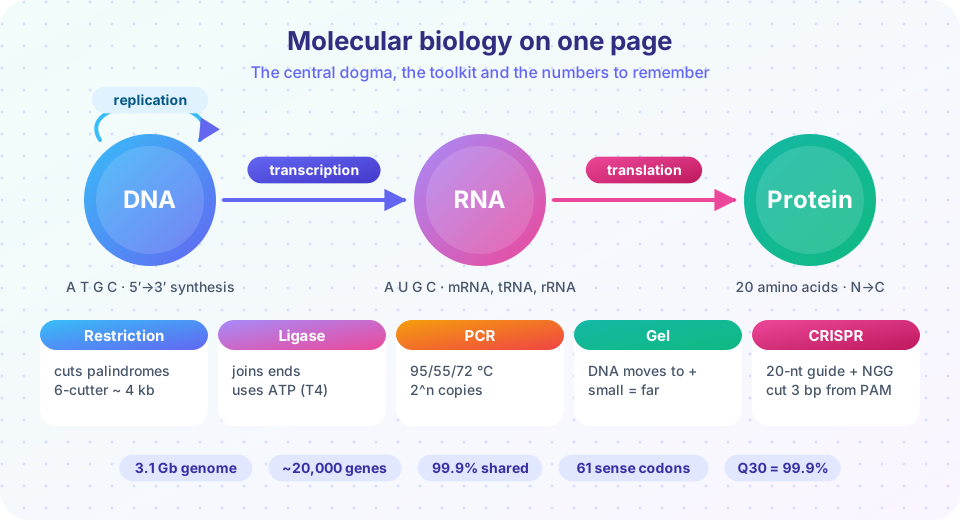
- DNA is copied by replication (semiconservative, 5′ to 3′ synthesis).
- RNA polymerase makes mRNA from the template strand; the mRNA matches the coding strand with U in place of T.
- In eukaryotes the transcript is capped, spliced and given a poly(A) tail.
- The genetic code has 64 codons: 61 sense and three stop (UAA, UAG, UGA); AUG is the start and codes for Met.
- The ribosome has A, P and E sites; tRNAs are charged by synthetases; elongation uses EF-Tu and EF-G (eEF1A and eEF2).
- Adding one amino acid costs about 4 high-energy phosphate bonds.
- The chain folds (hydrophobic effect, funnel landscape), often with chaperones.
- Point mutations are silent, missense or nonsense; indels not divisible by 3 are frameshifts.
- Regulation acts at six levels: chromatin, initiation, splicing, mRNA decay, translation and protein fate.
- The lac operon: repressor off with lactose (allolactose); CAP-cAMP on with low glucose.
Tools in ten lines
- Restriction enzymes cut palindromes; a 6-base site cuts about once per 4,096 bp.
- T4 ligase joins compatible ends using ATP.
- A vector has an ori, a selectable marker and a cloning site; blue-white screening finds inserts.
- PCR: 95 °C, ~55 °C, 72 °C; copies = n × (1 + E)^cycles, ideal 2^cycles.
- Primers: 18 to 25 nt, GC 40 to 60 percent; Tm ≈ 64.9 + 41 × (G + C − 16.4) / N.
- Gels: DNA runs to the positive electrode; distance is linear in log size.
- CRISPR-Cas9: 20-nt guide, NGG PAM, cut about 3 bp upstream of the PAM.
- NHEJ gives indels (knockouts); HDR copies a template (precise edits).
- Base and prime editors change DNA without a double-strand break.
- Controls: non-targeting guide, untreated cells, replicates, off-target check.
Genomics in ten lines
- Human genome: about 3.1 billion bp, about 20,000 protein-coding genes, 1 to 2 percent coding.
- Two people share about 99.9 percent of their DNA.
- Coverage C = N × L / G; uncovered fraction ≈ e^−C; human WGS about 30×.
- Phred Q = −10 log₁₀ P: Q20 = 99 percent, Q30 = 99.9 percent.
- Sanger reads up to about 1 kb; short reads 50 to 300 bases; long reads 10 kb to Mb.
- Mapping uses a reference; de novo assembly builds contigs from overlaps.
- TPM = (count ÷ length) scaled so that each sample adds up to 10⁶.
- GWAS threshold 5 × 10⁻⁸ (Bonferroni for about a million tests).
- Hardy-Weinberg: p² + 2pq + q² = 1; carriers = 2pq.
- qPCR: fold change = 2^(−ΔΔCt).
Common misconceptions
"Memorizing the sheet is enough." Numbers without the reasoning fail on new problems; use the sheet to check, not to replace, understanding.
"All formulas apply everywhere." The Tm formula is for 14 or more nucleotides; PCR doubling is the ideal case; Hardy-Weinberg assumes random mating and no selection.
"Codon tables are the same for all organelles." Human mitochondria read UGA as Trp and have other variations.
Try it
The first tool is a codon table you can click. Type a codon (in RNA letters) or click a cell to see the amino acid. The grid is the standard genetic code.
The second tool is a pocket calculator for DNA sequences: reverse complement, GC content, melting temperature, transcription and translation of a sequence you can edit.
Press Run (or Ctrl + Enter) to see the result here.
Program input · what you'd type while the program runs
Type the answers before you press Run, one per line. Each time the program reads a line (with input()), it gets the next line from this box.
Check your understanding
Quick check · 4 questions
of 4 answered You scored / 4 · perfect!
-
1. Which number is the approximate size of the haploid human genome?
About 3.1 billion base pairs. -
2. How many stop codons does the standard genetic code have?
UAA, UAG and UGA. -
3. Which formula gives the fold change from qPCR?
Each Ct unit is one doubling, so fold change is 2 to the power of minus ΔΔCt. -
4. In Hardy-Weinberg, the carrier frequency of a recessive allele with frequency q is
Heterozygotes occur with frequency 2pq.
Summary
- The central dogma, the code, the ribosome cycle and folding explain how a gene becomes a protein.
- Regulation acts at six levels; the lac operon is the model for bacteria.
- The toolkit cuts, joins, carries, copies, sees and edits DNA; CRISPR needs a guide and a PAM.
- Genomics runs on a few numbers and formulas: coverage, Phred, TPM, 5 × 10⁻⁸, Hardy-Weinberg and ΔΔCt.
Next: Further study
Track your progress
Create a free account to tick off lessons and pick up where you left off on any device.
of Molecular Biology lessons completed