


















Lesson 46 of 48 · Projects and Practice
Glossary of Molecular Biology
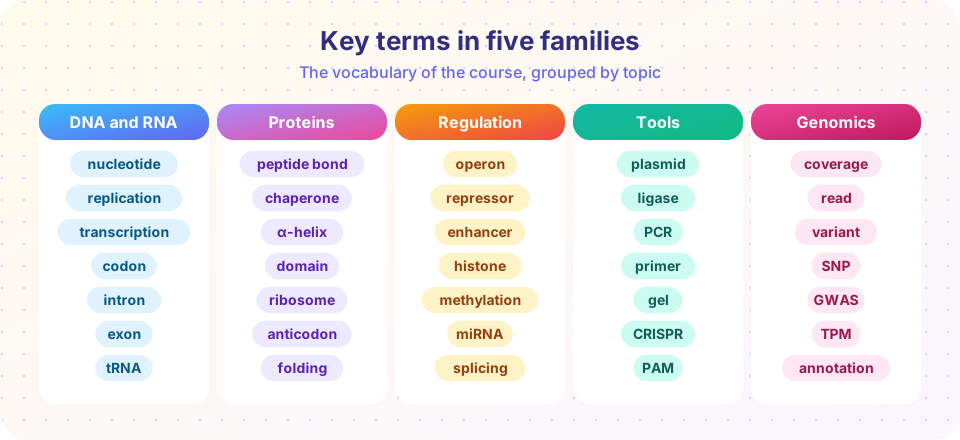
A glossary of 75 key molecular biology terms in five families: nucleic acids, proteins, gene regulation, tools and genomics, with a flashcard trainer and a lookup tool.
Molecular biology has a large vocabulary, and the words are precise: codon, anticodon and PAM are not interchangeable. This glossary collects the terms that matter most from the whole course in five families. Use it as a reference, then use the flashcards to test yourself. If a definition surprises you, go back to the lesson that explains it.
What you will learn
- The exact meaning of 75 key terms.
- How the terms connect: for example codon, anticodon, tRNA and ribosome.
DNA, RNA and the flow of information
| Term | Meaning |
|---|---|
| Nucleotide | A building block of nucleic acids: a sugar, a phosphate and a base |
| Base pair | Two bases held by hydrogen bonds: A with T (or U), G with C |
| Replication | Copying of DNA before cell division |
| Transcription | Making RNA from a DNA template by RNA polymerase |
| Translation | Making a polypeptide from the sequence of an mRNA |
| Central dogma | Information flows from DNA to RNA to protein |
| Template strand | The DNA strand read by RNA polymerase |
| Promoter | A DNA region where RNA polymerase begins transcription |
| Exon | A segment that remains in the mature mRNA |
| Intron | A segment removed by splicing |
| Codon | Three mRNA bases that specify an amino acid or a stop |
| Anticodon | Three tRNA bases that pair with a codon |
| Reading frame | The way a sequence is divided into codons |
| Open reading frame | A stretch from a start codon to a stop codon in one frame |
| tRNA | An adapter RNA that carries an amino acid |
Proteins and translation
| Term | Meaning |
|---|---|
| Amino acid | The building block of proteins, 20 standard types |
| Peptide bond | The covalent bond between the carboxyl of one amino acid and the amino group of the next |
| Polypeptide | A chain of amino acids |
| Ribosome | The RNA-protein machine that makes proteins |
| Aminoacyl-tRNA synthetase | An enzyme that attaches the right amino acid to its tRNA |
| Wobble | Loose pairing at the third codon position |
| Start codon | AUG, which begins translation and codes for methionine |
| Stop codon | UAA, UAG or UGA, which end translation |
| Release factor | A protein that recognizes a stop codon and frees the chain |
| α-helix | A coiled secondary structure with 3.6 residues per turn |
| β-sheet | A secondary structure of strands joined side to side by hydrogen bonds |
| Native state | The folded, functional shape of a protein |
| Chaperone | A protein that helps others fold and avoid aggregation |
| Denaturation | Loss of the native structure without breaking peptide bonds |
| Proteasome | A complex that degrades proteins tagged with ubiquitin |
Gene regulation
| Term | Meaning |
|---|---|
| Operon | A bacterial group of genes under one promoter |
| Operator | A DNA site where a repressor binds |
| Repressor | A protein that lowers transcription of a gene |
| Activator | A protein that raises transcription |
| Inducer | A molecule that turns an operon on, such as allolactose |
| CAP (CRP) | A bacterial activator that works with cAMP |
| Enhancer | A DNA element that boosts transcription from a distance |
| Transcription factor | A sequence-specific DNA-binding regulator |
| Histone | A protein around which DNA is wrapped in nucleosomes |
| Nucleosome | 147 bp of DNA around a histone octamer |
| Epigenetic mark | A heritable chemical tag that affects expression without changing DNA sequence |
| DNA methylation | A methyl group added to cytosine, often silencing a promoter |
| Alternative splicing | Joining exons in different combinations |
| microRNA | A roughly 22-nt RNA that guides silencing of mRNAs |
| Riboswitch | An RNA element that binds a small molecule and changes expression |
Tools of recombinant DNA
| Term | Meaning |
|---|---|
| Restriction enzyme | An enzyme that cuts DNA at a specific sequence |
| Sticky end | A single-stranded overhang left by a staggered cut |
| DNA ligase | An enzyme that joins DNA ends |
| Plasmid | A small circular DNA that replicates independently |
| Vector | A DNA molecule that carries an insert into cells |
| Transformation | Uptake of DNA by a bacterial cell |
| Selectable marker | A gene, often antibiotic resistance, used to select cells with a plasmid |
| PCR | An in vitro method that amplifies DNA with primers and a heat-stable polymerase |
| Primer | A short oligonucleotide that starts DNA synthesis |
| Gel electrophoresis | Separation of molecules by size in an electric field |
| Southern blot | Detection of a DNA sequence on a membrane with a labeled probe |
| CRISPR-Cas9 | A programmable nuclease guided by RNA |
| Guide RNA | The RNA that directs Cas9 to its target |
| PAM | A short motif next to the target that Cas9 requires |
| NHEJ / HDR | Error-prone end joining / template-directed repair of a break |
Genomics
| Term | Meaning |
|---|---|
| Genome | All of the DNA of an organism |
| Read | One sequenced fragment |
| Coverage | The average number of reads over each base |
| Phred score | A measure of base-call accuracy: Q = −10 log₁₀ P |
| Assembly | Merging reads into longer sequences |
| Reference genome | A representative sequence that reads are compared with |
| Annotation | Marking genes and features on a genome |
| Variant | A difference from the reference sequence |
| SNP | A single-base variant common in a population |
| Allele frequency | The proportion of chromosomes carrying a variant |
| RNA-seq | Sequencing of RNA to measure expression |
| TPM | Transcripts per million, a normalized expression unit |
| GWAS | A study that tests many variants for association with a trait |
| Pharmacogenomics | The study of how variants affect drug response |
| Gene therapy | Treatment by adding, replacing or editing genes |
Common misconceptions
"Codon and anticodon are the same thing." The codon is on the mRNA; the anticodon is on the tRNA and pairs with it.
"A gene is the same as a protein." A gene is a DNA region; one gene can give several proteins through splicing.
"Mutation always means harmful." Most variants are neutral; some are harmful and a few are beneficial.
Try it
The first example is a flashcard trainer. It shows a term and lets you reveal the definition, then marks it known or to review. It is a self-study tool, not a test.
The second example is a tiny lookup tool: type part of a word and it prints the matching glossary entries. Add your own terms to the dictionary to build a personal glossary.
Press Run (or Ctrl + Enter) to see the result here.
Program input · what you'd type while the program runs
Type the answers before you press Run, one per line. Each time the program reads a line (with input()), it gets the next line from this box.
Check your understanding
Quick check · 5 questions
of 5 answered You scored / 5 · perfect!
-
1. Which term describes three bases on a tRNA that pair with a codon?
The anticodon is on the tRNA and pairs with the mRNA codon. -
2. A DNA element that boosts transcription from far away is called
Enhancers act at a distance, often by DNA looping. -
3. What does Phred Q30 mean?
Q = −10 log10 P, so Q30 gives P = 0.001. -
4. What is an open reading frame?
An ORF runs in triplets from a start codon to a stop codon. -
5. Which pair describes DNA repair of a Cas9 break correctly?
NHEJ joins ends and often causes indels; HDR copies a donor template.
Summary
- The glossary groups the 75 key terms of the course into nucleic acids, proteins, regulation, tools and genomics.
- Many confusions are between pairs: codon and anticodon, template and coding strand, NHEJ and HDR.
- Use the flashcards and the lookup tool to practice recall, not recognition.
Next: Cheat sheet
Track your progress
Create a free account to tick off lessons and pick up where you left off on any device.
of Molecular Biology lessons completed