


















Lesson 33 of 48 · Recombinant DNA and CRISPR
Chapter 7 Overview: Recombinant DNA and CRISPR
A map of the molecular toolkit: restriction enzymes, ligase, plasmid vectors, PCR, gel electrophoresis and CRISPR-Cas9, and the history that produced them.
For most of history, biologists could only watch DNA. In the 1970s they learned to cut it, join it, copy it and move it between species, and the field changed forever. The tools in this chapter let a bacterium produce human insulin, let a forensic lab identify a person from a speck of blood, and let researchers change one letter in a living genome. You will learn how each tool works, why it works and how to combine them.
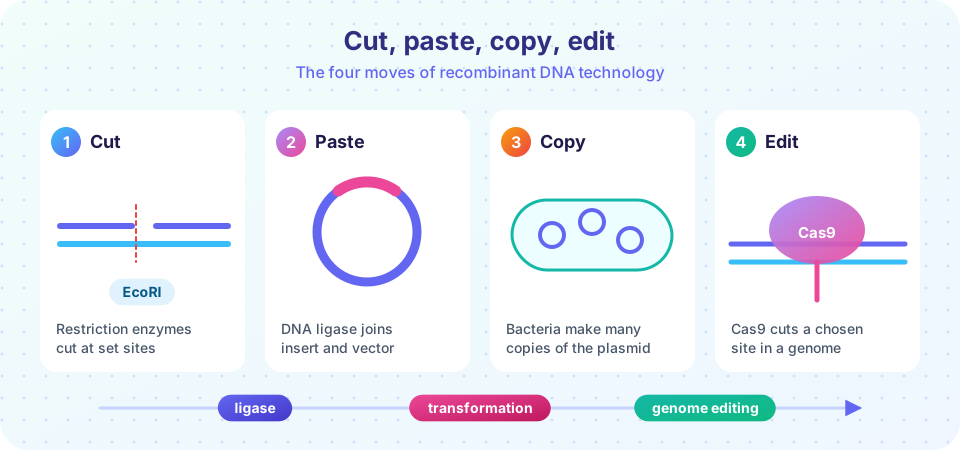
What you will learn
- The main tools of genetic engineering and the problem each one solves.
- A short history, from the first recombinant molecules to genome editing.
- How the tools combine into a workflow.
Key terms
Recombinant DNA: DNA made by joining pieces from different sources.
Vector: a DNA molecule, such as a plasmid, that carries inserted DNA into a host cell.
Cloning: making many identical copies of a DNA fragment, usually in bacteria.
PCR: the polymerase chain reaction, an in vitro method that copies a chosen DNA region.
Genome editing: making targeted changes to the DNA of a living cell.
A short history
- 1970 to 1978. Hamilton Smith and others isolated restriction enzymes, which cut DNA at defined sequences; Werner Arber, Daniel Nathans and Smith shared the 1978 Nobel Prize in Physiology or Medicine.
- 1972. Paul Berg's group made the first recombinant DNA molecules in a test tube (Nobel Prize in Chemistry 1980).
- 1973. Stanley Cohen and Herbert Boyer put a recombinant plasmid into E. coli and showed that it was copied and its genes were used.
- 1975. At the Asilomar conference scientists discussed safety and set guidelines for the new technology, an early example of self-regulation.
- 1978 to 1982. Genentech engineered E. coli to make human insulin; recombinant human insulin was approved for patients in 1982, the first recombinant drug.
- 1983 to 1988. Kary Mullis conceived PCR (Nobel Prize in Chemistry 1993); the heat-stable Taq polymerase made it practical.
- 2012 to 2013. Jennifer Doudna and Emmanuelle Charpentier, with colleagues, turned the bacterial CRISPR-Cas9 system into a programmable DNA-cutting tool; Feng Zhang and George Church showed it works in human cells (Doudna and Charpentier shared the 2020 Nobel Prize in Chemistry).
The toolkit in five steps
Cut and join
Carry and copy
See and edit
A guide RNA aims the cut.
What each lesson covers
- Cloning and PCR covers restriction enzymes, ligase, vectors, transformation, selection, libraries and the polymerase chain reaction.
- Gel electrophoresis and blotting shows how to see DNA and size fragments, with Southern blots and DNA fingerprints.
- CRISPR-Cas9 genome editing explains how the system finds its target, how the cell repairs the cut and where the technique is going.
- Chapter 7 review practices cloning arithmetic and tests you on the whole chapter.
Common misconceptions
"Genetic engineering moves genes by magic." It uses ordinary enzymes: cutting, joining and copying DNA with proteins that cells already use.
"PCR makes a protein." PCR copies DNA only; no protein is made.
"CRISPR can edit any gene at will with no side effects." Off-target cuts, incomplete editing and delivery problems are real limitations.
Try it
The first example plots the milestones above on a timeline. The dates come from the list in this lesson.
Press Run (or Ctrl + Enter) to see the result here.
Program input · what you'd type while the program runs
Type the answers before you press Run, one per line. Each time the program reads a line (with input()), it gets the next line from this box.
The second example is a small matcher: pick a goal and see which tool is the best fit. The text is a summary of this chapter.
Check your understanding
Quick check · 4 questions
of 4 answered You scored / 4 · perfect!
-
1. Which enzymes cut DNA at specific recognition sequences?
Restriction enzymes recognize short sequences and cut the DNA there. -
2. Who made the first recombinant DNA molecules in a test tube (1972)?
Paul Berg's group joined DNA from different sources in 1972. -
3. What does PCR copy?
PCR is an in vitro method for copying a chosen DNA region. -
4. What does the guide RNA do in CRISPR-Cas9?
The guide RNA is the address label; Cas9 is the scissors.
Summary
- Recombinant DNA technology rests on enzymes that cut and join DNA, vectors that carry it and hosts that copy it.
- PCR copies DNA in a tube, gels reveal its size and CRISPR edits it in cells.
- The key advances date from the 1970s (cloning), the 1980s (PCR) and the 2010s (CRISPR).
- Each tool has limits, and later lessons show what they are.
Next: Cloning and PCR
Track your progress
Create a free account to tick off lessons and pick up where you left off on any device.
of Molecular Biology lessons completed