


















Lesson 6 of 48 · Getting Started
Chapter 1 Review: Getting Started
Review the central dogma, cell types, the key experiments and the basic lab techniques, with a one-page summary picture, a recap table and a ten-question quiz.
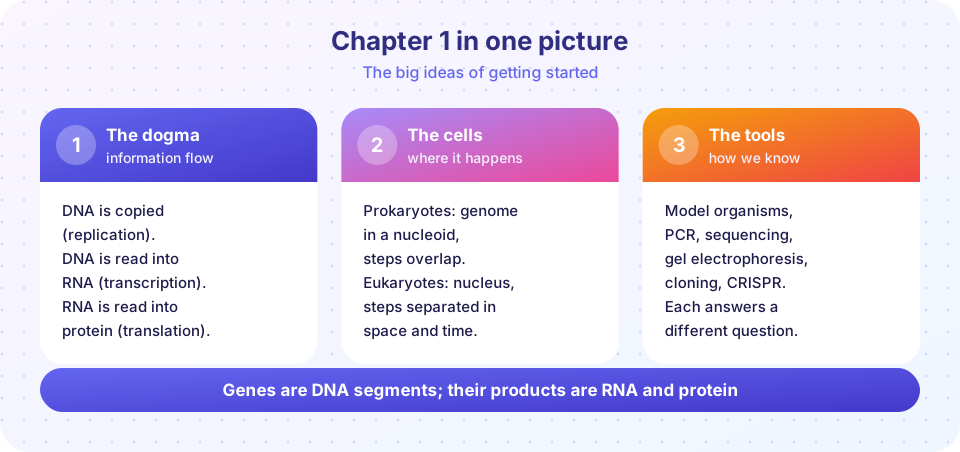
You have now seen the whole stage on which molecular biology plays: the central dogma that gives information a direction, the two cell plans that house the genome, the classic experiments that proved DNA is the genetic material, and the tools that let scientists measure and copy DNA. This review pulls those threads into one place before chapter 2 zooms in on the molecules themselves.
What you will learn
- How to recall the main ideas of chapter 1 in one organized overview.
- How the topics connect: why cell type decides how the dogma is carried out.
- Which calculations from the chapter you should be able to do without help.
Recap table
| Topic | Key facts | Where it returns |
|---|---|---|
| Central dogma | DNA to DNA, DNA to RNA, RNA to protein; 64 codons, 61 sense, 3 stop | Chapters 3, 4, 5 |
| Genetic code | Redundant, unambiguous, almost universal | Chapter 5 |
| Prokaryotes | Nucleoid, one circular chromosome, plasmids, operons, coupled expression | Chapters 3, 4, 6 |
| Eukaryotes | Nucleus, linear chromosomes, introns, processing and export | Chapters 4, 5, 6 |
| Griffith, Avery | Transformation, then identified as DNA | Chapter 7 |
| Hershey-Chase | 32P (DNA) entered the cell, 35S (protein) stayed outside | Chapter 3 |
| Meselson-Stahl | Replication is semiconservative | Chapter 3 |
| PCR | 2^n copies after n ideal cycles; needs two primers | Chapters 7, 8 |
| Gels | Smaller fragments run farther; distance is about linear in log(size) | Chapter 7 |
| Sequencing | Sanger chain termination; NGS reads millions of fragments | Chapter 8 |
Key terms
Codon: three RNA bases that specify an amino acid or a stop.
Operon: genes transcribed together under one promoter.
Plasmid: a small circular extra chromosome.
Primer: a short DNA that starts DNA synthesis.
Amplicon: the product of a PCR.
How the pieces fit
The dogma tells you what must happen; the cell type tells you where and when. A bacterium reads a gene into mRNA while ribosomes are already attaching to it, so expression is quick and tightly coupled. A eukaryote must process the RNA and ship it out of the nucleus, which adds steps that can be regulated but takes longer.
The experiments tell you how we know. Notice the pattern in each: Griffith, Avery, Hershey and Chase, and Meselson and Stahl all changed one variable and watched a clear outcome. When you meet a new claim later in the course, ask which experiment would show it.
The tools are how those experiments are done today. You will use PCR to amplify a gene before cloning it, gels to check the product size and sequencing to confirm the result.
Common misconceptions
"The central dogma forbids reverse transcription." It allows RNA-to-DNA transfer; it forbids transfer from protein to nucleic acids.
"Prokaryotes are simply smaller eukaryotes." They have a different internal organization, and archaea share some machinery with eukaryotes.
"Bigger genome means a more complex organism." Genome size varies widely and does not follow complexity.
Try it
First, a primer calculator that applies the Wallace rule to a short oligonucleotide and reports its length, GC content and approximate Tm. It is a rule of thumb for short primers, not a precise thermodynamic model.
Press Run (or Ctrl + Enter) to see the result here.
Program input · what you'd type while the program runs
Type the answers before you press Run, one per line. Each time the program reads a line (with input()), it gets the next line from this box.
Second, a quick consistency check of Chargaff's rules in the browser console, where you can edit the counts.
Press Run (or Ctrl + Enter) to see the console output here.
No output.
Check your understanding
Quick check · 10 questions
of 10 answered You scored / 10 · perfect!
-
1. Which flow of information does the central dogma forbid?
Once information is in protein it does not flow back into nucleic acids. -
2. How many of the 64 codons code for an amino acid?
Three codons are stop signals, so 61 code for amino acids. -
3. Which is true of bacterial gene expression?
There is no nucleus, so ribosomes can begin translating an mRNA that is still being made. -
4. What did the heat-killed S bacteria supply in Griffith's experiment?
A heat-stable substance, later shown to be DNA, transformed live R cells into S cells. -
5. In Hershey-Chase, which label was found inside the infected bacteria?
The phosphorus label of DNA entered the cell while most of the sulfur label of protein stayed outside. -
6. After 2 generations in 14N, Meselson and Stahl saw which bands?
This pattern fits semiconservative replication. -
7. A PCR starts with 5 template molecules and runs 20 ideal cycles. About how many copies result?
5 x 2^20 = 5 x 1,048,576, about 5.2 million. -
8. On an agarose gel, a 500 bp fragment is compared with a 3,000 bp fragment. Which runs farther?
Smaller fragments move through the gel faster. -
9. Why is a surface-area-to-volume ratio relevant to cell size?
The ratio is 3/r for a sphere, so smaller cells have more surface per volume to take in nutrients. -
10. Which technique gives the order of bases in a DNA fragment?
Electrophoresis gives sizes and PCR amplifies; sequencing reads the bases.
Summary
- The dogma sets the direction of information flow; the cell architecture sets how it is carried out.
- Key experiments (Griffith, Avery, Hershey and Chase, Meselson and Stahl) each isolated one variable to reach a clear conclusion.
- PCR, electrophoresis and sequencing are the basic tools, and each has a simple mathematical logic.
- Chapter 2 now looks closely at the molecules that carry out these processes.
Track your progress
Create a free account to tick off lessons and pick up where you left off on any device.
of Molecular Biology lessons completed