


















Lesson 2 of 48 · Getting Started
The Central Dogma: DNA to RNA to Protein
Follow genetic information from DNA to RNA to protein: replication, transcription, translation, the genetic code, and the exceptions such as reverse transcription.
Every cell in your body carries the same DNA, yet a neuron looks nothing like a red blood cell. The difference lies in which parts of the DNA each cell reads, and what happens after it reads them. The framework that organizes this is the central dogma of molecular biology, proposed by Francis Crick in 1958 and restated by him in 1970.
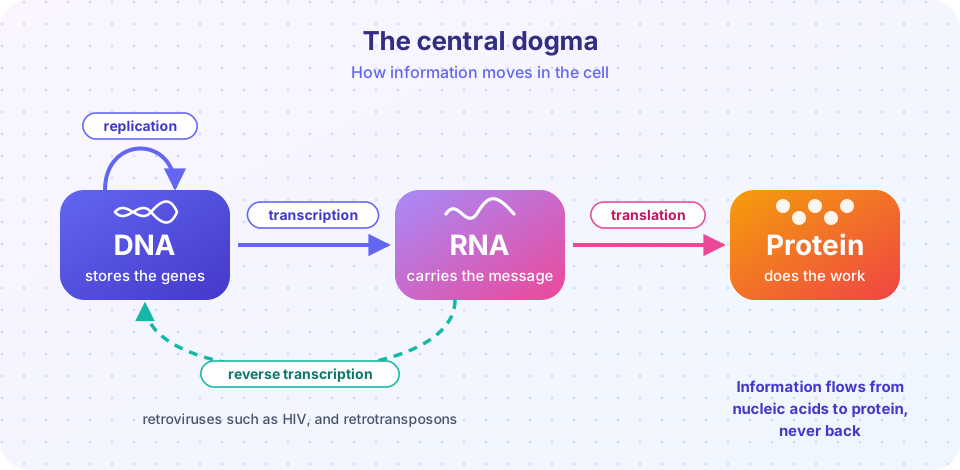
The central dogma is not a law that says "DNA makes RNA makes protein and that is all." It is a statement about the direction of information. Once information has passed into protein, it cannot flow back out into DNA or RNA. Everything in this course hangs on that idea.
What you will learn
- The three main information-transfer processes: replication, transcription and translation.
- How the genetic code maps RNA triplets to amino acids.
- What the central dogma does and does not claim, including reverse transcription.
- How to use the dogma to predict what a mutation will do.
Key terms
Replication: copying DNA to make two identical DNA molecules.
Transcription: copying one strand of DNA into RNA.
Translation: reading messenger RNA in triplets to build a polypeptide.
Codon: three RNA nucleotides that specify one amino acid or a stop signal.
Reverse transcription: making DNA from an RNA template, done by reverse transcriptase.
Three processes, one direction
Replication happens before a cell divides. The two strands of the double helix separate, and each acts as a template for a new partner strand, so one DNA molecule becomes two. Chapter 3 covers how this works in detail.
Transcription makes an RNA copy of a gene. An enzyme called RNA polymerase reads one DNA strand (the template strand) and builds a complementary RNA chain. RNA uses the base uracil (U) instead of thymine (T), so a template reading 3'-TACGGT-5' yields the RNA 5'-AUGCCA-3'. Chapter 4 covers this.
Translation converts the RNA message into a protein on a ribosome. The ribosome reads messenger RNA three nucleotides at a time. Each triplet, a codon, is matched by a transfer RNA carrying a specific amino acid, and the amino acids are joined into a chain. Chapter 5 covers this.
A cell may run these processes at different times and places. In a bacterium they overlap, because there is no nucleus to separate them. In a eukaryote, DNA stays in the nucleus, RNA is processed and exported, and translation takes place in the cytoplasm.
The genetic code
Four RNA letters taken three at a time give 4 × 4 × 4 = 64 possible codons. Sixty-one of them specify one of the 20 standard amino acids, and three (UAA, UAG, UGA) are stop signals. The codon AUG does double duty: it codes for methionine and also usually marks where translation starts.
Because 64 codons share 20 amino acids, the code is redundant (also called degenerate): most amino acids have more than one codon. It is not ambiguous, though, because each codon means one thing only. The code is also almost universal. With a few small exceptions, such as the mitochondrial code, the same codons mean the same amino acids in bacteria, plants and humans. That shared language is why a human gene can be made into a protein in a bacterium, which is the basis of much biotechnology.
Marshall Nirenberg and Heinrich Matthaei took the first step in solving the code in 1961. They fed an artificial RNA made only of uracil to a cell-free system and got a protein made only of phenylalanine. UUU codes for phenylalanine. By 1966 the whole table had been worked out by several labs.
What the dogma allows and forbids
Crick's idea can be written as a small table of transfers.
| Transfer | Status | Example |
|---|---|---|
| DNA to DNA | General | Replication |
| DNA to RNA | General | Transcription |
| RNA to protein | General | Translation |
| RNA to RNA | Special | RNA virus replication |
| RNA to DNA | Special | Reverse transcription in retroviruses such as HIV |
| DNA to protein | Special (lab only) | Cell-free systems with single-stranded DNA, never normal in cells |
| Protein to nucleic acid | Never observed | Forbidden by the dogma |
In 1970 Howard Temin and David Baltimore independently discovered reverse transcriptase, an enzyme in retroviruses that copies RNA into DNA. Some thought this broke the dogma, but it did not: it was an RNA-to-DNA transfer that Crick had already listed as a possibility. What would break the dogma is protein passing information into nucleic acid. Prions are misfolded proteins that spread by converting other proteins, but that transfers protein shape to protein shape, not information to nucleic acid.
From mutation to consequence
You can use the dogma as a prediction machine. Take the DNA coding strand ATG GCT TGG and the protein it produces, Met-Ala-Trp. Change the second codon's first base from G to A: ATG ACT TGG. The RNA reads AUG ACU UGG, and ACU codes for threonine, so the protein becomes Met-Thr-Trp. This is a missense mutation. A change that creates a stop codon is a nonsense mutation, and one that leaves the amino acid unchanged, thanks to redundancy, is a silent mutation.
The Try it blocks let you run this process yourself, in both a live widget and a program.
Common misconceptions
"The central dogma says information can only go DNA to RNA to protein." It allows RNA-to-DNA and RNA-to-RNA transfers. It forbids information flowing out of protein.
"Reverse transcriptase disproved the dogma." It did not; that flow was already allowed. It only disproved the idea that DNA-to-RNA is the only direction nucleic acids can move.
"Every codon codes for an amino acid." Three of the 64 codons are stop signals.
Try it
This widget reads a DNA coding strand, shows the transcribed mRNA and the translated protein, and stops at the first stop codon. It is a teaching model that uses the standard code only.
Now the same logic as a program, with a small genetic-code lookup. Try changing one base and see whether the protein changes.
Press Run (or Ctrl + Enter) to see the result here.
Program input · what you'd type while the program runs
Type the answers before you press Run, one per line. Each time the program reads a line (with input()), it gets the next line from this box.
Check your understanding
Quick check · 5 questions
of 5 answered You scored / 5 · perfect!
-
1. Which process makes an RNA copy of a gene?
Transcription uses DNA as a template to build RNA. Translation uses RNA to build protein. -
2. How many codons are possible, and how many code for amino acids?
4 x 4 x 4 = 64 codons. Three are stop codons, so 61 specify amino acids. -
3. What did the discovery of reverse transcriptase in 1970 change?
RNA-to-DNA transfer was an allowed special case. Protein-to-nucleic-acid transfer would be the real violation. -
4. A DNA change turns a codon from GAA (Glu) into GAG (Glu). This is a
Both codons code for glutamic acid, so the protein is unchanged. That is a silent mutation. -
5. Which statement about the genetic code is correct?
The code is redundant but unambiguous, and almost universal.
Summary
- The central dogma describes the direction of information: DNA to DNA (replication), DNA to RNA (transcription) and RNA to protein (translation).
- The genetic code has 64 codons: 61 for amino acids and 3 stop codons. It is redundant, unambiguous and almost universal.
- Reverse transcription (RNA to DNA) is an allowed exception; information never flows from protein back to nucleic acid.
- Mutations are classified by their effect: silent, missense or nonsense.
Track your progress
Create a free account to tick off lessons and pick up where you left off on any device.
of Molecular Biology lessons completed