


















Lesson 27 of 48 · Translation and Protein Folding
Chapter 5 Review: Translation and Protein Folding
A recap of the genetic code, ribosome cycle and protein folding, with a one-page summary picture, a recap table and a ten-question quiz.
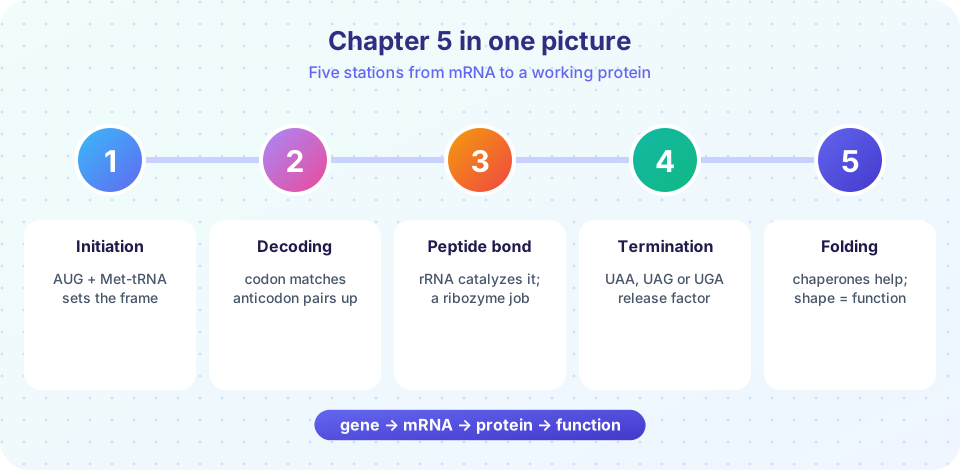
This review puts the chapter on one page. If you can walk along the five stations in the picture and say what happens at each, and use the two tools below (a peptide mass calculator and a six-frame translator), you have the core skills of this chapter.
Recap table
| Topic | The one thing to remember |
|---|---|
| Genetic code | 64 codons: 61 sense, 3 stop (UAA, UAG, UGA); AUG starts and codes for Met |
| Degeneracy | Several codons per amino acid, but each codon has one meaning; wobble at the third position |
| Reading frame | Set by the start codon; indels not divisible by 3 shift it |
| Mutations | Silent, missense, nonsense, frameshift |
| tRNA charging | Synthetases attach the right amino acid; this costs 2 high-energy bonds |
| Ribosome | Small subunit decodes, large subunit forms the peptide bond (rRNA catalysis); A, P and E sites |
| Initiation | Shine-Dalgarno and fMet in bacteria; cap, scanning and Kozak context in eukaryotes |
| Elongation | Decoding (EF-Tu / eEF1A), bond formation, translocation (EF-G / eEF2) |
| Termination | Release factors read stop codons (RF1, RF2; eRF1) |
| Energy | About 4 high-energy bonds per amino acid |
| Folding | Sequence encodes the structure (Anfinsen); funnel landscape; hydrophobic effect |
| Chaperones | Prevent aggregation: trigger factor, Hsp70, chaperonins, Hsp90 |
| Misfolding | Cystic fibrosis (ΔF508), prion disease, amyloid disorders |
What you will learn
- How to apply the whole chapter to calculation and translation tasks.
- Which connections between lessons matter most: code, ribosome, energy and folding.
Common misconceptions
"If the codon is correct, the protein is correct." It must also fold correctly, and many proteins need processing after translation.
"Stop codons are rare accidents." Every gene ends with one; they are deliberate signals read by release factors.
"Bacteria and humans use completely different codes." The standard code is shared; the machines differ in details such as initiation and rRNA sizes.
Try it
The first example computes the average mass of a peptide from standard average residue masses (the mass of each amino acid after losing water in the peptide bond), plus one water for the chain ends. The result is accurate enough to compare with a mass spectrometry experiment.
Press Run (or Ctrl + Enter) to see the result here.
Program input · what you'd type while the program runs
Type the answers before you press Run, one per line. Each time the program reads a line (with input()), it gets the next line from this box.
The second example translates a DNA sequence in all six reading frames (three on each strand) and reports the longest open reading frame, a standard first step when analyzing a new sequence.
Press Run (or Ctrl + Enter) to see the result here.
Program input · what you'd type while the program runs
Type the answers before you press Run, one per line. Each time the program reads a line (with input()), it gets the next line from this box.
Check your understanding
Quick check · 10 questions
of 10 answered You scored / 10 · perfect!
-
1. How many sense codons does the standard genetic code contain?
64 total codons minus 3 stop codons leaves 61 sense codons. -
2. A mutation changes UAC (Tyr) to UAA. This is a
UAA is a stop codon, so the chain is cut short. -
3. Which molecule decides that alanine is attached to the correct tRNA?
The synthetase recognizes both the amino acid and its tRNAs. -
4. In which order do tRNA sites run from the 5′ side to the 3′ side of the mRNA?
E (exit), P (peptidyl) and A (aminoacyl) lie in that order along the mRNA from 5′ to 3′. -
5. Which factor family is used to translocate the ribosome?
EF-G (bacteria) and eEF2 (eukaryotes) hydrolyze GTP to move the ribosome one codon. -
6. About how many high-energy phosphate bonds does adding one amino acid cost?
Two for charging the tRNA, one for delivery and one for translocation. -
7. What does the hydrophobic effect do in folding?
Burying nonpolar groups releases ordered water and raises the entropy of the system. -
8. Chaperones are best described as
The sequence still encodes the fold; chaperones protect chains from clumping. -
9. Eukaryotic ribosomes find the start codon mainly by
The 40S subunit loads at the cap and scans; Shine-Dalgarno pairing is the bacterial mechanism. -
10. Which disease is caused by a misfolding mutation that deletes one phenylalanine of the CFTR protein?
ΔF508 is the most common cystic fibrosis mutation.
Summary
- The code, the ribosome and folding form one pipeline from mRNA to a working protein.
- Accuracy comes from three checkpoints: charging by synthetases, codon-anticodon pairing and quality control after folding.
- Translation is costly: about four high-energy bonds per amino acid.
- You can now translate sequences by hand and by code, classify mutations and explain why shape is function.
Track your progress
Create a free account to tick off lessons and pick up where you left off on any device.
of Molecular Biology lessons completed