


















Lesson 38 of 48 · Genomics and Applications
Chapter 8 Overview: Genomics and Its Applications
Get the big picture of genomics: what a genome contains, how the human genome was read, how large genomes are across life, and how the chapter is organized.
In the first half of this course you studied single genes. Genomics zooms out to look at all the DNA of an organism at once: how big it is, what it contains, how it differs between individuals and how it is used. The shift became possible when sequencing grew a million times faster and cheaper. In 2003 the Human Genome Project announced a finished human reference sequence after about thirteen years and billions of dollars. Today a human genome can be sequenced in a day, for a cost counted in hundreds of dollars. This chapter shows how that works and what we do with the results.
What you will learn
- What a genome is and how big genomes are across life.
- What the human genome contains, and how much of it codes for protein.
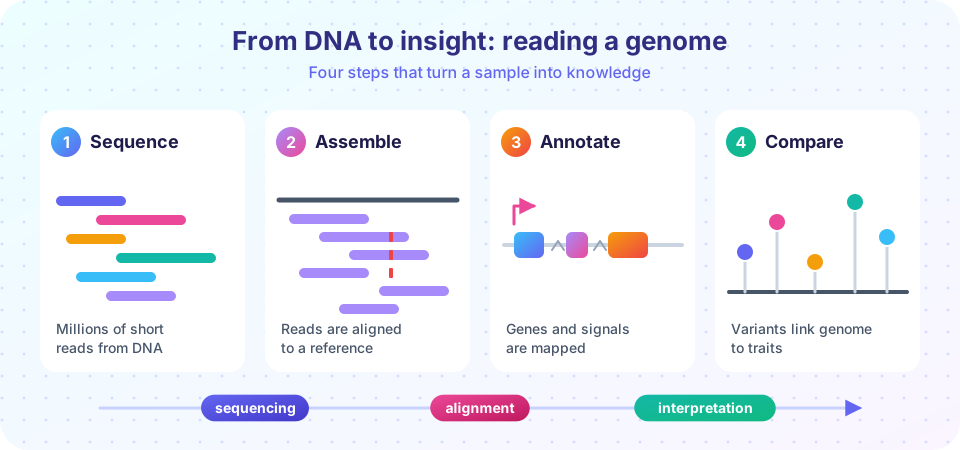
- The main steps of a genomics project.
- How the lessons of this chapter fit together.
Key terms
Genome: the complete set of DNA of an organism, including genes and everything between them.
Reference genome: a representative assembled sequence that reads from other individuals are compared with.
Annotation: marking genes, exons and regulatory elements on a sequence.
Variant: a difference between an individual's DNA and the reference.
Coverage: the average number of reads that cover each base of a genome.
What a genome contains
The human haploid genome has about 3.1 billion base pairs spread over 22 autosomes, the X and Y chromosomes and a small circular mitochondrial genome of about 16,600 bases. It contains roughly 20,000 protein-coding genes, but the exons that code for protein add up to only about 1 to 2 percent of the sequence. The rest includes introns, regulatory DNA such as enhancers and promoters, genes for functional RNAs (tRNAs, rRNAs, microRNAs, long noncoding RNAs) and a great deal of repeated sequence. Transposable elements, DNA that can copy and move, make up around half of the genome; the most common, the Alu element (about 300 bases) and LINE-1, together account for roughly a quarter to a third.
Two unrelated people differ at about one base in a thousand: roughly 99.9 percent of their DNA is identical, and a typical genome carries 4 to 5 million differences from the reference. Those differences, most of them harmless, are what genomic medicine and ancestry studies read.
Milestones
- 1990 to 2003. The Human Genome Project, an international public effort, with a competing private effort by Celera. Drafts were announced in 2001, and the "finished" reference in 2003.
- 2005 onward. Next-generation sequencing makes reading DNA thousands of times cheaper.
- 2022. The Telomere-to-Telomere (T2T) consortium published the first truly complete human genome, filling the last gaps (repeat-rich regions that short reads could not resolve) with long reads.
- Today. Pangenomes capture the diversity of many people instead of one reference, and sequencing of millions of people is under way in large biobanks.
Genome size across life
Genome size varies enormously and is only loosely related to the complexity of the organism, which is called the C-value paradox. A bacterium such as E. coli has about 4.6 million base pairs and some 4,300 genes, so genes are packed densely. Baker's yeast has about 12 million. Humans have about 3.1 billion but fewer genes than some plants. Some salamanders, lungfish and plants have genomes tens of times larger than ours, mostly because of repeated DNA.
The workflow
Read
Interpret
Use
Data first, biology second.
What each lesson covers
- Sequencing methods explains Sanger, short-read and long-read technologies, coverage, quality scores and assembly.
- Expression and variants covers RNA-seq, normalization, SNPs, genome-wide association studies and multiple testing.
- Medicine and biotechnology shows applications: diagnostics, cancer genomics, pharmacogenomics, mRNA vaccines, gene therapy and agriculture, with ethics.
- Chapter 8 review practices planning a sequencing project and tests the chapter.
Common misconceptions
"The human genome is a sequence of genes." Genes occupy a minority of it, and the coding part is only about 1 to 2 percent.
"There is one human genome." The reference is a model; every person has a different genome, and the reference is gradually being replaced by pangenomes.
"More DNA means a more complex organism." Genome size and complexity are poorly correlated.
Try it
The first example compares approximate genome sizes of a few organisms on a logarithmic scale. Values are rounded, for orientation only.
Press Run (or Ctrl + Enter) to see the result here.
Program input · what you'd type while the program runs
Type the answers before you press Run, one per line. Each time the program reads a line (with input()), it gets the next line from this box.
The second example does arithmetic with the numbers in this lesson: how many differences two people have, how much data a genome is as text and how much of the genome codes for protein.
Press Run (or Ctrl + Enter) to see the result here.
Program input · what you'd type while the program runs
Type the answers before you press Run, one per line. Each time the program reads a line (with input()), it gets the next line from this box.
Check your understanding
Quick check · 4 questions
of 4 answered You scored / 4 · perfect!
-
1. Roughly what fraction of the human genome codes for protein?
Protein-coding exons make up only a small fraction; the rest includes introns, regulatory DNA and repeats. -
2. How much do two unrelated people's genomes differ?
Roughly one base in a thousand, which amounts to millions of differences. -
3. What did the T2T genome of 2022 achieve?
Long reads allowed the repeat-rich gaps to be filled, giving a complete telomere-to-telomere assembly. -
4. The C-value paradox refers to the fact that
Some simple organisms have much larger genomes than humans, mainly because of repeated DNA.
Summary
- A genome is all of an organism's DNA; the human one has about 3.1 billion base pairs and about 20,000 protein-coding genes.
- Coding exons are only 1 to 2 percent; repeats and regulatory DNA fill much of the rest.
- People share about 99.9 percent of their DNA; the differences matter for medicine and ancestry.
- A genomics project sequences, aligns or assembles, annotates and compares.
Next: Sequencing methods
Track your progress
Create a free account to tick off lessons and pick up where you left off on any device.
of Molecular Biology lessons completed