


















Lesson 1 of 48 · Getting Started
Course Map: How to Study Molecular Biology
Start here: what molecular biology is, who this course is for, how the nine chapters fit together and how to study them with simulations, plots and quizzes.
Molecular biology asks a deceptively simple question: how do molecules make a living thing? A bacterium divides every twenty minutes, a fertilized egg becomes a body with hundreds of cell types, and a virus hijacks a cell it was never part of. Behind all of it sits a small set of molecules (DNA, RNA and proteins) and a handful of rules for how they copy, read and regulate one another.
This course teaches those rules from the ground up. You will learn how a cell stores information, how it copies and repairs that information, how it turns it into working machines, how it decides which genes to use, and how scientists now read and rewrite genomes on purpose. Everything is explained in plain language, with worked numbers and small programs you can run in the page.
What you will learn
- What molecular biology covers and how it differs from genetics, biochemistry and cell biology.
- How the nine chapters connect, so you always know where a topic fits.
- Which math and chemistry you need (very little) and which habits help most.
- How to use the interactive blocks and quizzes to learn actively.
Key terms
Molecular biology: the study of biological processes at the level of molecules, especially nucleic acids and proteins.
Gene: a stretch of DNA that is transcribed into an RNA product, often one that is translated into a protein.
Genome: the complete set of DNA in a cell or organism.
Expression: the use of a gene's information to make its RNA or protein product.
Who this course is for
The course assumes you have met the cell and a little genetics, for example in a general biology class for ages 15 and up. You do not need to remember organic chemistry. Every molecule is introduced when it first matters, and every special word is defined the first time it appears.
You will meet some numbers: lengths in nanometers, rates in nucleotides per second, probabilities such as one error in a billion. The arithmetic never goes beyond multiplication, division, powers of two and logarithms. Where a calculation helps, a Python block does it for you so you can change the inputs and watch the answer move.
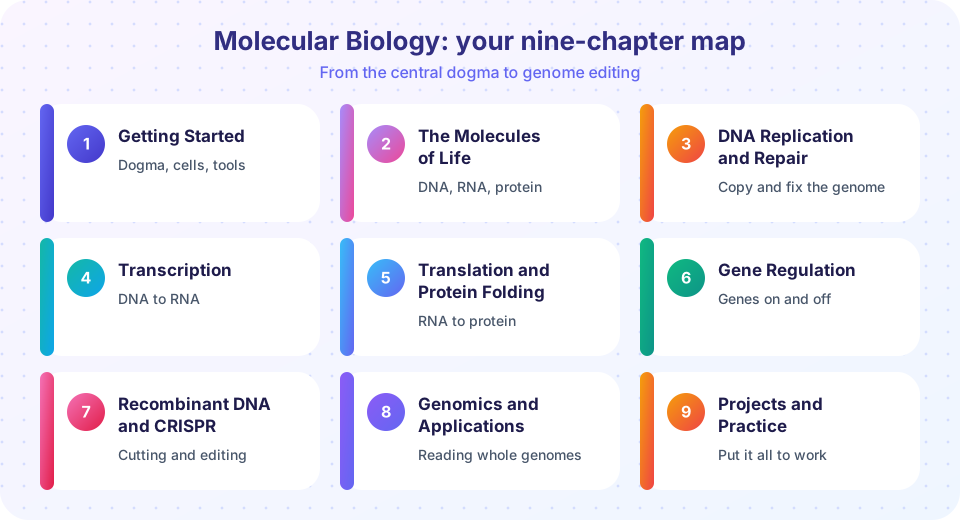
The nine chapters at a glance
Part one: the foundations
- Getting started
- Molecules of life
- Replication, repair
Part two: reading the genome
- Transcription
- Translation
- Gene regulation
Part three: using the knowledge
- Recombinant DNA
- Genomics
- Practice
Chapters build on each other; follow the order.
Chapters 1 to 4 are covered first: the central dogma, cell types, the molecules, replication and repair, and transcription. Chapters 5 to 9 continue with translation, regulation, recombinant DNA and CRISPR, genomics and applications, and finally projects.
Each chapter opens with an overview, has several concept lessons, and ends with a review that mixes all of its topics in one quiz. If you only have time for a quick pass, read the overviews and reviews. For mastery, do every lesson in order.
How to study each lesson
- Read the outcomes under "What you will learn" and decide what you want to be able to do afterward.
- Study the picture first. Every lesson has at least one illustration. Try describing it aloud before reading the text.
- Run the examples. The interactive blocks are small, honest models. Change a number and predict the result before pressing Run.
- Test yourself. Answer the quiz without scrolling up. Read each explanation, even for answers you got right.
- Return the next day. Recall after a night's sleep is what builds long-term memory.
Draw the pathway of each chapter from memory on paper: what goes in, what comes out, which enzyme acts. Molecular biology is mostly pathways, and drawing them is the best test of whether you understand them.
Common misconceptions
"A gene is a protein." A gene is a region of DNA. Its product may be a protein, but many genes make only RNA, such as tRNA and rRNA.
"DNA contains a blueprint of the body." DNA is closer to a recipe book: it lists the ingredients (RNA and proteins) and the conditions for using them. The body emerges from how cells use that information.
"Most of the genome is junk." Only about 1 to 2 percent of the human genome codes for protein, but much of the rest is regulatory, structural or transcribed into functional RNA. How much is truly functional is still debated.
Try it
First, a feeling for scale. Genome sizes span many orders of magnitude, so this chart uses a logarithmic axis. The values are rounded haploid genome sizes in millions of base pairs (Mb).
Press Run (or Ctrl + Enter) to see the result here.
Program input · what you'd type while the program runs
Type the answers before you press Run, one per line. Each time the program reads a line (with input()), it gets the next line from this box.
Second, the first tool of the trade: a tiny function that reads a DNA sequence. It builds the reverse complement (the other strand) and the GC content, two numbers you will use all course. This is a calculator that applies simple rules, not a model of a cell.
Press Run (or Ctrl + Enter) to see the result here.
Program input · what you'd type while the program runs
Type the answers before you press Run, one per line. Each time the program reads a line (with input()), it gets the next line from this box.
Check your understanding
Quick check · 4 questions
of 4 answered You scored / 4 · perfect!
-
1. Which statement best describes a gene?
A gene is a DNA segment. Its transcript can be a messenger RNA that is translated into protein, or a functional RNA such as tRNA. -
2. About how much of the human genome codes for proteins?
Roughly 1 to 2 percent of the human genome is protein-coding, although much of the rest has regulatory or structural roles. -
3. Why does the genome chart use a logarithmic axis?
A log axis spaces values by multiplication, so a virus and a human genome can be shown together. -
4. Which chapters cover how DNA is copied and how it is read into RNA?
Chapter 3 covers replication and repair, and chapter 4 covers transcription.
Summary
- Molecular biology explains life through the molecules that store, copy, read and regulate genetic information.
- The course has nine chapters that move from foundations to reading the genome to genome engineering and practice.
- Learn actively: study the picture, run and modify the examples, answer the quiz from memory and revisit the next day.
- Genes are DNA regions; only a small part of the human genome codes for protein.
Next: The Central Dogma
Track your progress
Create a free account to tick off lessons and pick up where you left off on any device.
of Molecular Biology lessons completed