


















Lesson 36 of 48 · Recombinant DNA and CRISPR
CRISPR-Cas9: Programmable Genome Editing
Understand how Cas9 and a guide RNA find a DNA target next to a PAM, how NHEJ and HDR repair the cut, and how base editing, off-targets and ethics shape the field.
Restriction enzymes cut where their built-in sequence tells them to. CRISPR-Cas9 cuts wherever you tell it to. By changing a short guide RNA, a researcher can point the same protein at almost any place in a genome. That is why, after its development in 2012, CRISPR spread through biology faster than almost any technique before it. In this lesson you will see where the system comes from, how it finds its target, what happens after the cut and why the answer to "can we edit anything?" is "not quite yet, and not without care".
What you will learn
- The natural role of CRISPR in bacteria.
- How guide RNA, Cas9 and the PAM select a target and how the cut is made.
- How NHEJ and HDR repair the cut and what edits they produce.
- What base editing, prime editing and CRISPRi do, and what limits and ethical questions remain.
Key terms
sgRNA (single guide RNA): an engineered RNA of about 100 nucleotides combining the targeting sequence (crRNA) and the scaffold (tracrRNA).
PAM (protospacer adjacent motif): a short sequence next to the target that Cas9 must find before it unwinds the DNA; for S. pyogenes Cas9 it is 5′-NGG-3′.
NHEJ: non-homologous end joining, a fast, error-prone repair of a double-strand break.
HDR: homology-directed repair, which copies a template to fix a break precisely.
Off-target effect: editing at a site that resembles the intended target.
Where CRISPR comes from
Bacteria and archaea have an adaptive immune system. When a virus (a phage) infects a bacterium and the cell survives, it cuts a short piece of the viral DNA and inserts it into its own genome as a spacer between repeats. This region is called CRISPR (clustered regularly interspaced short palindromic repeats). Later, the array is transcribed and processed into short RNAs, each of which guides a Cas nuclease to matching viral DNA and cuts it. Rodolphe Barrangou and Philippe Horvath showed in 2007 that this really is an immune system. In 2012 Martin Jinek, Krzysztof Chylinski, Emmanuelle Charpentier, Jennifer Doudna and colleagues showed that the two RNAs can be fused into one guide and that Cas9 from Streptococcus pyogenes can then be programmed to cut any DNA in a test tube. In 2013 Feng Zhang's and George Church's groups showed that it works in human cells. Charpentier and Doudna received the 2020 Nobel Prize in Chemistry.
How Cas9 finds and cuts a target
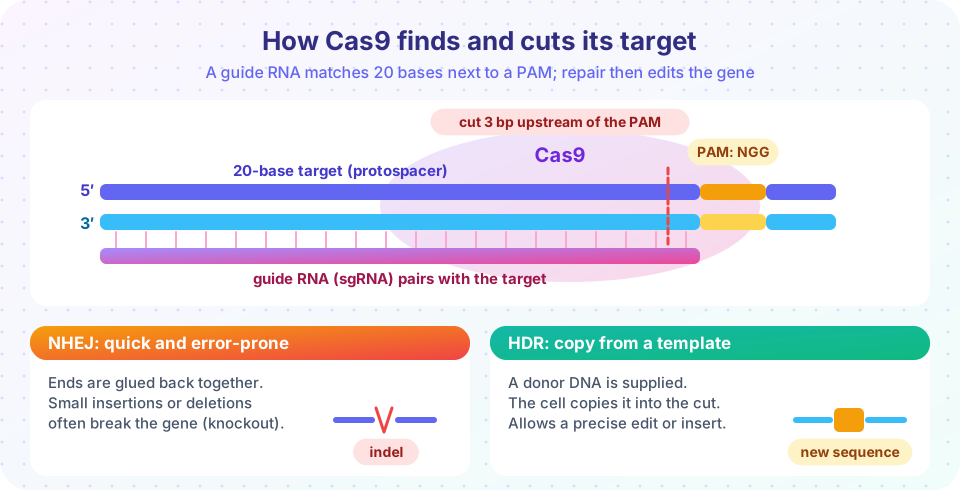
- Assemble. Cas9 binds the sgRNA, whose first 20 nucleotides are the spacer that matches the target.
- Scan. The complex tumbles along DNA and checks for a PAM (
NGGfor SpCas9). Without a PAM, nothing happens, however good the match. This protects the bacterium's own CRISPR array, which has no PAM. - Unwind and match. At a PAM the protein unwinds the DNA and the guide tries to pair with the adjacent 20 bases, starting at the end next to the PAM (the "seed" region). If the match is good, Cas9 changes shape.
- Cut. Two nuclease domains cut the two strands (HNH cuts the strand paired with the guide, RuvC the other strand), giving a blunt double-strand break about 3 base pairs upstream of the PAM.
A consequence of the NGG rule: an NGG occurs about once in every 16 positions on each strand, so about once in 8 base pairs along a double-stranded genome. Nearly every gene therefore contains many possible targets. Other Cas proteins have different PAMs and behaviors: Cas12a recognizes a T-rich PAM and makes staggered cuts, and Cas13 targets RNA.
What the cell does next
The cell sees a double-strand break and repairs it, and the repair pathway decides the outcome.
- NHEJ sticks the ends together quickly in any cell. It often loses or adds a few bases (insertions and deletions, "indels"). If the indel length is not a multiple of three, the reading frame shifts and the gene is usually knocked out. This is the simplest way to disable a gene.
- HDR uses a homologous template. If you provide a donor DNA with the desired change flanked by sequences matching the target, the cell can copy it into the cut, giving a precise edit or insertion. HDR works mostly in dividing cells and is less efficient than NHEJ.
Beyond cutting
- Base editors (David Liu's lab, 2016 and 2017) fuse a "nicking" or disabled Cas9 to a deaminase enzyme that changes one base to another (C to T or A to G) without a double-strand break.
- Prime editors (2019) combine a nicking Cas9 with a reverse transcriptase and an extended guide that carries the new sequence, allowing small insertions, deletions and all base changes.
- CRISPRi and CRISPRa use catalytically dead Cas9 (dCas9) fused to a repressor or activator domain to turn genes down or up without changing DNA.
Design and its limits
Guides are chosen with software. Good guides have a PAM next to a unique 20-base sequence, a GC content around 40 to 60 percent, and no run of four or more T's when the guide is made from a U6 promoter (TTTT ends transcription). Off-target sites, with a few mismatches to the guide, may also be cut, especially if mismatches lie far from the PAM; high-fidelity Cas9 variants and careful design reduce this, and whole-genome sequencing can check it. Other limits are delivery (getting Cas9 and the guide into the right cells in a body, using viruses, lipid nanoparticles or electroporation of cells outside the body), mosaicism in embryos and large unintended deletions.
Applications and ethics
CRISPR is used to make knockout cell lines and animal models, screen every gene for roles in disease, improve crops and engineer microbes. In medicine, the first approved CRISPR therapy, exa-cel (Casgevy), treats sickle-cell disease and β-thalassemia by editing a patient's blood stem cells outside the body; it was approved in the United Kingdom in November 2023 and the United States in December 2023. You will study this case in the final chapter. Editing somatic cells affects only the patient. Editing germline cells (embryos, eggs, sperm) would pass changes to future generations. In 2018 a researcher in China announced that he had edited human embryos that were then born as children; the scientific community and many governments condemned this as premature and unethical. Most countries restrict or ban germline editing for reproduction, and the debate about where lines should be drawn, for treatment versus enhancement and for fairness of access, continues.
Common misconceptions
"CRISPR is a cutting tool that never makes mistakes." Off-target edits and unwanted repair outcomes happen and have to be measured.
"Cas9 itself decides where to cut." The guide RNA decides; Cas9 also requires a PAM.
"HDR is the usual outcome." In most cells NHEJ dominates, which is why knockouts are easier than precise edits.
Try it
The first example scans a DNA sequence on both strands for NGG PAMs and lists the 20-base targets next to them, with GC content and the cut position. The sequence is invented.
Press Run (or Ctrl + Enter) to see the result here.
Program input · what you'd type while the program runs
Type the answers before you press Run, one per line. Each time the program reads a line (with input()), it gets the next line from this box.
The second example counts mismatches between a guide and candidate sites to flag likely off-targets. It is an illustration of the idea; real off-target prediction uses weighted scores and genome-wide searches.
Press Run (or Ctrl + Enter) to see the result here.
Program input · what you'd type while the program runs
Type the answers before you press Run, one per line. Each time the program reads a line (with input()), it gets the next line from this box.
The third example simulates repair outcomes after many cuts. The distribution of indel sizes is invented for illustration (real ones depend on the site and cell type); it shows how to count the share of frameshifts (if every indel size were equally likely, two thirds would shift the frame).
Press Run (or Ctrl + Enter) to see the result here.
Program input · what you'd type while the program runs
Type the answers before you press Run, one per line. Each time the program reads a line (with input()), it gets the next line from this box.
Check your understanding
Quick check · 5 questions
of 5 answered You scored / 5 · perfect!
-
1. Which sequence must be next to the target for SpCas9 to cut?
SpCas9 needs a 5′-NGG-3′ PAM next to the 20-base target. -
2. Where does Cas9 cut relative to the PAM?
The blunt cut lies about three base pairs from the PAM, inside the target. -
3. Which repair pathway usually produces a gene knockout?
NHEJ joins ends imprecisely; indels that shift the frame disrupt the gene. -
4. What do base editors avoid?
Base editors change one base using a deaminase fused to a nicking or dead Cas9 and do not make a double-strand break. -
5. Roughly how often does the NGG PAM occur in random double-stranded DNA?
NGG occurs once per 16 positions on each strand, so about once per 8 bp over both strands.
Summary
- CRISPR-Cas is a bacterial immune system adapted for editing; the guide RNA picks the target and the PAM allows Cas9 to bind and cut.
- The cut falls about 3 bp from the PAM; NHEJ gives indels (knockouts) and HDR gives precise edits with a template.
- Base editing, prime editing and dCas9 tools change DNA without double-strand breaks or alter expression.
- Off-targets, delivery and mosaicism limit use; germline editing raises serious ethical questions.
- The first CRISPR therapy was approved in late 2023.
Next: Chapter 7 review
Track your progress
Create a free account to tick off lessons and pick up where you left off on any device.
of Molecular Biology lessons completed