


















Lesson 12 of 48 · The Molecules of Life
Chapter 2 Review: The Molecules of Life
Review the structure of DNA, RNA, proteins and chromatin with a one-page summary picture, a comparison table, a molecule classifier and a ten-question quiz.
This chapter introduced the molecules at the center of molecular biology. DNA stores the genes as a pairing double helix, RNA carries and acts in single-stranded folded forms, proteins fold from amino acid chains into machines, and chromatin packs DNA so that a meter-long thread fits in a nucleus and remains readable. Use this review to check that the four pictures fit together.
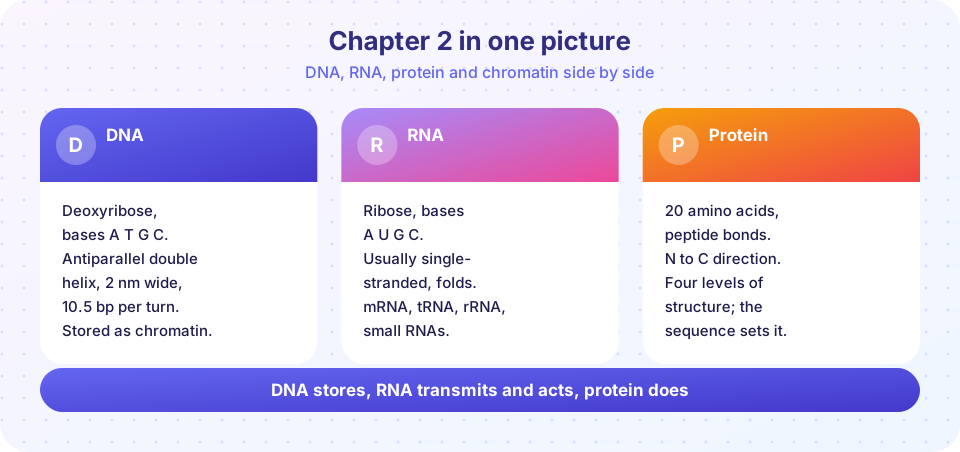
What you will learn
- How to compare DNA, RNA and protein on one page.
- Which numbers from chapter 2 to remember.
- How to classify an unknown sequence by its letters.
Comparison table
| Feature | DNA | RNA | Protein |
|---|---|---|---|
| Monomer | Deoxyribonucleotide | Ribonucleotide | Amino acid |
| Sugar | Deoxyribose | Ribose (2′ OH) | None |
| Alphabet | A, T, G, C | A, U, G, C | 20 amino acids |
| Link between monomers | Phosphodiester | Phosphodiester | Peptide |
| Typical form | Double helix | Single strand, folded | Folded chain |
| Direction | 5′ to 3′ | 5′ to 3′ | N to C terminus |
| Main role | Information storage | Message, adaptor, catalyst, regulation | Catalysis, structure, signaling |
| Stability | High | Lower | Varies |
Key terms
Antiparallel: strands running in opposite directions.
Hairpin: a stem-loop formed by self-pairing in a single strand.
Residue: one amino acid in a chain.
Nucleosome: 147 bp of DNA on a histone octamer.
Tm: the temperature at which half of the DNA has melted.
Numbers to remember
- B-DNA: diameter about 2 nm, rise 0.34 nm per base pair, about 10.5 base pairs per turn.
- A-T has 2 hydrogen bonds; G-C has 3.
- tRNA is about 76 nucleotides; miRNA about 22.
- Average amino acid residue mass is about 110 Da.
- α-helix: 3.6 residues per turn.
- Nucleosome core: 147 bp; typical repeat about 200 bp.
- Human diploid DNA: about 2 m in total.
How the chapter connects
The pairing rules from the DNA lesson return in RNA hairpins and codon-anticodon pairing. The folding principle from protein structure, with oily groups inside and charged groups outside, also helps explain why DNA wraps around positively charged histones. And everything in chapter 3 (replication) depends on the 5′ to 3′ direction and the pairing rule you learned here.
Common misconceptions
"All RNA is translated." Only mRNA is; tRNA, rRNA and small RNAs act as RNA.
"The tertiary structure is encoded separately from the primary." There is one code: the primary sequence, from which the other levels follow.
"Histones are only found in humans." Histones are found in all eukaryotes and many archaea.
Try it
A molecule classifier: it guesses whether a sequence is DNA, RNA or protein from its alphabet. It is a heuristic for teaching, not a real classification method, and short sequences can be ambiguous.
Press Run (or Ctrl + Enter) to see the result here.
Program input · what you'd type while the program runs
Type the answers before you press Run, one per line. Each time the program reads a line (with input()), it gets the next line from this box.
Second, a quick comparison of DNA and protein capacity in numbers. It calculates how many different sequences exist for a given length, which shows why short random chains already carry lots of information.
Press Run (or Ctrl + Enter) to see the result here.
Program input · what you'd type while the program runs
Type the answers before you press Run, one per line. Each time the program reads a line (with input()), it gets the next line from this box.
Check your understanding
Quick check · 10 questions
of 10 answered You scored / 10 · perfect!
-
1. Which base pairs with adenine in RNA?
RNA uses uracil in place of thymine, and uracil pairs with adenine. -
2. A strand reads 5'-GGAUC-3'. What is its complementary RNA strand written 5' to 3'?
Complement of GGAUC read 3' to 5' is CCUAG; written 5' to 3' it is GAUCC. -
3. How many hydrogen bonds form between G and C?
G-C has three; A-T has two. -
4. Which interaction is the main driver of tertiary protein folding?
Oily side chains cluster in the core, away from water. -
5. What is the role of linker histone H1?
H1 sits at the nucleosome entry and exit and helps pack nucleosomes together. -
6. Which RNA contains the anticodon?
The anticodon is the three-base region of tRNA that pairs with a codon. -
7. Roughly how long is the DNA in a diploid human cell?
About 6.2 billion base pairs at 0.34 nm each gives about 2 m. -
8. A peptide bond is formed by
Amino acids join in a condensation reaction that releases water. -
9. Which statement about heterochromatin is correct?
Heterochromatin is compact and largely transcriptionally inactive. -
10. Which statement about RNA is correct?
RNA folds into 3D shapes and ribozymes such as the ribosome's rRNA catalyze reactions.
Summary
- DNA, RNA and proteins are polymers with different monomers, links and roles; chromatin packages DNA for storage and control.
- Pairing rules (A-T or A-U, G-C) and the 5′ to 3′ direction are the key to nucleic acid behavior.
- Protein shape comes from the sequence through four levels of structure.
- With these molecules in hand, chapter 3 explains how DNA is copied and repaired.
Track your progress
Create a free account to tick off lessons and pick up where you left off on any device.
of Molecular Biology lessons completed