


















Lesson 30 of 48 · Gene Regulation
Eukaryotic Gene Control: Chromatin, Enhancers and Epigenetics
Learn how histone marks, DNA methylation, transcription factors and enhancers working at a distance decide which genes a eukaryotic cell uses.
A bacterial promoter sits in plain sight. A eukaryotic gene is wrapped around proteins, folded in a nucleus, and controlled by switches that can be thousands of bases away. This extra complexity pays off: it allows each of the hundreds of cell types in your body to have its own stable pattern of expression, and to keep that pattern through many cell divisions. In this lesson you will learn the layers of eukaryotic control: chromatin, transcription factors, enhancers and epigenetic marks.
What you will learn
- How nucleosomes and histone modifications open or close chromatin.
- How DNA methylation silences genes and is copied during replication.
- How transcription factors, enhancers and Mediator turn on a gene from a distance.
- What combinatorial control and pioneer factors mean.
Key terms
Nucleosome: 147 base pairs of DNA wrapped about 1.65 times around a histone octamer.
Histone acetylation: adding acetyl groups to lysines on histone tails, which loosens chromatin.
Enhancer: a regulatory DNA element that boosts transcription of a gene, often far away and in either orientation.
CpG island: a short stretch rich in CG dinucleotides, often at promoters.
Epigenetics: the study of heritable changes in gene activity not caused by changes in DNA sequence.
Chromatin: DNA is packaged
Eukaryotic DNA is wrapped around histone proteins. A nucleosome is a core of eight histones (two each of H2A, H2B, H3 and H4) with 147 base pairs of DNA wrapped around it. Linker histone H1 and further folding compact the nucleosome chain into tight fibers. DNA that is tightly packed is hard for transcription machinery to reach, so packaging itself is a way to silence genes. Cells use two broad states: loosely packed euchromatin (genes often active) and densely packed heterochromatin (genes mostly silent).
The tails of the histones stick out of the nucleosome and carry chemical tags, a "histone code" that other proteins read.
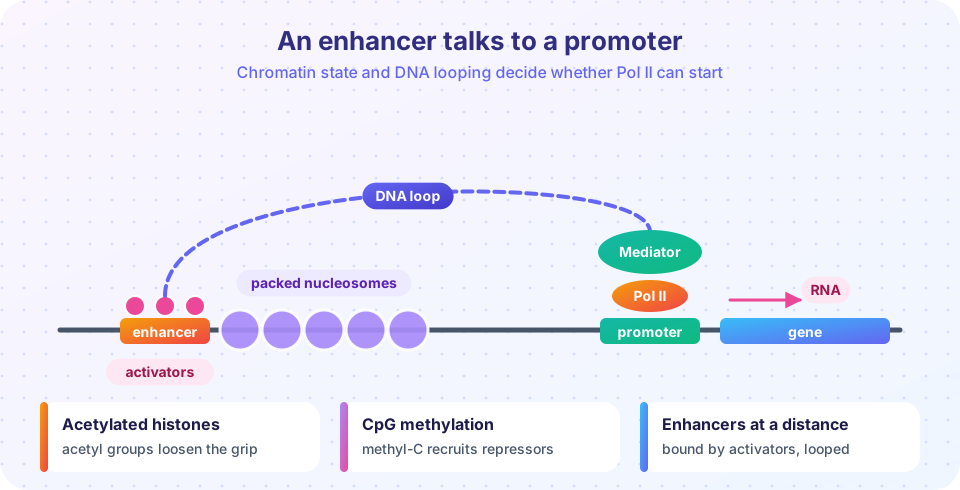
- Acetylation of lysines by histone acetyltransferases (HATs) removes the positive charge of lysine, loosens the grip on DNA and opens chromatin. Histone deacetylases (HDACs) reverse it. Some cancer drugs inhibit HDACs.
- Methylation of histone lysines can mean different things depending on the position: H3K4me3 marks active promoters, while H3K27me3 (placed by the Polycomb complex) and H3K9me3 mark repressed or heterochromatic regions.
- Chromatin remodelers use ATP to slide or eject nucleosomes and so expose DNA.
DNA methylation
In vertebrates, the cytosine of many CG dinucleotides carries a methyl group (5-methylcytosine), added by DNA methyltransferases. Methylation within promoters is generally associated with long-term silencing: methyl-binding proteins recruit HDACs and other repressors. Most mammalian promoters lie in CpG islands, stretches that are rich in CG and normally unmethylated. When a CpG island is methylated, the gene is off; this is how X-chromosome inactivation and genomic imprinting are maintained. After DNA replication, the new strand is unmethylated, and the maintenance enzyme DNMT1 copies the pattern from the old strand, which is what makes the mark heritable through cell division. In cancer, tumor-suppressor promoters are sometimes abnormally methylated.
Transcription factors and the basal machinery
RNA polymerase II cannot start on its own. At the promoter it needs general transcription factors that form a pre-initiation complex; TFIID contains the TATA-binding protein, which binds the TATA box where there is one. This basal machinery makes a low level of transcription. The gene's real behavior is set by sequence-specific transcription factors, which bind short DNA motifs (typically 6 to 12 base pairs) through DNA-binding domains such as zinc fingers, homeodomains, basic helix-loop-helix and leucine zippers. Most have a second part, an activation domain that recruits coactivators such as the Mediator complex and histone acetyltransferases, or a repression domain that recruits corepressors and HDACs.
Enhancers and DNA looping
An enhancer is a stretch of DNA, typically a few hundred base pairs, that carries clusters of transcription-factor binding sites. Enhancers can lie tens of thousands of bases away from the gene, upstream or downstream, even inside introns, and still work. They act by looping: the DNA bends so that the activators on the enhancer touch the Mediator and the basal machinery at the promoter. Genomes are organized into loop domains and topologically associating domains (TADs); the protein CTCF marks boundaries and insulator elements block enhancers from acting on the wrong genes. A single gene can have several enhancers, each active in a different tissue or time. A classic example is the limb enhancer of the Shh gene, which lies about a million bases from the gene it controls; changes in it cause extra digits in some animals and humans.
Combinatorial control
A typical enhancer needs several factors at once. A modest number of transcription factors, used in different combinations, can create a huge number of regulatory outcomes: this is combinatorial control. Some factors are pioneer factors, which can bind to DNA wrapped in nucleosomes and open the way for others. In 2006 Shinya Yamanaka showed that four transcription factors (Oct4, Sox2, Klf4 and c-Myc) turn skin cells back into pluripotent stem cells, a result that shared the 2012 Nobel Prize with John Gurdon, who earlier showed that nuclei from specialized cells could still direct development.
Memory and its limits
Because histone marks and DNA methylation can be copied when a cell divides, a liver cell's daughters remain liver cells. This is epigenetic memory. It is also reversible, as the reprogramming experiments showed. The term "epigenetic" is sometimes stretched to cover everything from diet to inheritance across generations; the evidence for transmission through generations is strong in plants and some animals but limited and debated in humans, and most marks are erased in the germ line.
Common misconceptions
"Methylation always silences." DNA methylation in promoters is generally repressive, but methylation inside gene bodies is found in active genes, and histone methylation can be either activating or repressive depending on position.
"Enhancers must be next to the gene." They can be very far away, in either orientation, even inside another gene.
"One transcription factor controls one gene." Most factors regulate hundreds of genes, and most genes are regulated by many factors.
Try it
The first example plots binding of an activator to a regulatory site as a function of its concentration. Cooperative binding (several factors helping each other, Hill coefficient above 1) makes the response switch-like. The parameters are illustrative.
Press Run (or Ctrl + Enter) to see the result here.
Program input · what you'd type while the program runs
Type the answers before you press Run, one per line. Each time the program reads a line (with input()), it gets the next line from this box.
The second example is a combinatorial enhancer. A gene needs activator A and activator B together (an AND), and is blocked by repressor R. The table shows the output in each cell type. It is a logic model, not data.
Press Run (or Ctrl + Enter) to see the result here.
Program input · what you'd type while the program runs
Type the answers before you press Run, one per line. Each time the program reads a line (with input()), it gets the next line from this box.
The third example scans an invented DNA sequence for CpG islands using the classic criteria: a window of at least 200 base pairs, GC content above 50 percent and an observed-to-expected CpG ratio above 0.6. The sequence is random with one island-like region added, so it is a demonstration.
Press Run (or Ctrl + Enter) to see the result here.
Program input · what you'd type while the program runs
Type the answers before you press Run, one per line. Each time the program reads a line (with input()), it gets the next line from this box.
Check your understanding
Quick check · 5 questions
of 5 answered You scored / 5 · perfect!
-
1. What does histone acetylation usually do?
Acetylation neutralizes the positive charge on lysines, loosening the histone-DNA contact. -
2. Which enzyme copies the DNA methylation pattern onto the new strand after replication?
DNMT1 recognizes hemimethylated sites and methylates the new strand, so the pattern is inherited by daughter cells. -
3. An enhancer 50,000 base pairs from a promoter can still activate it because
DNA looping brings enhancer-bound factors and Mediator into contact with the promoter. -
4. Which set of four factors reprogrammed skin cells into pluripotent stem cells in Yamanaka's 2006 work?
These four transcription factors can induce pluripotency. -
5. A CpG island at a promoter that becomes heavily methylated is usually
Promoter methylation recruits repressive complexes and shuts the gene off.
Summary
- Chromatin packaging controls access to DNA; histone acetylation opens it, and marks such as H3K27me3 repress.
- DNA methylation at CpG islands silences promoters and is copied by DNMT1 at replication.
- Transcription factors and Mediator help Pol II start; enhancers act at a distance through DNA looping.
- Combinatorial control lets a few factors specify many cell types; pioneer factors open closed chromatin.
- Epigenetic memory is reversible, as reprogramming shows.
Next: Control at the RNA level
Track your progress
Create a free account to tick off lessons and pick up where you left off on any device.
of Molecular Biology lessons completed