


















Lesson 13 of 48 · DNA Replication and Repair
Chapter 3 Overview: Copying and Protecting the Genome
Preview DNA replication and repair: the semiconservative model, how fast forks move, why accuracy matters and how the Meselson-Stahl bands arise, with simulations.
Every time a cell divides, it must copy its entire genome, and it must do so almost without error. A human cell copies about six billion base pairs in a few hours, and the copy has fewer than a handful of mistakes. At the same time, DNA is under constant attack from the cell's own chemistry, from sunlight and from toxins, so the cell also needs systems that detect and repair damage.
This chapter explains both processes. This overview sets the big picture: the model of semiconservative replication, the speed and scale of the job, and the three layers of quality control that make it so accurate.
What you will learn
- What semiconservative replication means and how Meselson and Stahl proved it.
- Why replication needs many forks in eukaryotes but only one origin in E. coli.
- The size of the accuracy problem and the three layers that solve it.
- What each lesson in this chapter covers.
Key terms
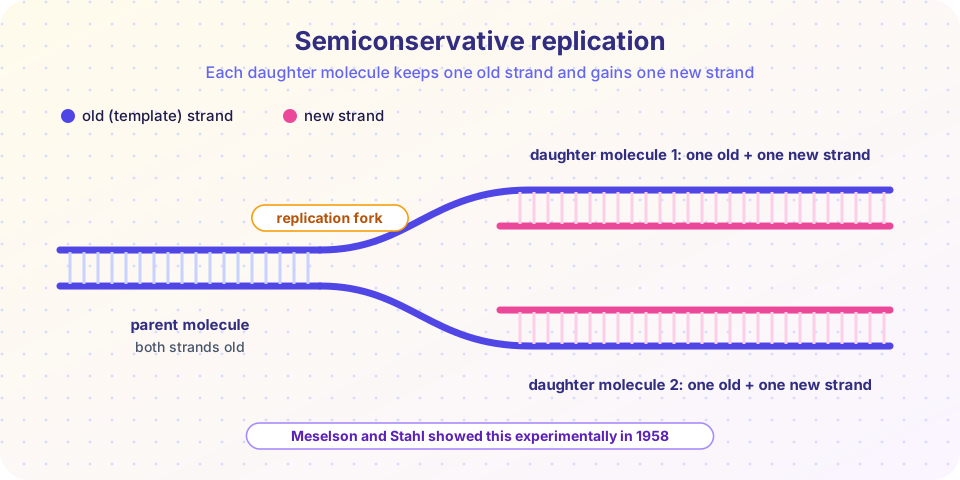
Semiconservative: each new DNA molecule keeps one old strand and one new strand.
Replication fork: the Y-shaped region where the parent DNA is being unwound and copied.
Origin of replication: a DNA sequence where copying begins.
Template: a strand that is read to make its complement.
The chapter at a glance
Copying DNA
Getting it right
Beyond copying
Replication and repair work as a team.
Lessons in this chapter
- The Replication Fork and Its Enzymes: helicase, primase, polymerase, ligase, leading and lagging strands.
- Origins and Telomeres: where copying starts and how chromosome ends are protected.
- DNA Damage and Repair: the main kinds of damage and the pathways that fix them.
- Chapter 3 Review: a summary picture and a quiz.
Why semiconservative
Chapter 1 showed that Meselson and Stahl grew E. coli in heavy nitrogen (¹⁵N) and then in light nitrogen (¹⁴N). We can predict what they would see under each model. If replication were conservative, after one generation they would find a band of fully heavy DNA and a band of fully light DNA. If it were semiconservative, every molecule would be a hybrid with one heavy strand and one light strand, giving a single intermediate band. After two generations the semiconservative model predicts half hybrid and half light. The observed result matched semiconservative copying exactly.
The elegance of the mechanism is that the template strand carries the information for its partner. Because A pairs with T and G with C, the old strand can be read to make a perfect complement.
The scale of the job
E. coli copies its 4.6 million base pairs from one origin, with two forks moving in opposite directions at up to about 1,000 nucleotides per second each. That finishes the job in roughly 40 minutes. Human forks move much more slowly, around 30 to 50 nucleotides per second, so a single origin would need years to copy a chromosome. Human cells instead fire tens of thousands of origins, so many forks work at once, and copying takes about 8 hours.
The accuracy problem
DNA polymerase does not pick the right nucleotide by chance. Correct base pairs fit the active site best, which already gives an error rate of roughly one in 10,000 to 100,000 bases. A built-in proofreading exonuclease removes mistakes the moment they happen, improving accuracy about 100-fold. Mismatch repair then scans the new strand and fixes remaining errors, another 100-fold or so. The overall error rate is on the order of one in a billion or more per base per replication. Multiply these stages and you see why layered quality control works better than a single perfect enzyme.
Common misconceptions
"Replication starts at one end and runs to the other." Replication starts at origins in the middle and proceeds in both directions. A human chromosome has many origins.
"Both new strands are made the same way." One strand (the leading strand) is made continuously; the other (the lagging strand) is made in short pieces. The next lesson explains why.
"DNA polymerase never makes mistakes." It does, but proofreading and repair catch most of them.
Try it
This simulation computes the fractions of heavy, hybrid and light DNA expected in each generation under the conservative and semiconservative models. It follows the logic of the Meselson-Stahl experiment and is a calculation, not a measurement.
Press Run (or Ctrl + Enter) to see the result here.
Program input · what you'd type while the program runs
Type the answers before you press Run, one per line. Each time the program reads a line (with input()), it gets the next line from this box.
Second, a timing calculator that estimates how long replication takes for a bacterium and for a human chromosome with different numbers of origins. All speeds are typical values and the real process is more variable.
Press Run (or Ctrl + Enter) to see the result here.
Program input · what you'd type while the program runs
Type the answers before you press Run, one per line. Each time the program reads a line (with input()), it gets the next line from this box.
Check your understanding
Quick check · 4 questions
of 4 answered You scored / 4 · perfect!
-
1. What does semiconservative replication mean?
In semiconservative replication, each daughter DNA keeps one original strand and gains one new strand. -
2. Why do human cells use many replication origins?
Human forks move at tens of nucleotides per second, so thousands of origins share the work. -
3. Which step improves accuracy by about 100-fold by removing a wrongly added base?
DNA polymerase has a 3' to 5' exonuclease activity that removes mispaired nucleotides. -
4. After two generations in light nitrogen, semiconservative replication predicts
Two of the four molecules still hold one heavy strand; the other two are fully light.
Summary
- Replication is semiconservative: one old and one new strand per daughter molecule, shown by Meselson and Stahl.
- Bacteria use one origin and fast forks; eukaryotes use thousands of origins and slower forks.
- Accuracy comes from three layers: nucleotide selection, proofreading and mismatch repair.
- The chapter covers the fork machinery, origins and telomeres, and repair pathways.
Track your progress
Create a free account to tick off lessons and pick up where you left off on any device.
of Molecular Biology lessons completed