


















Lesson 41 of 48 · Genomics and Applications
Genomics in Medicine and Biotechnology
Survey real uses of molecular biology: genetic testing, cancer genomics, pharmacogenomics, mRNA vaccines, gene therapy and crops, with the ethical questions each raises.
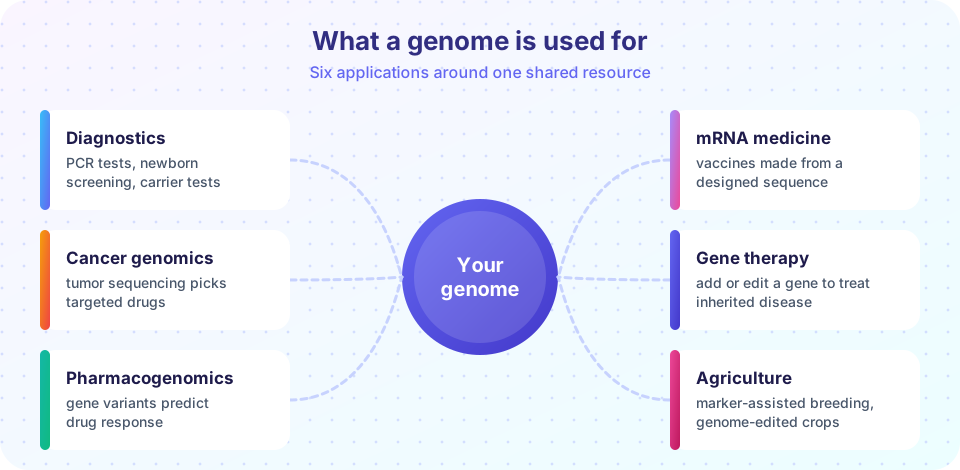
Everything you have learned so far (DNA, RNA, proteins, regulation, cloning, sequencing) now converts into tools for people. A genome read from a few drops of blood can explain a rare disease, guide a cancer treatment, predict how someone will respond to a drug or help a farmer grow a crop. A designed RNA sequence can become a vaccine within days. This lesson tours the main applications, explains the molecular idea behind each and sets out the ethical questions that come with such power.
This lesson is educational information about science. It is not medical advice, and nothing here replaces a conversation with a doctor or a genetic counselor.
What you will learn
- How genetic testing and screening work, and what they can and cannot say.
- How tumor sequencing guides targeted drugs, and how variants influence drug response.
- How mRNA vaccines and gene therapies use the central dogma.
- What the ethical questions about privacy, consent and fairness are.
Key terms
Targeted therapy: a drug designed to act on a specific molecular change, such as a mutant protein in a tumor.
Pharmacogenomics: the study of how genetic variants affect responses to drugs.
mRNA vaccine: a vaccine that delivers mRNA so that the recipient's cells make an antigen.
Gene therapy: treating disease by adding, replacing or editing genes.
AAV (adeno-associated virus): a small virus whose emptied shell is used as a vector for gene delivery.
Diagnostics and screening
- Infectious disease tests. PCR and qPCR detect tiny amounts of viral or bacterial DNA or RNA. COVID-19 tests used RT-qPCR, in which a fluorescent signal appears earlier (a lower Ct value) when more template is present.
- Newborn screening. A drop of blood from the heel is tested for conditions that are treatable if caught early, such as phenylketonuria (PKU), where a diet prevents harm if started in the first weeks of life.
- Carrier screening. Tests can find healthy carriers of recessive conditions such as cystic fibrosis, so couples can understand their reproductive risks.
- Prenatal testing. Fragments of fetal DNA circulate in the mother's blood; sequencing them (non-invasive prenatal testing) can screen for chromosome differences such as trisomy 21. These are screening tests, so a positive result is confirmed with a diagnostic test.
- Rare disease diagnosis. Exome or genome sequencing of a patient and parents often finds the causal variant in children with undiagnosed conditions, ending a long search.
Cancer genomics
Cancer is a disease of the genome: cells acquire mutations (usually after birth) in genes that control growth and repair. Sequencing a tumor reveals its driver mutations, and some are drug targets. The Philadelphia chromosome, a fusion of the BCR and ABL1 genes, creates a constantly active kinase in chronic myeloid leukemia; imatinib, a drug designed to block it, was approved in 2001 and turned a fatal disease into a manageable one for many patients. Lung cancers with activating EGFR mutations respond to EGFR inhibitors. Tumors with defective BRCA1 or BRCA2 are vulnerable to PARP inhibitors. Inherited variants matter too: people who inherit a harmful BRCA1 variant have a much higher lifetime risk of breast and ovarian cancer, which is why testing is offered to those with a strong family history. Blood tests that detect tumor DNA (liquid biopsies) are being used to track treatment.
Pharmacogenomics
Genetic variants change how people handle drugs.
- HLA-B*57:01 carriers can have a severe hypersensitivity reaction to the HIV drug abacavir; testing before treatment prevents it.
- CYP2C19 variants reduce activation of the antiplatelet drug clopidogrel in some people.
- TPMT variants change the dose of thiopurine drugs that can be tolerated.
- HLA-B*15:02 is linked to a severe skin reaction to carbamazepine in people of some Asian ancestries.
mRNA medicine
In a normal vaccine, you inject a weakened pathogen or an antigen protein. In an mRNA vaccine you inject the instructions: an mRNA, wrapped in lipid nanoparticles that fuse with cells, encoding an antigen such as the coronavirus spike protein. Ribosomes in the recipient's cells translate it, the immune system sees the antigen and the mRNA is degraded within days. The mRNA never enters the nucleus and does not change DNA. Two developments made it work. First, Katalin Karikó and Drew Weissman found that replacing uridine with modified nucleosides such as pseudouridine in the mRNA greatly reduces unwanted inflammatory reactions and increases protein production; they received the 2023 Nobel Prize in Physiology or Medicine. Second, lipid nanoparticles protect the RNA and deliver it. The first COVID-19 mRNA vaccines were authorized in December 2020, less than a year after the virus sequence was published. Because only the sequence changes, the same platform can be adapted quickly, and mRNA is being tested for cancer vaccines and protein replacement.
Gene therapy and editing
Gene therapy treats a disease by changing genes. In gene addition, a working copy of a gene is delivered, usually by an AAV vector. Voretigene (Luxturna, approved in the US in 2017) delivers a working RPE65 gene to the retina of people with an inherited form of blindness. Onasemnogene (Zolgensma, 2019) delivers SMN1 to infants with spinal muscular atrophy. Delivery to the right cells, immune responses and the size limit of AAV (about 4.7 kb of cargo) are challenges. In gene editing, CRISPR changes the patient's own DNA. Exa-cel (Casgevy), approved in late 2023, edits blood stem cells taken from the patient, who then receive their own edited cells back. We will follow this case in the last chapter.
Agriculture and the environment
Crops can be changed by conventional breeding using DNA markers to select traits, by adding genes (transgenic, or GM, crops) or by editing existing ones. Bt crops contain a gene for a bacterial protein from Bacillus thuringiensis that is toxic to certain insect pests, and reduce insecticide spraying. Golden Rice was engineered to make β-carotene, a precursor of vitamin A. Genome editing can produce changes, such as a disabled susceptibility gene, that are indistinguishable from natural mutations, and regulators in different countries treat such crops differently. Microbes engineered to make drugs, fuels and materials are another large area, from recombinant insulin to enzymes in detergents.
Ethics and society
- Privacy. A genome identifies you and your relatives. Who may see it? In the United States, the Genetic Information Nondiscrimination Act (2008) bars discrimination by health insurers and employers, but does not cover life or long-term care insurance.
- Consent and ownership. The cells of Henrietta Lacks, taken in 1951 without her knowledge, became the HeLa line that has driven decades of research. Her family's story changed the debate about consent and return of benefits.
- Fairness. Many therapies cost hundreds of thousands of dollars, and genomic data come mostly from people of European ancestry.
- What to test for? Predictive tests can reveal risks that cannot be treated. People have a right not to know as well as to know.
- Germline editing and enhancement. Treating disease in one person is different from heritable changes or enhancement.
Common misconceptions
"mRNA vaccines can change your DNA." The mRNA stays in the cytoplasm and is degraded; cells have no mechanism to copy it into the genome in this setting.
"A genetic test result is a diagnosis." Many results are risks or probabilities, and a variant of uncertain significance is not a verdict.
"Genetically modified means unsafe." Safety depends on the specific trait and product, and each case is evaluated on its own.
Try it
The first example calculates relative gene expression from qPCR Ct values with the ΔΔCt method. A lower Ct means more starting template. The Ct values are invented.
Press Run (or Ctrl + Enter) to see the result here.
Program input · what you'd type while the program runs
Type the answers before you press Run, one per line. Each time the program reads a line (with input()), it gets the next line from this box.
The second example uses Hardy-Weinberg to turn a disease incidence into a carrier frequency, for example for a recessive disease that affects 1 in 2,500 people.
Press Run (or Ctrl + Enter) to see the result here.
Program input · what you'd type while the program runs
Type the answers before you press Run, one per line. Each time the program reads a line (with input()), it gets the next line from this box.
The third example simulates thousands of couples who are both carriers of an autosomal recessive condition and counts the outcomes. Each child has a 1 in 4 chance of being affected; the simulation illustrates the probabilities and does not predict any single family.
Press Run (or Ctrl + Enter) to see the result here.
Program input · what you'd type while the program runs
Type the answers before you press Run, one per line. Each time the program reads a line (with input()), it gets the next line from this box.
Check your understanding
Quick check · 5 questions
of 5 answered You scored / 5 · perfect!
-
1. Why do mRNA vaccines not alter a person's DNA?
The mRNA is translated by ribosomes in the cytoplasm and does not enter the nucleus or integrate into the genome. -
2. Which drug class was developed against the BCR-ABL fusion kinase in chronic myeloid leukemia?
Imatinib blocks the BCR-ABL kinase and was approved in 2001. -
3. In qPCR, a lower Ct value means
The fluorescence crosses the threshold earlier when more template is present. -
4. Two parents are carriers of an autosomal recessive condition. The chance that a child is affected is
Each parent passes the recessive allele with probability 1/2, so the child inherits both with probability 1/4. -
5. What is the main role of the AAV in a gene therapy such as Luxturna?
An emptied AAV shell carries the therapeutic gene into target cells.
Summary
- Molecular tools underpin diagnostics, screening, cancer treatment, drug dosing, vaccines, gene therapy and agriculture.
- Tumor sequencing finds targetable drivers; pharmacogenomics links variants to drug response.
- mRNA vaccines deliver instructions that cells translate; gene therapy adds or edits genes.
- Hardy-Weinberg links disease incidence to carrier frequency.
- Privacy, consent and fairness are central ethical questions.
Next: Chapter 8 review
Track your progress
Create a free account to tick off lessons and pick up where you left off on any device.
of Molecular Biology lessons completed