


















Lesson 11 of 48 · The Molecules of Life
Chromatin and Chromosomes: Packing the Genome
See how two meters of DNA fit in a nucleus: nucleosomes, histones, chromatin fibers, loops, mitotic chromosomes, histone marks and bacterial nucleoids, with calculators.
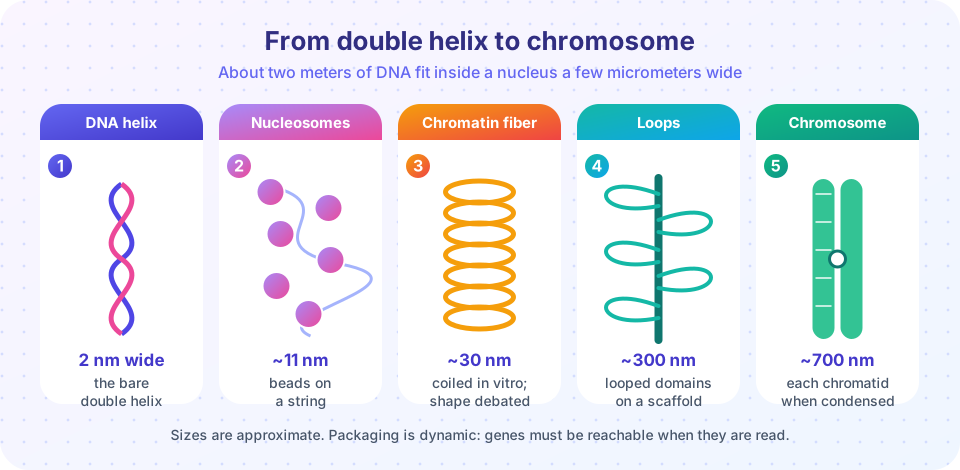
A single human cell contains about two meters of DNA packed into a nucleus a few micrometers wide. That is like fitting a 20-kilometer thread into a tennis ball. The solution is chromatin: DNA wrapped around proteins and folded again and again. Packaging is not only storage, though. How tightly a region is packed decides whether the cell can read its genes, so chromatin is also a layer of control.
This lesson follows the DNA from the bare helix to a condensed chromosome, describes the proteins that do the packing and introduces the chemical marks that signal which regions are open or closed.
What you will learn
- The structure of the nucleosome and the role of the four core histones.
- The successive levels of DNA compaction and their approximate dimensions.
- The difference between euchromatin and heterochromatin.
- How chemical marks on histones help control gene activity.
- How bacteria package DNA without histones.
Key terms
Histone: a small, positively charged protein around which DNA wraps.
Nucleosome: 147 base pairs of DNA wrapped around a histone octamer.
Euchromatin / heterochromatin: loosely packed, gene-rich chromatin versus tightly packed, mostly silent chromatin.
Centromere: the region of a chromosome where spindle fibers attach.
Chromatid: one of the two identical copies of a replicated chromosome.
The nucleosome: the first level
The basic unit of chromatin is the nucleosome. At its heart is a histone octamer: two copies each of the core histones H2A, H2B, H3 and H4. About 147 base pairs of DNA wrap around the octamer in roughly 1.65 left-handed turns. Histones are rich in lysine and arginine, so they carry a strong positive charge that balances the negative charge of the DNA's phosphates, which is why the DNA can bend so sharply.
Between nucleosomes lies linker DNA, so the whole repeat, in many human cells, is about 200 base pairs, though the length varies by species and tissue. Under the electron microscope, this arrangement looks like beads on a string, a fiber about 11 nm wide. A fifth histone, the linker histone H1, binds where the DNA enters and leaves the nucleosome and helps bring nucleosomes closer together.
The human haploid genome has about 3.1 billion base pairs, so with a 200-bp repeat there are about 15 million nucleosomes per haploid set, or about 30 million in a typical diploid cell.
Higher levels of folding
Nucleosome arrays can coil into thicker fibers. A regular 30 nm fiber forms readily from purified chromatin in the test tube, but whether it is common in living nuclei is debated; many studies find more irregular and dynamic arrangements. Beyond that, the fiber is organized into loops, anchored by proteins such as the ring-shaped complexes cohesin and condensin, and these loops fold into larger domains. When a cell prepares to divide, condensin helps compact each replicated chromosome into the familiar mitotic X shape, in which two sister chromatids are joined at the centromere.
The overall compaction is large. Human chromosome 1 holds about 248 million base pairs, which would stretch to about 84 mm as bare DNA at 0.34 nm per base pair. A condensed mitotic chromosome 1 is on the order of 10 micrometers long, so the packing ratio is roughly several thousand to ten thousand fold.
Open and closed chromatin
Not every region is equally packed. Euchromatin is relatively open and rich in genes that are active or can be activated. Heterochromatin is more compact and mostly silent, and is found around centromeres and telomeres and on regions with repetitive DNA. A cell can convert one into the other, which is one way a stem cell becomes a specialized cell.
Histone marks
Each histone has a flexible tail that sticks out of the nucleosome. Enzymes decorate these tails with small chemical groups. Acetylation of lysine (by histone acetyltransferases, removed by deacetylases) neutralizes the lysine's positive charge, loosens the grip on DNA and is generally linked with active genes. Methylation has varying effects depending on the site: H3 lysine 4 trimethylation (H3K4me3) marks active promoters, whereas H3 lysine 9 and lysine 27 trimethylation (H3K9me3, H3K27me3) are associated with repressed regions. Because these marks can be written, erased and read by other proteins, they are the basis of the "histone code" idea, in which patterns of marks guide gene activity. The precise logic is still being worked out and is more complex than a simple code. Chapter 6 returns to this.
Packaging in bacteria and archaea
Bacteria have no histones like ours. Their circular chromosome is compacted into the nucleoid by supercoiling (twisting the double helix on itself, controlled by enzymes such as gyrase), by loops and by small nucleoid-associated proteins such as HU and H-NS. Many archaea do have histone-like proteins that form nucleosome-like particles, another sign that their machinery is closer to ours than that of bacteria.
Common misconceptions
"DNA is wrapped around the histones only for storage." Packaging also controls access to genes; open regions are read, closed ones largely are not.
"The 30 nm fiber is the established form of chromatin in cells." It forms in the test tube; its prevalence in living cells is debated.
"Heterochromatin is junk." It has roles in protecting chromosome ends, holding centromeres together and silencing repeats.
Try it
How many nucleosomes are there, and how much DNA does each wrap? This calculator uses 147 base pairs per core and different repeat lengths, and shows what fraction of the genome is wrapped. The numbers are rounded.
Press Run (or Ctrl + Enter) to see the result here.
Program input · what you'd type while the program runs
Type the answers before you press Run, one per line. Each time the program reads a line (with input()), it gets the next line from this box.
Second, an interactive picture of how acetylation loosens DNA. Click the lysine tail to add or remove an acetyl group and watch the DNA grip change. It is a simplified model of a single nucleosome.
Check your understanding
Quick check · 5 questions
of 5 answered You scored / 5 · perfect!
-
1. How many base pairs of DNA wrap around a nucleosome core?
A nucleosome core has about 147 bp of DNA wrapped in roughly 1.65 turns around the histone octamer. -
2. Which histones make up the core octamer?
The octamer contains two copies each of H2A, H2B, H3 and H4; H1 is the linker histone. -
3. What does histone acetylation usually do?
Acetylation neutralizes lysine's positive charge, weakening its grip on DNA. -
4. Where is heterochromatin typically found?
Heterochromatin is compact and mostly silent, concentrated at centromeres, telomeres and repeats. -
5. How do bacteria compact their DNA without histones like ours?
Supercoiling by gyrase plus proteins such as HU and H-NS compact the nucleoid.
Summary
- Chromatin is DNA packaged with proteins; the unit is the nucleosome with 147 bp of DNA around a histone octamer.
- Higher levels (fibers, loops, mitotic chromosomes) compact DNA thousands of fold, though details of the 30 nm fiber are debated.
- Euchromatin is open and gene-rich; heterochromatin is compact and mostly silent.
- Histone tail marks such as acetylation and methylation help control gene activity.
- Bacteria compact DNA by supercoiling and nucleoid-associated proteins.
Next: Chapter 2 Review
Track your progress
Create a free account to tick off lessons and pick up where you left off on any device.
of Molecular Biology lessons completed