


















Lesson 39 of 48 · Genomics and Applications
DNA Sequencing: Sanger, Short Reads, Long Reads and Assembly
Learn how Sanger, Illumina and nanopore sequencing work, what coverage and Phred quality scores mean, and how reads are assembled or mapped to a reference.
To read a genome you cannot start at one end and read to the other. Every sequencing machine reads short pieces of DNA, from tens to hundreds of thousands of bases, and the pieces are put back together by computer. The craft lies in three things: how each piece is read (chemistry), how many pieces you read (coverage) and how well you trust each base (quality). This lesson gives you all three, plus the two ways of reassembling the result: assembly from scratch and mapping to a reference.
What you will learn
- How Sanger, short-read and long-read sequencing work, and when to use each.
- What coverage means and how it relates to missing parts of a genome.
- How to read a Phred quality score and a FASTQ record.
- The difference between de novo assembly and read mapping.
Key terms
Read: the sequence of bases obtained from one DNA fragment.
Coverage (depth): the average number of reads overlapping each base, written like 30×.
Phred quality score (Q): a number that encodes the chance of a wrong base call, Q = −10 log₁₀ P(error).
Contig: a continuous stretch of sequence assembled from overlapping reads.
FASTQ: a text format that stores reads and their quality scores.
Sanger sequencing
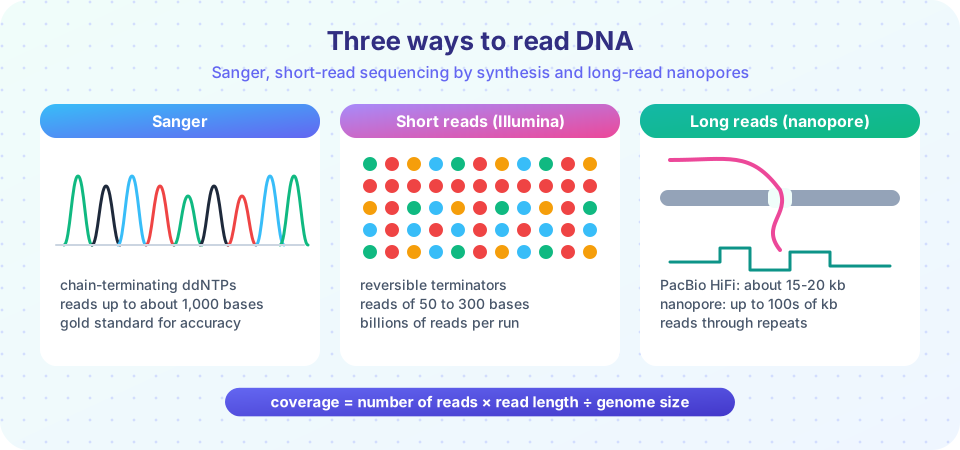
In 1977 Frederick Sanger and colleagues introduced the chain-termination method, which earned him a second Nobel Prize in Chemistry (1980, shared with Walter Gilbert and Paul Berg). A DNA polymerase copies the template in the presence of the normal nucleotides and a small amount of dideoxynucleotides (ddNTPs). A ddNTP lacks the 3′ hydroxyl group, so when it is added the chain cannot be extended. The reaction therefore produces a family of fragments, each ending at a different position, with the last base labeled by one of four fluorescent dyes. Capillary electrophoresis separates the fragments by size, and a detector reads the colors in order: this is the chromatogram of four colored peaks. Sanger reads are up to about 1,000 bases with very high accuracy, which is why the method is still used to confirm clones, PCR products and single variants. The Human Genome Project was done with it, but only at the cost of years and billions of dollars, because each reaction reads only one fragment.
Short-read sequencing
Sequencing by synthesis (Illumina) made DNA sequencing massively parallel. The sample is fragmented, short adapter sequences are attached to the ends, and the fragments are bound to a glass flow cell, where they are amplified in place into clusters of identical copies (bridge amplification). Then in every cycle all clusters incorporate one fluorescent reversible terminator nucleotide; a camera records the color at every cluster, and a chemical step removes the dye and the block so the next cycle can begin. After 100 to 300 cycles each cluster has yielded a read, and one run gives billions of reads at once. Reads are often sequenced from both ends of a fragment (paired-end), which helps place them. Accuracy per base is high (typically above 99.9 percent), but the short length makes repeats hard to resolve.
Long-read sequencing
Two technologies read single DNA molecules much longer than 1 kb.
- PacBio SMRT sequencing watches a polymerase copy a template in a tiny well and records fluorescent flashes. Circular consensus (HiFi) reads of about 15 to 20 kb are read several times to reach accuracy above 99.9 percent.
- Oxford Nanopore pulls a DNA strand through a protein pore in a membrane while a voltage is applied. Each short stretch of bases (a k-mer) in the pore blocks the ionic current in a characteristic way, so the current trace is converted to bases by a neural network. Reads can reach hundreds of kilobases and, in records, megabases, and the device can detect modified bases such as methylcytosine directly.
Long reads span repeats, resolve structural variants and made the first complete human genome possible. Their per-read error rates are higher than for short reads, though improving.
Coverage and the Poisson rule
If you sequence reads of length L, N of them, from a genome of size G, the average coverage is C = N × L / G. Reads land at random, so the number of reads covering a given base follows approximately a Poisson distribution with mean C (Lander and Waterman, 1988). The fraction of the genome with no coverage is therefore about e^(−C). At 1× coverage 37 percent of the genome is missed, at 5× about 0.7 percent, and at 30× practically none, around 10⁻¹³. Whole-genome sequencing of humans normally uses about 30×, because variants need several reads to be called with confidence, and because errors must be distinguished from real differences. Targeted panels may use hundreds of times coverage on a small region.
Quality scores and FASTQ
A base call may be wrong. Each base gets a Phred score Q = −10 log10(P), where P is the probability of error: Q10 means a 10 percent chance of error, Q20 means 1 percent, Q30 means 0.1 percent (99.9 percent accuracy). A FASTQ record has four lines: an identifier starting with @, the sequence, a + line and a string of characters that encode the quality of each base as the ASCII code minus 33. For example I (code 73) stands for Q40 and 5 (code 53) for Q20. Reads are trimmed or filtered at low-quality ends before analysis.
Putting reads back together
There are two strategies.
- Mapping (alignment) to a reference. If a good reference exists, as for humans, each read is aligned to its best-matching position with tools like BWA or minimap2. Differences from the reference are then called as variants. This is fast and is the standard for resequencing.
- De novo assembly. For a new species, there is no reference. Algorithms find overlaps between reads and merge them into contigs: older assemblers used an overlap-layout-consensus approach, and short-read assemblers split the reads into k-mers and walk a de Bruijn graph. Repeats longer than the reads create ambiguity, because the algorithm cannot tell which copy a read came from, so assemblies are fragmented. Long reads, optical mapping and Hi-C contact data help place contigs on chromosomes.
Common misconceptions
"30× coverage means every base is read exactly 30 times." It is an average; some bases are covered more, some less, in a roughly Poisson pattern (and with extra variation for GC-rich or repetitive regions).
"Higher Q means more reads." Q is the confidence of one base call, not the number of reads.
"Sanger is obsolete." It is slower per base but still the reference method for short, high-confidence confirmation.
Try it
The first example plots the fraction of a genome that has no coverage and the fraction covered at least 10 times as the average coverage increases, using the Poisson model.
Press Run (or Ctrl + Enter) to see the result here.
Program input · what you'd type while the program runs
Type the answers before you press Run, one per line. Each time the program reads a line (with input()), it gets the next line from this box.
The second example decodes a small FASTQ record: it converts quality characters to Phred scores and error probabilities and reports the expected number of errors in the read. The read is invented.
Press Run (or Ctrl + Enter) to see the result here.
Program input · what you'd type while the program runs
Type the answers before you press Run, one per line. Each time the program reads a line (with input()), it gets the next line from this box.
The third example is a toy greedy assembler. It cuts an invented genome into overlapping reads, then repeatedly merges the pair of reads with the longest overlap. It is a teaching sketch: real assemblers use graphs and handle errors and repeats.
Press Run (or Ctrl + Enter) to see the result here.
Program input · what you'd type while the program runs
Type the answers before you press Run, one per line. Each time the program reads a line (with input()), it gets the next line from this box.
Check your understanding
Quick check · 5 questions
of 5 answered You scored / 5 · perfect!
-
1. In Sanger sequencing, what stops chain extension?
A ddNTP has no 3′-OH, so no further nucleotide can be added. -
2. Which technology reads single molecules of tens to hundreds of kilobases?
Long-read platforms read very long single DNA molecules. -
3. A genome is sequenced to 5× average coverage. Roughly what fraction has no reads?
e^−5 is about 0.0067, which is 0.7 percent. -
4. A base has Phred score Q30. The chance that the call is wrong is
Q = −10 log10 P, so Q30 gives P = 10^−3. -
5. Why are repeats a problem for short-read assembly?
If a repeat is longer than the reads, the assembler cannot tell which copy a read came from.
Summary
- Sanger sequencing uses chain terminators and reads up to about 1 kb with high accuracy.
- Short-read sequencing by synthesis reads billions of short fragments in parallel; long-read platforms read single molecules of tens to hundreds of kilobases.
- Coverage C = N × L / G; the uncovered fraction is about e^−C.
- Phred scores give the error probability; FASTQ stores reads with qualities.
- Reads are mapped to a reference or assembled de novo; long reads help with repeats.
Next: Expression and variants
Track your progress
Create a free account to tick off lessons and pick up where you left off on any device.
of Molecular Biology lessons completed