


















Lesson 23 of 48 · Translation and Protein Folding
Chapter 5 Overview: From mRNA to Protein
A map of how ribosomes read the genetic code, build proteins and fold them into working shapes, with the questions this chapter will answer.
You have seen how a gene is copied into messenger RNA. Now the message must be used. Translation is the step where a ribosome reads the mRNA three bases at a time and links amino acids into a chain. That chain is only the beginning: it has to fold into a precise three-dimensional shape before it can do anything useful. This chapter follows the whole journey, from the genetic code to the folded protein.
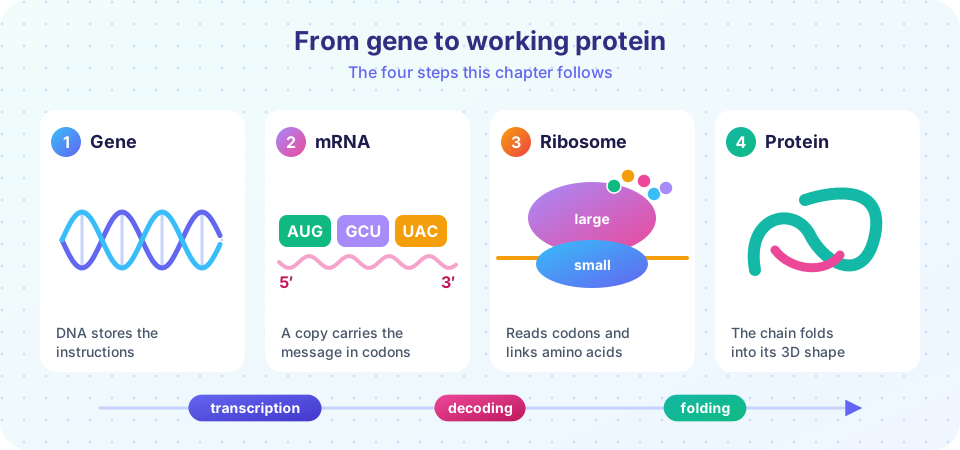
What you will learn
- Why a cell needs a "dictionary" (the genetic code) and what it looks like.
- How a ribosome, transfer RNAs and a handful of protein factors cooperate to build a chain.
- Why newly made chains need help (chaperones) to reach their working shape.
- How a single changed base can change, or not change, a protein.
- How long and how expensive translation is for a living cell.
Key terms
Translation: the synthesis of a polypeptide using the sequence of an mRNA as the template.
Codon: three consecutive bases of mRNA that specify one amino acid or a stop signal.
Ribosome: a large complex of ribosomal RNA (rRNA) and proteins that carries out translation.
tRNA: a small adapter RNA that carries one amino acid and recognizes a codon through its anticodon.
Native state: the folded, functional three-dimensional shape of a protein.
The big picture
Every cell makes thousands of different proteins, and almost everything a cell does depends on them. Enzymes speed up reactions, channels move ions, antibodies recognize invaders and structural proteins give cells their shape. DNA never leaves the safety of the nucleus (in eukaryotes), so the cell makes a working copy of each gene as mRNA and sends it to ribosomes. That is the flow of information that Francis Crick summarized in 1958 as the central dogma: information passes from nucleic acid to protein, not back from protein to nucleic acid.
Here is the chapter in five questions.
Chapter 5 in five steps
The adapters
The finish
Why it matters
Shape is function.
What each lesson covers
- The genetic code explains codons, degeneracy, start and stop signals, reading frames and the four kinds of point mutation.
- The ribosome and the elongation cycle opens up the machine: tRNA charging, initiation, the A, P and E sites, translocation, termination and the energy bill.
- Protein folding and chaperones shows how a chain finds its shape, what chaperones do and what happens when folding fails.
- Chapter 5 review pulls it together with a recap table and a longer quiz.
Common misconceptions
"The start codon is the first base of the mRNA." Almost never. Messenger RNAs carry an untranslated leader (the 5′ UTR) before the AUG that starts the reading frame.
"Translation and transcription happen in different places in every cell." In bacteria there is no nucleus, so ribosomes can begin translating an mRNA while it is still being transcribed.
"A protein is finished when the ribosome releases it." Most chains still need to fold, and many need cutting, trimming or chemical decoration before they work.
Try it
The first demonstration shows how the size of a gene sets the length of the mRNA message and the time a ribosome needs. The time rates are rounded textbook figures: a ribosome in a fast-growing bacterium adds roughly 15 to 20 amino acids per second, while in a eukaryotic cell the rate is slower, a few amino acids per second.
Press Run (or Ctrl + Enter) to see the result here.
Program input · what you'd type while the program runs
Type the answers before you press Run, one per line. Each time the program reads a line (with input()), it gets the next line from this box.
The second demonstration is a small calculator that turns a protein length into a message length and an energy cost. It is an illustration that applies the textbook figure of about four high-energy phosphate bonds per peptide bond.
Check your understanding
Quick check · 4 questions
of 4 answered You scored / 4 · perfect!
-
1. Which molecule physically reads the codons of an mRNA?
The ribosome holds the mRNA while charged tRNAs pair their anticodons with the codons. -
2. A coding sequence has 99 codons followed by a stop codon. How many nucleotides is that?
100 codons times 3 bases each is 300 nucleotides, counting the stop codon. -
3. Why does a freshly made chain often need chaperones?
Chaperones shield exposed hydrophobic regions and give chains a protected place to fold. -
4. Which statement about the 5′ UTR is correct?
The 5′ untranslated region sits upstream of the AUG that begins the reading frame.
Summary
- Translation converts the base sequence of an mRNA into the amino acid sequence of a polypeptide.
- The ribosome, tRNAs and protein factors do the work; the genetic code is the dictionary.
- A chain is not a protein until it folds, and folding often needs help.
- A coding sequence with n codons plus a stop codon has 3(n + 1) nucleotides.
Next: The genetic code
Track your progress
Create a free account to tick off lessons and pick up where you left off on any device.
of Molecular Biology lessons completed