


















Lesson 20 of 48 · Transcription
Eukaryotic Transcription: Three Polymerases and General Factors
Learn how eukaryotic cells use RNA polymerases I, II and III, the TATA box, general transcription factors, Mediator and enhancers to transcribe genes inside chromatin.
Bacteria use one RNA polymerase and a few sigma factors. Eukaryotic cells need a much richer system. Their genomes are larger, their genes are controlled by distant sequences, the DNA is packaged in chromatin and the RNA must be processed before use. The result is a machine with three RNA polymerases, dozens of general transcription factors and a layer of regulators acting from afar.
This lesson explains how RNA polymerase II, which makes mRNA, is recruited to a promoter, how it begins and how it is controlled, and what the other two polymerases do.
What you will learn
- The products of RNA polymerases I, II and III.
- The core promoter elements of a Pol II gene, including the TATA box.
- How general transcription factors assemble the preinitiation complex.
- What enhancers, Mediator and the CTD of Pol II do.
Key terms
General transcription factor (GTF): a protein needed at every Pol II promoter (TFIID, TFIIB and so on).
TBP: the TATA-binding protein, part of TFIID, which bends the DNA at the promoter.
Preinitiation complex (PIC): Pol II plus GTFs assembled at the promoter.
Enhancer: a regulatory DNA element that can act at a distance, in either orientation.
CTD: the C-terminal domain of the largest Pol II subunit, a repeated tail that is modified during transcription.
Three polymerases for three jobs
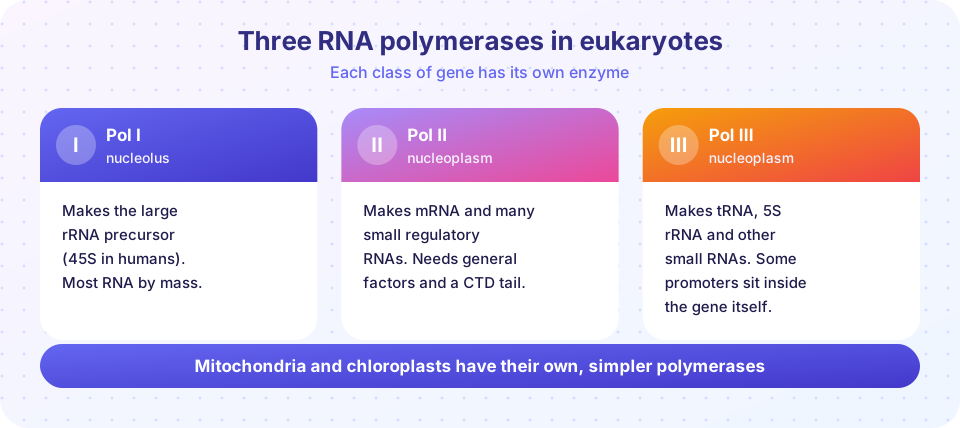
Eukaryotic nuclei have three main RNA polymerases:
| Polymerase | Main products | Location |
|---|---|---|
| RNA polymerase I | Large ribosomal RNA precursor (45S pre-rRNA in humans) | Nucleolus |
| RNA polymerase II | mRNA, many small nuclear RNAs, microRNAs | Nucleoplasm |
| RNA polymerase III | tRNA, 5S rRNA, other small RNAs | Nucleoplasm |
Pol I products make up most of the RNA by mass in a growing cell because ribosomes are so abundant. Pol II is the most studied because it makes the RNA for protein-coding genes. Mitochondria and chloroplasts also have their own simpler polymerases.
The Pol II core promoter
Core promoter elements surround the start site (+1). Not every gene has all of them.
- The TATA box, consensus TATAAA (often written TATAAAA), lies about 25 to 30 base pairs upstream of +1 in many genes. It is found in a minority of human promoters, though.
- The initiator (Inr) overlaps +1 and has a loose consensus around a pyrimidine, an A at +1 and another pyrimidine.
- The BRE (TFIIB recognition element) flanks the TATA box, and the DPE (downstream promoter element) lies about 30 base pairs downstream.
Many vertebrate genes have no TATA box but start within CpG-rich regions called CpG islands, which are often unmethylated and associated with broadly expressed genes.
Assembling the preinitiation complex
Pol II cannot bind the promoter alone. General transcription factors, named TFII plus a letter, assemble on the DNA in a rough order:
- TFIID, containing TBP and TBP-associated factors (TAFs), binds the TATA box or other promoter elements. TBP bends the DNA sharply.
- TFIIA and TFIIB stabilize TFIID's binding and help position the polymerase; TFIIB sets the start site.
- Pol II with TFIIF joins the complex.
- TFIIE and TFIIH complete the assembly. TFIIH has two key activities: a helicase that unwinds DNA at the start site, using ATP, and a kinase that phosphorylates the CTD of Pol II.
Opening of the DNA creates the transcription bubble, and the polymerase starts to make RNA. After about 20 to 30 nucleotides, many Pol II enzymes pause just downstream of the promoter, waiting for a signal to proceed. This promoter-proximal pausing is a regulated checkpoint in many human genes.
The CTD: a coordination tail
The largest subunit of Pol II ends in a long, flexible tail, the C-terminal domain (CTD), made of repeats of the seven-amino-acid motif Tyr-Ser-Pro-Thr-Ser-Pro-Ser (YSPTSPS). Human Pol II has 52 repeats. The serines in the repeats are phosphorylated in a pattern that changes during the transcription cycle. Early phosphorylation helps recruit capping enzymes; later phosphorylation recruits splicing and polyadenylation factors. In this way the CTD acts as a landing pad that couples transcription with RNA processing.
Enhancers and Mediator
The core promoter sets the baseline. Strong, regulated expression depends on enhancers, short DNA elements bound by sequence-specific transcription factors (activators). Enhancers can be thousands or even hundreds of thousands of base pairs away from the gene and can work in either orientation. They act by looping to the promoter and recruiting co-activators.
A large protein complex called Mediator bridges activators bound at enhancers and Pol II at the promoter. Co-activators also include histone acetyltransferases, which loosen chromatin, and chromatin remodelers that slide or remove nucleosomes. All of this takes place in a nucleus where DNA is packaged into chromatin, so opening chromatin is part of starting a gene. Chapter 6 covers regulation in more detail.
Termination in brief
Pol II does not stop at a short, specific terminator. Instead, when it transcribes past the poly-A signal (AAUAAA), the new RNA is cut by a protein complex. A 5′ to 3′ exonuclease called Xrn2 then chases the polymerase along the remaining RNA and helps dislodge it (the "torpedo" model). The next lesson describes the cut and poly-A tail.
Common misconceptions
"All eukaryotic promoters have a TATA box." Only a minority do; many use other elements, especially CpG island promoters.
"Enhancers must be near the gene." They can be very far away and still control a gene by DNA looping.
"Transcription factors and general transcription factors are the same." GTFs are needed at all Pol II promoters; sequence-specific transcription factors regulate particular genes.
Try it
A TATA box and Inr scanner. It searches a sequence for the TATA box (TATAAA-type, allowing one mismatch) and reports its position relative to a given start site. It is a simple pattern finder, not a full promoter predictor.
Press Run (or Ctrl + Enter) to see the result here.
Program input · what you'd type while the program runs
Type the answers before you press Run, one per line. Each time the program reads a line (with input()), it gets the next line from this box.
Second, a polymerase chooser: pick the type of gene you want to transcribe and the widget tells you which polymerase does it, where, and which promoter features it needs.
Check your understanding
Quick check · 5 questions
of 5 answered You scored / 5 · perfect!
-
1. Which polymerase transcribes protein-coding genes in eukaryotes?
Pol II makes mRNA and many small regulatory RNAs. -
2. What does TBP do?
The TATA-binding protein, part of TFIID, binds and sharply bends promoter DNA. -
3. Which GTF has both helicase and kinase activities?
TFIIH unwinds DNA at the start site and phosphorylates the CTD. -
4. What is an enhancer?
Enhancers bind activators and loop to the promoter, working at a distance and in either orientation. -
5. Which polymerase makes the large rRNA precursor in the nucleolus?
Pol I transcribes the rRNA genes in the nucleolus.
Summary
- Eukaryotes have three nuclear RNA polymerases: Pol I (large rRNA), Pol II (mRNA and others) and Pol III (tRNA, 5S rRNA).
- A Pol II core promoter may include a TATA box, Inr, BRE and DPE; many genes use CpG islands instead of a TATA box.
- General transcription factors (TFIID with TBP, TFIIB, TFIIF, TFIIE, TFIIH) assemble Pol II into the preinitiation complex.
- The CTD of Pol II coordinates RNA processing; enhancers and Mediator link distant regulators to the promoter.
- Termination involves cutting at the poly-A signal and a torpedo exonuclease.
Track your progress
Create a free account to tick off lessons and pick up where you left off on any device.
of Molecular Biology lessons completed