


















Lesson 16 of 48 · DNA Replication and Repair
DNA Damage and Repair: Keeping the Genome Intact
Learn the main kinds of DNA damage and how cells repair them: base excision, nucleotide excision, mismatch repair, and double-strand break repair by NHEJ and homologous recombination.
DNA is a chemical, and chemicals react. Water breaks bonds in the DNA backbone and bases, oxygen radicals from normal metabolism oxidize bases, ultraviolet (UV) light fuses neighboring bases, and replication leaves occasional mismatches. A single human cell suffers thousands of damage events every day. Yet the genome stays stable for decades, because repair systems recognize damage and fix it.
This lesson sorts damage into types and matches each with its repair pathway. The pathways are specialized: one pathway is good at single wrong bases, another at bulky distortions and another at broken chromosomes. Understanding them helps explain inherited cancer risks and how some cancer drugs work.
What you will learn
- Common sources and types of DNA damage.
- How base excision, nucleotide excision and mismatch repair work step by step.
- How cells repair double-strand breaks by NHEJ and homologous recombination.
- How defects in repair genes lead to disease.
Key terms
Lesion: a site of damage in DNA.
Glycosylase: an enzyme that removes a damaged base by cutting its bond to the sugar.
Pyrimidine dimer: two adjacent pyrimidine bases fused by UV light.
NHEJ: non-homologous end joining, a fast but error-prone fix for double-strand breaks.
HR: homologous recombination, an accurate repair that copies from a matching sequence.
Where damage comes from
Damage arises from outside and inside the cell. Hydrolysis removes bases (depurination leaves an abasic site) or converts cytosine to uracil (deamination). Oxidation by reactive oxygen species creates lesions such as 8-oxoguanine, which mispairs with adenine. Alkylation adds methyl or larger groups to bases. UV light causes cyclobutane pyrimidine dimers and (6-4) photoproducts between adjacent thymines or cytosines. Ionizing radiation and some chemicals break the backbone, sometimes cutting both strands. And replication errors leave mismatched base pairs.
Unrepaired lesions cause mutations when the cell copies the DNA or block replication and transcription outright. That is why repair matters for cancer and aging.
Base excision repair (BER)
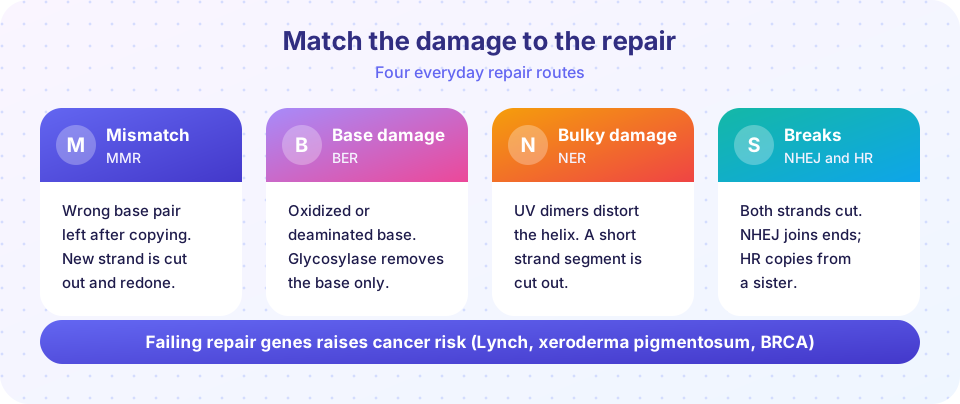
BER fixes small, non-distorting changes to a single base. A DNA glycosylase recognizes the damaged base (for example uracil in DNA or 8-oxoguanine), flips it out of the helix and cuts it off, leaving an abasic site. An endonuclease (APE1) cuts the backbone at that site, a polymerase (Pol β in humans) inserts the correct nucleotide, and ligase seals the nick. Different glycosylases are specific to different lesions.
Cytosine deamination shows why DNA uses thymine rather than uracil: when C turns into U, the cell recognizes uracil as an error because uracil does not belong in DNA, and removes it. If DNA used uracil normally, the cell could not tell a deaminated cytosine from a real U.
Nucleotide excision repair (NER)
NER handles bulky lesions that distort the helix, such as UV dimers and chemical adducts. Proteins recognize the distortion, a helicase (part of TFIIH) opens the DNA around the lesion, and two endonucleases cut on either side, removing a short stretch of about 24 to 32 nucleotides in humans. A polymerase fills the gap using the other strand as template, and ligase seals it. NER comes in two flavors: global genome repair scans the whole genome, and transcription-coupled repair is triggered when RNA polymerase stalls at a lesion.
Inherited defects show how important NER is. People with xeroderma pigmentosum have defective NER and are extremely sensitive to sunlight, with a very high risk of skin cancer. Defects in transcription-coupled repair cause Cockayne syndrome. Bacteria and many other organisms also have photolyase, which uses visible light to reverse UV dimers directly; placental mammals lack it.
Mismatch repair (MMR)
MMR fixes mismatches and small loops left after replication. In E. coli, MutS recognizes the mismatch, MutL recruits MutH, which cuts the new strand, identified because it is not yet methylated at GATC sequences (the parent strand is). The new-strand segment is removed and resynthesized. In humans, MSH2 and MLH1 families do the job. The cell needs to know which strand is new, or it might "correct" the right base into the wrong one. Defects in MMR genes cause Lynch syndrome, an inherited predisposition to colon and other cancers.
Double-strand break repair
A double-strand break (DSB) cuts the chromosome in two and is the most dangerous kind of damage. There are two main routes.
Non-homologous end joining (NHEJ) is quick. The Ku70/Ku80 proteins bind the broken ends, recruit DNA-PK and other factors, trim or fill the ends if needed and ligase IV joins them. It works throughout the cell cycle but can delete or add a few bases at the junction, so it is error-prone.
Homologous recombination (HR) is accurate but needs a matching template, usually the sister chromatid, so it works mostly in S and G2 phases. The ends are resected to expose single-stranded 3′ tails; RAD51 coats them and searches for the matching sequence; the broken end invades the template and DNA is synthesized from it. BRCA1 and BRCA2 are essential for this process, and mutations in them raise the risk of breast and ovarian cancer.
The 2015 Nobel Prize in Chemistry recognized Tomas Lindahl (BER), Paul Modrich (MMR) and Aziz Sancar (NER) for mapping these pathways.
Common misconceptions
"Repair always restores the original sequence." NHEJ often changes the sequence slightly, and repair can introduce mutations if it fails.
"Sunlight only damages skin cells' surface." UV directly damages DNA in the living cells of the skin's deeper layers; repair is the main defense.
"A repair defect makes cancer certain." It raises risk substantially but does not make it inevitable; other mutations are needed too.
Try it
First, a UV-damage hot spot finder. Adjacent pyrimidines (T or C) can form dimers under UV light. This program lists all neighboring pyrimidine pairs in a sequence, highlighting TT as the most common site. It identifies possible sites only, not actual damage.
Press Run (or Ctrl + Enter) to see the result here.
Program input · what you'd type while the program runs
Type the answers before you press Run, one per line. Each time the program reads a line (with input()), it gets the next line from this box.
Second, a pathway selector. Pick a type of damage and see the matching repair route and its key proteins. It summarizes the lesson as a lookup table.
Check your understanding
Quick check · 5 questions
of 5 answered You scored / 5 · perfect!
-
1. Which pathway removes a bulky UV-induced thymine dimer?
NER recognizes helix-distorting lesions and removes a short segment containing them. -
2. Why does DNA contain thymine rather than uracil?
Because DNA normally has no uracil, any uracil is flagged as damage and removed by a glycosylase. -
3. Which repair route needs a homologous template such as the sister chromatid?
Homologous recombination copies sequence information from a matching DNA molecule. -
4. Inherited defects in mismatch repair genes are linked to
MSH2, MLH1 and related genes are mutated in Lynch syndrome, which predisposes to colon and other cancers. -
5. What does NHEJ do?
NHEJ ligates the ends quickly without a template, so small insertions or deletions can occur.
Summary
- DNA is damaged by hydrolysis, oxidation, alkylation, UV light, radiation and replication errors.
- BER fixes single damaged bases, NER removes bulky lesions, and MMR corrects replication mismatches using strand discrimination.
- Double-strand breaks are fixed by error-prone NHEJ or accurate homologous recombination (needs BRCA1 and BRCA2).
- Defects in these pathways cause inherited diseases such as xeroderma pigmentosum and Lynch syndrome.
Next: Chapter 3 Review
Track your progress
Create a free account to tick off lessons and pick up where you left off on any device.
of Molecular Biology lessons completed