


















Lesson 22 of 48 · Transcription
Chapter 4 Review: Transcription
Review bacterial and eukaryotic transcription, promoters, polymerases, termination and RNA processing with a summary picture, comparison table, a pipeline program and a quiz.
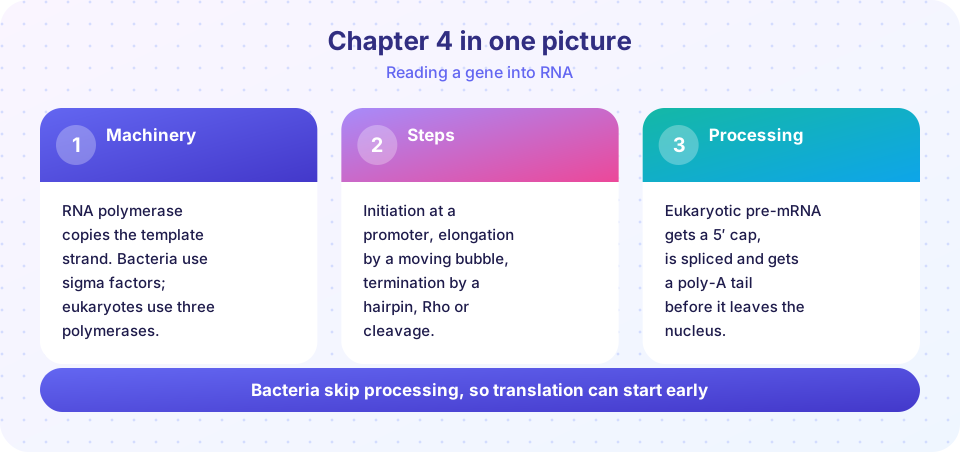
Chapter 4 followed information from DNA into RNA. You saw that RNA polymerase reads a template strand and builds RNA 5′ to 3′ without a primer, that bacteria recognize promoters with sigma factors while eukaryotes assemble general transcription factors on a TATA or CpG-rich promoter, that termination relies on hairpins, Rho or cleavage, and that eukaryotic pre-mRNA is capped, spliced and tailed before it is exported.
What you will learn
- How to compare bacterial and eukaryotic transcription in one table.
- How the steps of gene expression fit together from DNA to mature mRNA.
- How to run a full toy pipeline from a gene to a protein sequence.
Comparison table
| Feature | Bacteria | Eukaryotes |
|---|---|---|
| RNA polymerase | One (core α₂ββ′ω) | Three (Pol I, II, III) |
| Promoter recognition | Sigma factor reads -35 and -10 | GTFs (TFIID with TBP) read TATA, Inr, CpG islands |
| Elongation speed | About 40 to 80 nt/s | About 20 to 70 nt/s |
| Termination | Hairpin plus U run, or Rho | Cleavage at AAUAAA plus torpedo exonuclease |
| mRNA processing | Almost none | 5′ cap, splicing, poly-A tail |
| Link to translation | Coupled | Separated by the nuclear envelope |
| Messages | Often polycistronic | Monocistronic |
Key terms
Template strand: read by RNA polymerase.
Promoter: the DNA site where transcription begins.
Lariat: the looped intron intermediate in splicing.
Poly-A tail: the 3′ run of A's added after cleavage.
Open complex: the promoter DNA melted into a bubble.
How the pieces connect
Transcription is where gene regulation usually begins, because the cell can decide how often a promoter fires. Which sequences a polymerase sees depends on chromatin (chapter 2) and on proteins that bind enhancers and promoters (chapter 6). What happens to the RNA next depends on the cell: a bacterium hands it straight to a ribosome, while a eukaryote must process and export it. Chapter 5 takes the mature mRNA to the ribosome.
Common misconceptions
"The template strand is the one with the same sequence as the RNA." That is the coding strand; the template is complementary to the RNA.
"Splicing happens after the mRNA reaches the cytoplasm." It occurs in the nucleus, usually while the RNA is being made.
"Bacteria and eukaryotes use the same promoter signals." Their promoter elements and recognition proteins differ.
Try it
A toy gene-expression pipeline. Starting with a gene's coding strand, it transcribes it (T becomes U), splices out lowercase introns, adds a poly-A tail and translates the coding region with a minimal codon table. The codon table includes only a few codons. This is a demonstration of the logic, not a real gene.
Press Run (or Ctrl + Enter) to see the result here.
Program input · what you'd type while the program runs
Type the answers before you press Run, one per line. Each time the program reads a line (with input()), it gets the next line from this box.
Second, a table of times. The calculator below estimates how long a bacterial transcription unit and a human gene take to be transcribed at typical speeds.
Press Run (or Ctrl + Enter) to see the console output here.
No output.
Check your understanding
Quick check · 10 questions
of 10 answered You scored / 10 · perfect!
-
1. Which strand does RNA polymerase read?
It reads the template strand, producing RNA complementary to it. -
2. Which sigma-70 promoter element is at about -10?
The Pribnow box TATAAT lies near -10; TTGACA is near -35. -
3. Which enzyme transcribes the large rRNA precursor?
Pol I makes the 45S pre-rRNA in the nucleolus. -
4. What does TFIIH do?
TFIIH has helicase and kinase activities. -
5. The intrinsic terminator consists of
A hairpin and a U-rich tail cause the RNA to release. -
6. What is the 5' cap?
7-methylguanosine joined by a triphosphate bridge protects the RNA and aids translation. -
7. Which pair marks the ends of an intron?
The GU-AG rule. -
8. Which signal is recognized for cleavage and polyadenylation?
AAUAAA lies upstream of the cleavage site. -
9. What can alternative splicing achieve?
By including different exon combinations, a gene yields multiple mRNAs. -
10. Why can bacterial transcription and translation overlap?
Without a nuclear envelope, ribosomes can attach to a nascent mRNA.
Summary
- RNA polymerase copies the template strand into RNA without a primer; the three stages are initiation, elongation and termination.
- Bacteria use one polymerase with sigma factors and -35/-10 promoters; eukaryotes use three polymerases and a set of general factors, with enhancers acting at a distance.
- Eukaryotic pre-mRNA is capped, spliced (GU-AG rule, spliceosome) and polyadenylated (AAUAAA).
- Alternative splicing multiplies the proteins one gene can make.
- Chapter 5 will translate the mature message into protein.
Track your progress
Create a free account to tick off lessons and pick up where you left off on any device.
of Molecular Biology lessons completed