


















Lesson 44 of 48 · Projects and Practice
Practice Set: The Central Dogma and the Toolkit
Ten worked problems on transcription, translation, mutations, PCR, digests, gels, coverage, Hardy-Weinberg, qPCR and cloning, plus a problem generator you can rerun.
You learn molecular biology by doing the calculations yourself. This practice set has ten problems that mix the course: from decoding a gene, through the wet-lab arithmetic of cloning and PCR, to the numbers of genomics. Try each one on paper first, then run the solution checker to compare. The checker computes every answer with code, so you can also change the inputs and see how the result responds.
What you will learn
- How to turn a word problem into a formula and a calculation.
- How to check results with a short program.
- Which mistakes are common: strand direction, frame, units and log scales.
Key terms
Template strand: the DNA strand that is read by RNA polymerase; the mRNA is complementary to it.
Coding (sense) strand: the DNA strand with the same sequence as the mRNA (with T instead of U).
Antiparallel: the two strands of a duplex run in opposite 5′ to 3′ directions.
Fold change: the ratio of an amount in one condition to another.
Molar ratio: the ratio of numbers of molecules, not masses.
The problems
Problem 1: Transcription and translation. The template strand of a gene reads 3′-TACGGATTCAAGTTAATC-5′. Write the mRNA (5′ to 3′) and the protein it encodes.
Problem 2: Mutations. The mRNA is 5′-AUGCCUAAGUUCAAUUAG-3′. Classify each change: (a) C at base 12 becomes A; (b) A at base 7 becomes U; (c) U at base 15 becomes C; (d) the C at base 5 is deleted.
Problem 3: PCR. A reaction starts with 4 template molecules. How many copies exist after 25 cycles with 100 percent efficiency, and with 90 percent efficiency (a factor of 1.9 per cycle)?
Problem 4: Restriction digest. A circular plasmid of 5,000 bp is cut at positions 400, 1,900 and 3,100. What are the fragment sizes?
Problem 5: Gel. On a gel the 3,000 bp ladder band is at 18 mm and the 1,000 bp band at 30 mm. An unknown band is at 24 mm. Estimate its size (distance is linear in log size).
Problem 6: Coverage. You produce 6 Gb of sequence for a 120 Mb genome. What is the coverage, and what fraction of the genome is expected to have zero reads?
Problem 7: Hardy-Weinberg. A recessive disease affects 1 in 10,000 people. What is the carrier frequency?
Problem 8: qPCR. Control cells have Ct 25.0 (target) and 17.0 (reference); treated cells have Ct 23.0 and 17.5. What is the fold change of the target in treated vs control cells?
Problem 9: Ligation. You have 60 ng of a 3,000 bp vector and a 900 bp insert. How many nanograms of insert give a 3:1 insert:vector molar ratio?
Problem 10: CRISPR. On the top strand 5′-GCATTGACCGGTTACGGATCCAGGTACC-3′, find every NGG PAM and the 20-base guide sequence in front of it (only where 20 bases exist).
Hints
- Problem 1: the mRNA matches the coding strand, so write the complement of the template and keep track of direction.
- Problem 2: change one base, then re-read only the affected codon; a deletion shifts everything downstream.
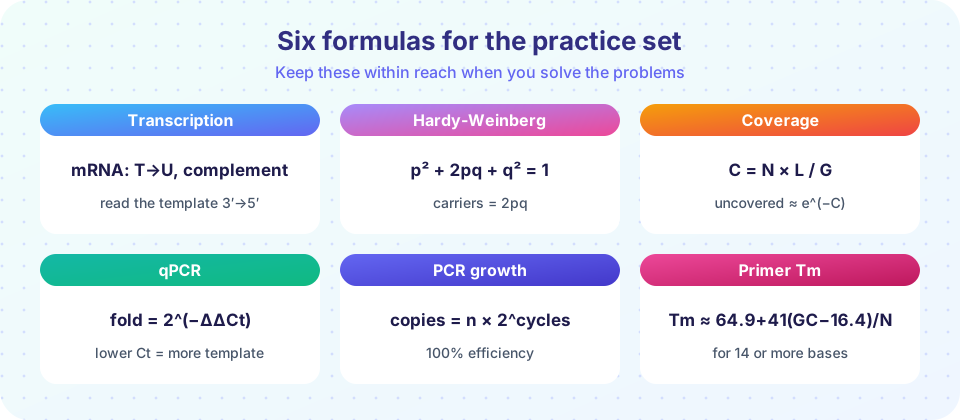
- Problem 3: copies = n₀ × (1 + E)^cycles.
- Problem 4: a circle with k cuts gives k fragments; one of them spans the "end" of the sequence.
- Problem 5: interpolate on the log of the size, not on the size.
- Problem 6: coverage = bases sequenced ÷ genome size.
- Problem 7: q² = incidence, carriers = 2pq.
- Problem 8: ΔCt = Ct(target) − Ct(reference); ΔΔCt = ΔCt(treated) − ΔCt(control); fold = 2^−ΔΔCt.
- Problem 9: insert mass = ratio × vector mass × insert length ÷ vector length.
Common misconceptions
"The mRNA has the same sequence as the template strand." It has the same sequence as the coding strand (with U for T) and is complementary to the template.
"Mass ratio and molar ratio are the same." A short insert has fewer base pairs per molecule, so less mass gives the same molecule count.
"Fold change is the difference of the Ct values." Ct is a log₂ scale, so fold change = 2 raised to the difference.
Try it
The first TryIt is the solution checker. It solves the ten problems by code. Look at it only after your own attempt.
Press Run (or Ctrl + Enter) to see the result here.
Program input · what you'd type while the program runs
Type the answers before you press Run, one per line. Each time the program reads a line (with input()), it gets the next line from this box.
The second TryIt is a problem generator with random DNA. Increase n_problems or change the seed for new exercises, then set show_answers = True to check.
Press Run (or Ctrl + Enter) to see the result here.
Program input · what you'd type while the program runs
Type the answers before you press Run, one per line. Each time the program reads a line (with input()), it gets the next line from this box.
Check your understanding
Quick check · 5 questions
of 5 answered You scored / 5 · perfect!
-
1. A template strand reads 3′-TAC-5′. The mRNA codon is
The mRNA is complementary to the template: A pairs with T, U with A, G with C, which gives AUG read 5′ to 3′. -
2. With 100 percent efficiency, 1 molecule gives how many copies after 10 cycles?
2^10 = 1,024. -
3. A circular plasmid is cut at 3 sites. How many fragments result?
In a circle the number of fragments equals the number of cuts. -
4. ΔΔCt is −2. The fold change is
Fold change = 2^(−ΔΔCt) = 2^2 = 4. -
5. Why does a 900 bp insert need less mass than a 3,000 bp vector for the same number of molecules?
Mass is proportional to length for the same number of molecules.
Summary
- Always write the direction of strands (5′ and 3′) and compare codon by codon.
- PCR, coverage and fold change are exponential relationships; gels and Ct values are logarithmic scales.
- Hardy-Weinberg links disease incidence to carrier frequency.
- Molar ratios, not mass ratios, decide ligations.
- Checking your answers with code is a good habit and a skill in itself.
Track your progress
Create a free account to tick off lessons and pick up where you left off on any device.
of Molecular Biology lessons completed