


















Lesson 15 of 48 · DNA Replication and Repair
Origins of Replication and Telomeres
Learn where DNA replication starts and ends: the bacterial oriC, eukaryotic origin licensing, the end-replication problem, telomeres, telomerase and cell aging.
Replication must start at the right place, at the right time, exactly once per cell cycle. If an origin fires twice, a region is copied twice and the genome becomes unbalanced. If an origin never fires, a stretch is left uncopied. At the other extreme of the chromosome, the very ends pose a special problem: the usual copying mechanism cannot quite finish them.
This lesson covers how origins are chosen and controlled, and how telomeres and the enzyme telomerase solve the end problem. It also shows why telomere length is linked to how many times a cell can divide.
What you will learn
- How a bacterial origin (oriC) is recognized and opened.
- How eukaryotic cells license and fire thousands of origins once per cycle.
- Why linear chromosomes shorten and how telomerase counteracts this.
- How telomere length relates to cell aging and cancer.
Key terms
Origin (ori): a DNA site where replication starts.
Licensing: loading a pre-replicative complex onto an origin in G1 so it is allowed to fire.
Telomere: a repetitive DNA-protein structure at the end of a linear chromosome.
Telomerase: a ribonucleoprotein enzyme that extends telomeres using an RNA template.
Hayflick limit: the limited number of divisions a normal human cell can undergo in culture.
Bacteria: one origin, bidirectional forks
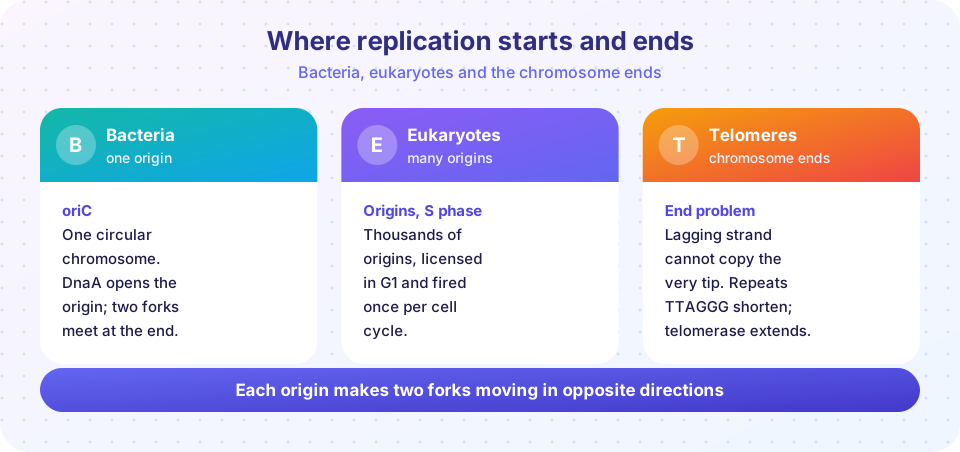
The E. coli chromosome has a single origin, oriC, of about 245 base pairs. It contains repeated binding sites for the initiator protein DnaA and an AT-rich region that is easy to melt. DnaA binds ATP, assembles on oriC and unwinds the AT-rich DNA. It then recruits the helicase DnaB, with help from a loader, and primase. Two forks form and move in opposite directions around the circle until they meet at a termination region roughly opposite the origin.
Control is tight. The cell restricts initiation to once per cell cycle by sequestering newly replicated origins, which are temporarily hidden by methylation-dependent binding of a protein called SeqA. Fast-growing bacteria can even start a new round before the previous one finishes, so a daughter cell may inherit a chromosome that is already partly copied, which is how doubling times can be shorter than the replication time.
Eukaryotes: licensing and firing
A human cell needs tens of thousands of origins. The cell solves the "exactly once" problem by separating the process into two stages in time.
In G1, the origin recognition complex (ORC) binds origin sites, and with Cdc6 and Cdt1 it loads the inactive MCM helicase onto the DNA as a double hexamer. This is licensing. In S phase, kinases (CDKs and DDK) activate the helicase, converting it into the active CMG complex, and the origin fires. The same kinases also block new licensing, so a fired origin cannot be re-licensed until the next G1. Because licensing is only possible when kinase activity is low and firing only when it is high, no origin can fire twice in one cycle.
Eukaryotic origins fire at different times. Gene-rich, active regions generally replicate early; heterochromatin tends to replicate late. A cell does not need every licensed origin to fire, because the surplus acts as a backup in case a fork stalls.
The end-replication problem
A linear chromosome has two ends, and the lagging strand creates a problem there. The last RNA primer on the lagging strand is removed, but there is no upstream 3′ end for a polymerase to extend to fill the gap. So each round of replication would leave a short stretch of the 3′ end of the template single-stranded and unreplicated, and the chromosome would shorten with each division. Bacteria avoid the problem because their chromosomes are circular.
Telomeres and telomerase
Eukaryotic chromosome ends carry telomeres: long runs of a short repeated sequence. In humans and other vertebrates the repeat is TTAGGG, repeated for several thousand base pairs, ending in a single-stranded 3′ overhang. A protein complex called shelterin binds the repeats and folds the end back into a loop (the t-loop), hiding it so the cell doesn't mistake the end for a broken chromosome.
Telomeres are a buffer: they shorten with each division, by roughly tens to a couple of hundred base pairs, but they contain no genes, so the loss is harmless at first. Telomerase, discovered by Elizabeth Blackburn and Carol Greider in 1984 and 1985 (Nobel Prize 2009 with Jack Szostak), can rebuild them. It contains a protein subunit with reverse transcriptase activity (TERT) and its own RNA (TERC), which carries a short template complementary to the repeat. Telomerase uses this internal template to add repeats to the 3′ end; the lagging-strand machinery then fills in the complementary strand.
Most normal human body cells have little or no telomerase, so their telomeres slowly shorten. Leonard Hayflick showed in the 1960s that normal cells divide only about 50 times in culture. When telomeres become critically short, the cell stops dividing (senescence) or dies. Stem cells and germ cells keep telomerase active. Most cancer cells (about 85 to 90 percent) reactivate telomerase, which helps them divide without limit; the remainder use a recombination-based pathway. Inherited mutations in telomere maintenance genes cause diseases of tissues that renew rapidly.
Common misconceptions
"Telomerase makes cells immortal, so we should all activate it." Unchecked telomerase is a hallmark of cancer. Limited telomerase activity also protects us from tumors.
"Telomere length is a precise clock of your age." It correlates with age on average, but varies widely between people and tissues and is influenced by many factors.
"Bacteria have telomeres." Bacteria with circular chromosomes do not need them; a few with linear chromosomes have other end-protection systems.
Try it
This simulation follows telomere length over cell divisions. Each division removes a fixed number of base pairs, and the cell enters senescence when the telomere falls below a critical length. You can add telomerase activity that restores some length. It is a simplified model with illustrative numbers.
Press Run (or Ctrl + Enter) to see the result here.
Program input · what you'd type while the program runs
Type the answers before you press Run, one per line. Each time the program reads a line (with input()), it gets the next line from this box.
Second, an origin-spacing calculator for how many origins a human cell must fire to finish S phase in a given time, using a fork speed you can change.
Press Run (or Ctrl + Enter) to see the result here.
Program input · what you'd type while the program runs
Type the answers before you press Run, one per line. Each time the program reads a line (with input()), it gets the next line from this box.
Check your understanding
Quick check · 5 questions
of 5 answered You scored / 5 · perfect!
-
1. What protein recognizes and opens the E. coli origin oriC?
DnaA binds oriC, unwinds its AT-rich region and helps load the helicase. -
2. How does licensing prevent origins from firing twice per cell cycle?
Loading (licensing) and activating (firing) the helicase occur at opposite kinase levels, so a fired origin cannot be re-licensed until G1. -
3. What is the human telomere repeat?
Vertebrate telomeres consist of TTAGGG repeats. -
4. Why do linear chromosomes shorten at each division without telomerase?
After removing the last primer, there is no 3' end to extend, leaving a short unreplicated stretch. -
5. What does telomerase use as a template?
TERC carries a short sequence that templates new telomere repeats.
Summary
- Bacteria initiate at one origin (oriC) using DnaA; eukaryotes license thousands of origins in G1 and fire them in S phase.
- Separating licensing from firing guarantees each origin fires at most once per cycle.
- The end-replication problem shortens linear chromosomes; telomeres (TTAGGG repeats) buffer the loss.
- Telomerase extends telomeres with its own RNA template; it is active in stem cells and most cancers but low in normal body cells.
Next: DNA Damage and Repair
Track your progress
Create a free account to tick off lessons and pick up where you left off on any device.
of Molecular Biology lessons completed