


















Lesson 14 of 48 · DNA Replication and Repair
The Replication Fork: Enzymes, Leading and Lagging Strands
Learn how the replication fork works: helicase, SSB, primase, DNA polymerase, sliding clamp, Okazaki fragments and ligase, and why one strand is made in pieces.
DNA polymerase, the enzyme that copies DNA, has two limits. It can only add nucleotides to the 3′ end of an existing chain, so it needs a starting point. And it can only build in the 5′ to 3′ direction. The double helix, though, is antiparallel: at a fork, one template strand runs one way and its partner runs the other. How can an enzyme with a one-way rule copy both strands at once?
The solution is that cells copy the two strands differently. One strand is made in a single stretch and the other in short pieces that are stitched together. This lesson walks through the proteins and logic of the replication fork, using bacterial names first and noting the eukaryotic counterparts.
What you will learn
- The role of each major protein at the fork.
- Why a primer is needed and what RNA primers do.
- How the leading and lagging strands differ and why.
- How the sliding clamp, proofreading and ligation complete the job.
Key terms
Helicase: an enzyme that unwinds the double helix using the energy of ATP.
Primase: an RNA polymerase that makes short RNA primers.
Okazaki fragment: a short piece of the lagging strand, about 1,000 to 2,000 nucleotides in bacteria and about 100 to 200 in eukaryotes.
Sliding clamp: a ring-shaped protein that holds the polymerase on the DNA.
Ligase: an enzyme that seals a nick in the DNA backbone.
The cast of proteins
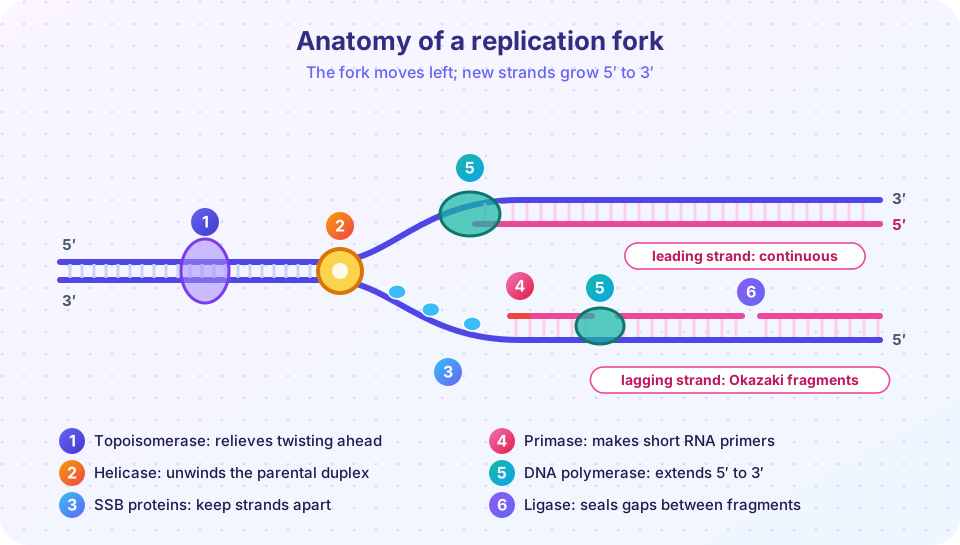
Topoisomerase (gyrase in bacteria) cuts and rejoins the DNA to relieve the twisting stress that builds up ahead of the fork. Without it, unwinding a helix would over-twist the DNA in front of the helicase, like unwinding a rope from one end.
Helicase (DnaB in E. coli; the CMG complex of Cdc45, MCM and GINS in eukaryotes) is a ring-shaped motor that encircles one strand and moves along it, prying the two strands apart using ATP.
Single-strand binding proteins (SSB in bacteria, RPA in eukaryotes) coat the exposed single strands, preventing them from re-pairing or folding into hairpins.
Primase (DnaG in bacteria; part of Pol α-primase in eukaryotes) makes a short RNA primer, around 10 nucleotides in bacteria, that provides the 3′ end DNA polymerase needs. Primase can start a chain from scratch, which polymerase cannot.
DNA polymerase extends the primer, adding deoxynucleotides one at a time. In E. coli the main replicative enzyme is Pol III; in eukaryotes Pol ε typically copies the leading strand and Pol δ the lagging strand. Each nucleotide arrives as a triphosphate; the polymerase joins its 5′ phosphate to the chain's 3′ OH and releases pyrophosphate, whose breakdown helps drive the reaction.
A sliding clamp (the β clamp in bacteria, PCNA in eukaryotes) is loaded onto the DNA by a clamp loader. It encircles the helix and tethers the polymerase, so the polymerase can copy thousands of bases without falling off. This property is called processivity.
DNA ligase seals the final nick between two adjacent fragments by forming the last phosphodiester bond, using ATP (or NAD⁺ in bacteria).
Leading and lagging strands
The fork opens in one direction. The template read 3′ to 5′ in the direction of the fork's movement can be copied smoothly: the polymerase follows the helicase and synthesizes a new strand 5′ to 3′ continuously. This is the leading strand.
The other template runs the opposite way. A polymerase that follows it in the direction of synthesis would move away from the fork. So the cell works backward in short bursts. As the fork opens more template, primase lays down a primer, polymerase extends it 5′ to 3′ away from the fork until it bumps into the previous fragment, and the process repeats. The pieces are Okazaki fragments, named after Reiji Okazaki and colleagues, who found them in the 1960s. This is the lagging strand.
A few steps finish the lagging strand: an enzyme removes each RNA primer (RNase H and, in eukaryotes, the flap endonuclease FEN1; in bacteria DNA polymerase I does the job), a polymerase fills the gap with DNA, and ligase seals the nick. Because the lagging strand needs a new primer for every fragment, it uses many more primers than the leading strand. In practice the two polymerases work together at the fork, and the lagging-strand template loops around so that both can move in step.
Proofreading and the cost of errors
The polymerase checks its own work. If a wrong nucleotide is added, the new chain's end is distorted and the polymerase pauses. A separate site on the enzyme, a 3′ to 5′ exonuclease, removes the last nucleotide, and then synthesis resumes. This proofreading improves fidelity by roughly 100-fold. Mismatch repair (next lessons) adds another factor of about 100.
Here is the arithmetic of layers. Suppose selection alone gives one error per 100,000 bases (10⁻⁵). Proofreading makes it 10⁻⁷, and mismatch repair 10⁻⁹. For a human genome of 6.2 billion bases, that is about six errors per cell division. The exact numbers vary with the polymerase and the sequence, but the logic of multiplying independent layers is the key idea.
Common misconceptions
"The lagging strand is made backward." It is made 5′ to 3′ like every strand; only the overall direction of fragment synthesis is opposite to the fork's movement.
"RNA primers stay in the final DNA." They are removed and replaced with DNA before ligation.
"Helicase and DNA polymerase are the same thing." Helicase unwinds; polymerase synthesizes. They cooperate at the fork.
Try it
This block draws the lagging strand as a series of Okazaki fragments behind a moving fork, in the style of a Gantt chart. Each fragment starts with a primer near the fork position at the time it was primed. It uses a simplified timeline; the real process is less regular.
Press Run (or Ctrl + Enter) to see the result here.
Program input · what you'd type while the program runs
Type the answers before you press Run, one per line. Each time the program reads a line (with input()), it gets the next line from this box.
The second example multiplies the layers of accuracy. Change the error rate of each layer and see how many errors a human genome copy would contain.
Press Run (or Ctrl + Enter) to see the result here.
Program input · what you'd type while the program runs
Type the answers before you press Run, one per line. Each time the program reads a line (with input()), it gets the next line from this box.
Check your understanding
Quick check · 5 questions
of 5 answered You scored / 5 · perfect!
-
1. Why does DNA polymerase need a primer?
Polymerase extends a 3' hydroxyl; it cannot start a chain de novo, so primase supplies a short RNA primer. -
2. Which strand is made in Okazaki fragments?
The lagging strand is synthesized away from the fork in short pieces. -
3. What does the sliding clamp do?
The ring-shaped clamp tethers the polymerase, allowing it to copy thousands of bases without dissociating. -
4. Which enzyme seals the last nick between adjacent fragments?
Ligase forms the final phosphodiester bond between adjacent DNA pieces. -
5. Proofreading by DNA polymerase works through
The enzyme backs up and removes a wrongly added base with its 3' to 5' exonuclease.
Summary
- The fork unwinds (helicase, topoisomerase), stabilizes single strands (SSB), primes (primase), extends (polymerase plus sliding clamp) and seals (ligase).
- Polymerase only adds to a 3′ end, so the leading strand is continuous and the lagging strand is made in Okazaki fragments.
- Primers are removed and replaced by DNA before the fragments are ligated.
- Proofreading and later mismatch repair multiply the accuracy of copying.
Next: Origins and Telomeres
Track your progress
Create a free account to tick off lessons and pick up where you left off on any device.
of Molecular Biology lessons completed