


















Lesson 28 of 48 · Gene Regulation
Chapter 6 Overview: Controlling Genes
See why cells with the same DNA behave differently, and get a map of the six levels of gene regulation from chromatin to protein degradation.
Your body contains hundreds of different cell types, and almost all of them carry the same DNA. A neuron and a liver cell have the same genome, yet they look, behave and make very different proteins. The difference is not in which genes a cell has but in which genes it uses, and how much. That is gene regulation. It is also how a bacterium switches on lactose-digesting enzymes only when lactose is the available food. This chapter explains the main control systems, from the classic bacterial operon to the many layers of eukaryotic control.
What you will learn
- Why genes need to be regulated and what "on" and "off" really mean.
- The six control points between DNA and a working protein.
- Which parts of the story belong to bacteria and which to eukaryotes.
- How each later lesson in this chapter fits the map.
Key terms
Gene expression: the process that uses the information in a gene to make a functional product, usually a protein.
Transcription factor: a protein that binds specific DNA sequences and raises or lowers transcription.
Operon: a bacterial unit in which several genes share one promoter and are switched together.
Epigenetic mark: a chemical tag on DNA or histones that affects expression without changing the DNA sequence.
Housekeeping gene: a gene needed in nearly all cells, often expressed at a steady level.
Why regulate at all?
Making a protein is expensive. A bacterium that produced the enzymes for digesting lactose when no lactose was around would waste energy and lose to competitors. In a multicellular organism the problem is larger: the roughly 20,000 protein-coding genes of the human genome must be used in the right cell, at the right time and in the right amount. Genes for hemoglobin are used in developing red blood cells and not in neurons. Genes for cell division must switch off after the body has finished growing. Mistakes lead to disease, and cancer is often a disease of broken regulation.
The modern picture began with François Jacob and Jacques Monod at the Pasteur Institute, who proposed in 1961 that a repressor protein turns off genes by binding to a DNA site. They shared the 1965 Nobel Prize in Physiology or Medicine with André Lwoff. Their idea was simple and radical: genes are not just recipes but are controlled by other genes.
The six dials
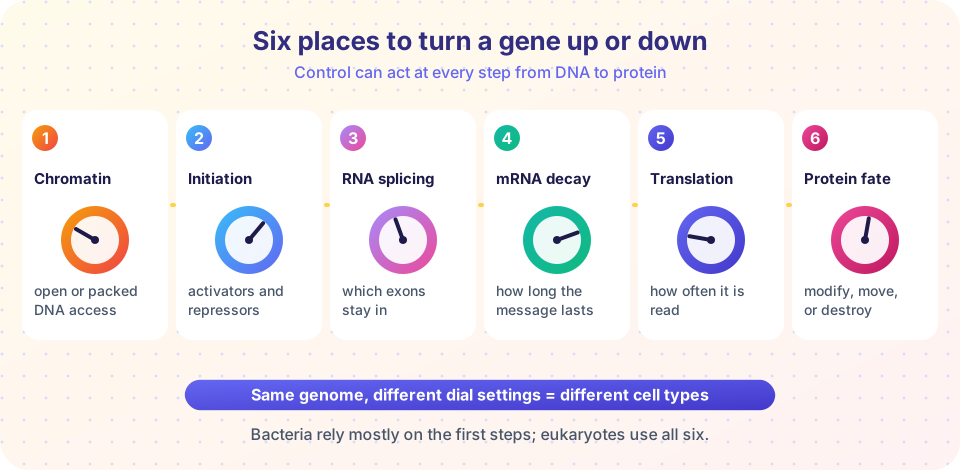
You can think of the path from DNA to active protein as a series of dials. Cells may adjust any of them, and often several at once.
Dials 1 and 2: open and start
Dials 3 and 4: edit and keep
Dials 5 and 6: read and use
Bacteria and eukaryotes
Dial 2 is the most studied.
Dial 2, the start of transcription, is the most heavily regulated step because it is the first and cheapest place to say no. But the others matter. A messenger RNA that is destroyed in minutes lets a cell change its protein output quickly, while a stable one gives a steady supply. A single gene can produce different proteins by splicing its RNA in different ways. A finished protein can be turned on and off by phosphorylation within seconds.
What each lesson covers
- The lac operon is the classic bacterial example of negative and positive control, with mutants as a logic puzzle.
- Eukaryotic control covers chromatin, histone marks, DNA methylation, enhancers and combinatorial control.
- Control at the RNA level covers splicing, mRNA stability and microRNAs.
- Chapter 6 review gathers it all and tests it.
Common misconceptions
"A gene is either on or off." Expression is a dial. Even a repressed gene often makes a little product, and activated genes vary a lot in output.
"Different cell types have different DNA." With a few exceptions (such as immune cells that rearrange antibody genes), cells keep the same genome. Cloning from adult cells proved this.
"Epigenetic means inherited without DNA, always." Marks are copied when cells divide, but most are reset between generations; transmission across generations is limited and under active research.
Try it
The first demonstration is an illustrative heat map: made-up expression levels of eight genes in three cell types. The values are invented to show the idea that one genome gives different patterns; they are not measurements.
Press Run (or Ctrl + Enter) to see the result here.
Program input · what you'd type while the program runs
Type the answers before you press Run, one per line. Each time the program reads a line (with input()), it gets the next line from this box.
The second demonstration multiplies six dials. It is a toy model: the output of a gene is the product of the six settings, so a small change in each step adds up to a large change overall.
Check your understanding
Quick check · 4 questions
of 4 answered You scored / 4 · perfect!
-
1. Which statement best explains why a liver cell and a neuron behave differently?
Cells in one body share the same genome, but regulation makes each cell type use a different set of genes. -
2. Who proposed in 1961 that a repressor protein controls genes by binding DNA?
Jacob and Monod worked out the repressor model with the lac operon. -
3. Which is NOT one of the six control points described in this overview?
The six points are chromatin, initiation, RNA splicing, mRNA decay, translation and protein fate. -
4. An operon is
Genes of an operon are transcribed together as one mRNA and controlled together.
Summary
- Cells with identical DNA differ because they regulate expression differently.
- Control exists at six points: chromatin, initiation, splicing, mRNA decay, translation and protein fate.
- Transcription initiation is the most heavily regulated step, but every level contributes.
- Bacteria use compact operon systems; eukaryotes layer many mechanisms.
Next: The lac operon
Track your progress
Create a free account to tick off lessons and pick up where you left off on any device.
of Molecular Biology lessons completed