


















Lesson 45 of 48 · Projects and Practice
Mini-Project: Plan a CRISPR Gene Knockout
Plan a gene knockout from start to finish: choose a target exon, design and score guides, design PCR primers, predict T7E1 fragments and list the controls and checks.
Knowing how CRISPR works is one thing; planning an experiment that will work is another. In this mini-project you will plan a gene knockout in cultured cells, the way a graduate student would before ordering any reagents. You will choose a target, design and rank guide RNAs, design primers to check the edit, predict what a validation assay should show and write down the controls that would let you trust the answer. Everything here is a plan: no laboratory results are claimed, and the sequence is invented.
What you will learn
- How to turn a biological question into a guide design problem.
- How to rank guides by simple rules and why more than one guide is used.
- How to design a check (PCR and T7E1 or sequencing) before the experiment.
- What controls and records make an experiment trustworthy.
Key terms
Knockout: a gene altered so that it no longer makes a functional product.
RNP: a ribonucleoprotein complex of purified Cas9 protein and guide RNA, delivered directly into cells.
T7E1 assay: an enzyme that cuts DNA heteroduplexes with mismatches; it reveals that editing happened, but does not give the sequence.
Clonal line: cells grown from a single edited cell so that all share the same genotype.
Phenotype: the observable consequence of the genetic change.
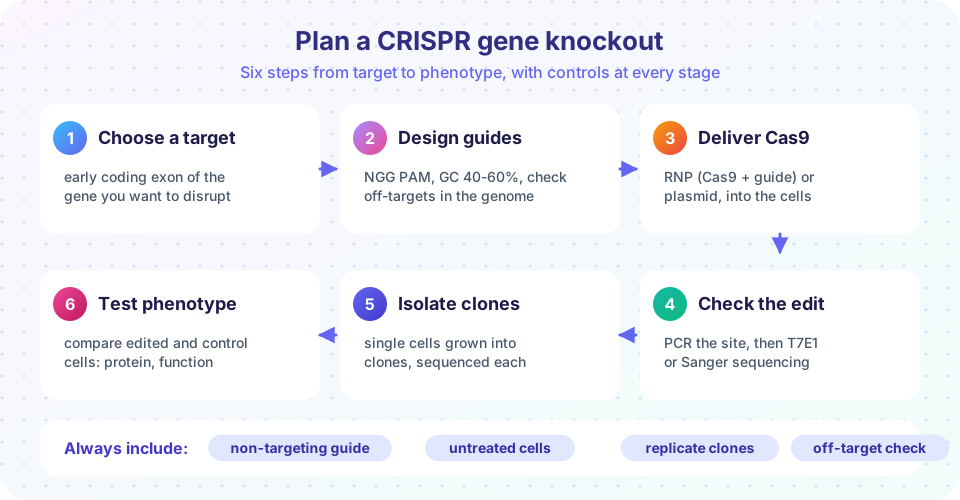
Step 1: choose the target
Goal: stop a gene from making functional protein. The most reliable way is to cause a frameshift early in the coding sequence, so that a premature stop codon follows and the mRNA is destroyed by nonsense-mediated decay. Target an exon that is early (but not the very first codons, where a downstream start codon might rescue it), shared by all isoforms of the gene and not near the last exon (where nonsense-mediated decay does not work well). Check the gene in a genome browser, and consider whether the cell line has extra copies of the gene (aneuploid cancer lines often do), because every copy must be edited.
Step 2: design guides
For SpCas9, a guide is the 20 bases directly in front of an NGG PAM. Rules of thumb for ranking:
- GC content between 40 and 60 percent.
- No run of four or more T's (it ends transcription if the guide is made from a U6 promoter).
- The cut site (3 bp before the PAM) lies early in the exon and within the protein domain you care about.
- A unique match in the genome, with no near-matches elsewhere, checked with a specialized off-target search tool.
Design at least two or three guides per gene: if two independent guides give the same phenotype it is unlikely that the result is due to off-target effects of one guide.
Step 3: deliver
Options include a plasmid that makes Cas9 and the guide (cheap, but long exposure increases off-target cutting), mRNA plus synthetic guide, or an RNP delivered by electroporation or lipid reagent (fast, with short exposure and low off-target activity). Some cells, such as primary immune cells, are hard to transfect and need optimized conditions.
Step 4: check the edit
Before any phenotype experiment, check that the DNA changed. Extract genomic DNA, amplify a 400 to 600 bp region around the cut site and look at the product:
- T7E1 assay. Denature and re-anneal the PCR product so that edited and unedited strands pair and form mismatched hybrids, which T7 endonuclease I cuts. A band pattern showing two smaller fragments indicates editing; the sum of the two fragments is the amplicon size, and the fragments are of sizes depending on the cut position.
- Sanger sequencing with decomposition (TIDE or ICE). A mixed trace after the cut site shows indels, and software estimates their spectrum and efficiency.
- Amplicon sequencing gives the complete outcome list and can detect off-target edits at predicted sites.
Step 5 and 6: clones and phenotype
Pools of edited cells are mixtures. For a clean result, grow single-cell clones, sequence the target site of each and keep clones where all copies carry frameshifts. Then confirm protein loss (Western blot or immunofluorescence) because a frameshift sometimes gives a truncated protein or a rescue from an alternative start site. Finally, test the phenotype compared with controls, and, when possible, rescue by adding back the gene, which proves that the phenotype is due to the loss of that gene.
Controls and records
- Non-targeting guide: a guide with no match in the genome, to show that the cutting process itself does not cause the phenotype.
- Untreated (wild-type) cells, handled in parallel.
- Multiple independent guides and clones, to rule out off-target and clone-specific effects.
- Off-target analysis of the top predicted sites by sequencing.
- A written protocol and record of cell line identity, passage number and tests for mycoplasma.
Cell lines must also be authenticated, and work with human cells, animals or embryos needs ethical approval; this project concerns cultured somatic cells only.
Common misconceptions
"A band in the T7E1 assay proves a knockout." It shows that DNA was altered, not that every allele has a frameshift or that protein is gone.
"One guide is enough." A single guide cannot exclude an off-target explanation of the phenotype.
"A knockout always works as predicted." Cells sometimes compensate, skip exons or use alternative start codons, so protein-level checks are needed.
Try it
The first tool designs guides. It scans the invented exon on both strands for NGG PAMs, scores each guide by GC content, T runs and how early its cut site lies in the exon, and shows the top three. The scoring is a teaching heuristic, not a real predictor.
Press Run (or Ctrl + Enter) to see the result here.
Program input · what you'd type while the program runs
Type the answers before you press Run, one per line. Each time the program reads a line (with input()), it gets the next line from this box.
The second tool predicts what the validation assays should show. For an amplicon of known length and a cut position it lists the T7E1 fragment sizes and the fraction of edited alleles estimated from band intensities, using the standard formula for T7E1 quantification.
Press Run (or Ctrl + Enter) to see the result here.
Program input · what you'd type while the program runs
Type the answers before you press Run, one per line. Each time the program reads a line (with input()), it gets the next line from this box.
Write-up checklist
Complete these sentences for your own gene of interest (use any gene you know about): the target exon is ...; the guide sequences are ...; the delivery method is ...; the check is ...; the controls are ...; the phenotype I expect if the gene is needed for ... is ...; and the result that would convince me that the gene is not needed is ... . Good experimental design includes stating in advance what would change your mind.
Check your understanding
Quick check · 5 questions
of 5 answered You scored / 5 · perfect!
-
1. Why is a non-targeting guide used as a control?
It controls for the effects of Cas9 and the delivery procedure. -
2. Which exon is generally the best target for a knockout?
Early frameshifts trigger nonsense-mediated decay and affect all isoforms. -
3. A T7E1 assay on a 480 bp amplicon with a cut at base 215 shows bands of about
The fragments add to the amplicon length: 215 + 265 = 480. -
4. Why use two or three different guides against one gene?
Independent guides have different off-target sites, so shared effects are probably on target. -
5. A clone has a band in T7E1 but still makes protein by Western blot. A likely explanation is
DNA editing does not guarantee loss of function: in-frame indels or alternative initiation can preserve a protein.
Summary
- A knockout plan starts with an early, shared coding exon and two or three well-scored guides.
- RNP delivery gives short exposure and fewer off-target events.
- Validate DNA (T7E1, sequencing), then protein, then phenotype, and prefer single-cell clones.
- Controls (non-targeting guide, untreated cells, replicates, off-target checks) turn a result into evidence.
Track your progress
Create a free account to tick off lessons and pick up where you left off on any device.
of Molecular Biology lessons completed