


















Lesson 31 of 48 · Gene Regulation
Control at the RNA Level: Splicing, Stability and microRNAs
Learn how alternative splicing, mRNA lifetime, microRNAs, RNA interference and riboswitches control which proteins a cell makes after transcription.
Transcription is only the first draft. The RNA that Pol II produces in a eukaryotic cell is edited, packaged, transported, watched and eventually destroyed, and each of those steps can be regulated. Since the 1990s biologists have found that small RNAs, only about 22 nucleotides long, shape the expression of a large share of human genes. This lesson covers the post-transcriptional dials: how splicing makes many proteins from one gene, how mRNA lifetime sets the speed of response, and how microRNAs and RNA interference silence genes.
What you will learn
- How capping, splicing and polyadenylation prepare an mRNA, and how splicing can vary.
- Why mRNA half-life changes how quickly a gene responds.
- How microRNAs and siRNAs silence genes through RISC.
- What riboswitches and long noncoding RNAs add to the picture.
Key terms
Splicing: removal of introns and joining of exons by the spliceosome.
Alternative splicing: producing different mRNAs from one pre-mRNA by choosing different exons.
mRNA half-life: the time in which half of a population of mRNA molecules decays.
microRNA (miRNA): a roughly 22-nucleotide RNA that guides RISC to partly complementary mRNAs.
RNA interference (RNAi): gene silencing triggered by small RNAs.
Preparing the message
In eukaryotes, a nascent RNA is modified while it is being made. A 5′ cap (7-methylguanosine) is added at the start. It protects the RNA from exonucleases and helps ribosomes bind. The spliceosome, a machine of small nuclear RNAs and proteins, cuts out introns, using conserved signals: introns usually start with GU and end with AG, and contain a branch-point adenine near the 3′ end. At the 3′ end, the RNA is cut and a poly(A) tail of about 200 adenines in mammals is added. After these steps a mature mRNA leaves the nucleus.
Alternative splicing
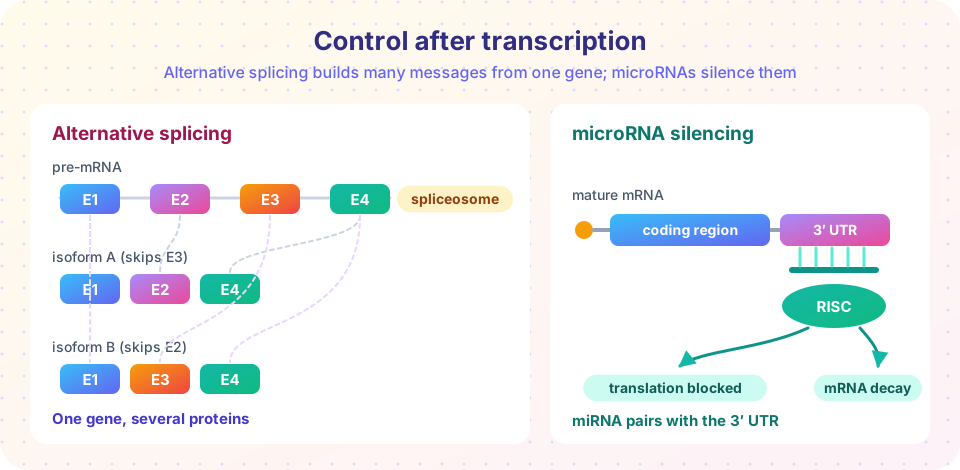
Splicing does not always include every exon. Exons may be skipped, alternative ends chosen or an intron retained. Roughly 90 to 95 percent of human multi-exon genes produce more than one isoform, which is one reason why 20,000 genes can encode a much larger set of proteins. Splice choice is controlled by splicing factors that bind exon or intron enhancers and silencers, and it can differ by tissue and developmental stage. The record is the Drosophila Dscam gene, which has four clusters of alternative exons with 12, 48, 33 and 2 options, so in theory it makes 12 × 48 × 33 × 2 = 38,016 different proteins. Splicing errors cause disease: mutations at splice sites or in regulators underlie conditions such as spinal muscular atrophy, which has an approved therapy (nusinersen) that changes the splicing of the SMN2 gene.
mRNA stability: the speed of response
Messenger RNAs are not permanent. Their half-lives range from a few minutes (many regulatory genes) to many hours (many housekeeping genes). The poly(A) tail is gradually shortened; when it is short, the cap is removed and exonucleases degrade the body. Sequence elements in the 3′ UTR, such as AU-rich elements, set the pace. Quality-control pathways such as nonsense-mediated decay destroy mRNAs that carry premature stop codons.
Stability determines how fast a cell can change its output. If a gene is switched on at a constant rate, the amount of mRNA rises as m(t) = m_ss × (1 − e^(−kt)), where the decay rate is k = ln 2 / half-life and m_ss is the final steady level. The time to reach half of the final level equals the half-life. Unstable messages therefore reach a new level quickly, and they also fall quickly when transcription stops. That is why rapidly changing signals use short-lived RNAs.
microRNAs and RNA interference
In 1993 Victor Ambros and Gary Ruvkun found in the worm C. elegans a tiny RNA, lin-4, that regulates another gene by binding to its 3′ UTR. For a long time it looked like a curiosity, until similar RNAs were found throughout animals and plants. Ambros and Ruvkun received the 2024 Nobel Prize in Physiology or Medicine. In 1998 Andrew Fire and Craig Mello showed that double-stranded RNA silences matching genes, a process called RNA interference (Nobel Prize 2006).
The mechanism: a primary miRNA is cut by Drosha in the nucleus and Dicer in the cytoplasm to give a duplex about 22 nucleotides long. One strand is loaded into an Argonaute protein to make the RNA-induced silencing complex (RISC). The miRNA guides RISC to mRNAs through base pairing. Pairing of the seed region (nucleotides 2 to 8 of the miRNA) with the 3′ UTR is usually enough in animals, with imperfect complementarity: the outcome is reduced translation and faster mRNA decay. In plants, and in the experimental use of siRNAs (small interfering RNAs), perfect pairing leads Argonaute to cut the target. Humans have well over a thousand miRNAs, and each can regulate hundreds of targets. The first RNAi drug, patisiran, was approved in 2018, and several others followed.
Other RNA regulators
- Riboswitches are structured RNA elements, mainly in bacterial mRNAs, that bind a small molecule such as a vitamin or metabolite. Binding refolds the RNA and switches transcription or translation of the genes on that message.
- Long noncoding RNAs (lncRNAs) longer than 200 nucleotides can guide chromatin modifiers. The best known is XIST, which coats and silences one X chromosome in female mammals.
- CRISPR RNAs form part of the bacterial immune system you will meet in the next chapter.
Common misconceptions
"Introns are junk." Many introns host regulatory sequences or even miRNAs, and splicing choices create protein diversity.
"miRNAs always destroy their target." In animals they mostly fine-tune expression by modest reduction, often less than two-fold.
"mRNA level equals protein level." The two correlate, but translation rate and protein stability also matter.
Try it
The first example enumerates the isoforms produced by combinations of optional exons and recomputes the Dscam count. The isoform labels are generated by simple logic, not by a real splicing predictor.
Press Run (or Ctrl + Enter) to see the result here.
Program input · what you'd type while the program runs
Type the answers before you press Run, one per line. Each time the program reads a line (with input()), it gets the next line from this box.
The second example compares how fast mRNA levels rise after a gene is switched on at time zero for two half-lives, showing why stable messages respond slowly.
Press Run (or Ctrl + Enter) to see the result here.
Program input · what you'd type while the program runs
Type the answers before you press Run, one per line. Each time the program reads a line (with input()), it gets the next line from this box.
The third example finds miRNA target sites in an invented 3′ UTR. It takes the seed of let-7a (nucleotides 2 to 8), builds the reverse complement and searches for it. Real target prediction uses more rules.
Press Run (or Ctrl + Enter) to see the result here.
Program input · what you'd type while the program runs
Type the answers before you press Run, one per line. Each time the program reads a line (with input()), it gets the next line from this box.
Check your understanding
Quick check · 5 questions
of 5 answered You scored / 5 · perfect!
-
1. What does the spliceosome do?
The spliceosome is the RNA-protein machine that performs splicing. -
2. If the isoforms of a pre-mRNA with two constitutive exons and three optional exons are all possible, how many isoforms exist?
Each of the three optional exons is either in or out: 2 × 2 × 2 = 8. -
3. Why do genes with short-lived mRNAs respond faster to a signal?
The time to approach a new steady state is set by the decay rate, so short half-lives give quick responses. -
4. In animals, a miRNA typically recognizes its target mainly through
Seed pairing (nucleotides 2 to 8) with sites in the 3′ UTR is the usual rule. -
5. Which pair is matched correctly?
Fire and Mello discovered RNAi in 1998.
Summary
- Eukaryotic mRNAs receive a 5′ cap, are spliced and get a poly(A) tail.
- Alternative splicing produces many isoforms from one gene.
- mRNA half-life sets how fast expression can change.
- miRNAs and siRNAs guide RISC to targets, lowering translation or causing decay; the discoveries were honored by Nobel Prizes in 2006 and 2024.
- Riboswitches and long noncoding RNAs are further RNA-based regulators.
Next: Chapter 6 review
Track your progress
Create a free account to tick off lessons and pick up where you left off on any device.
of Molecular Biology lessons completed