


















Lesson 24 of 48 · Translation and Protein Folding
The Genetic Code: Codons, Reading Frames and Mutations
Learn how 64 codons map to 20 amino acids, why the code is degenerate, how reading frames work and how point mutations change proteins.
Four bases, twenty amino acids: the cell needs a rule that turns one into the other. That rule is the genetic code. It is a dictionary that pairs each three-base word of mRNA, called a codon, with an amino acid or a signal to stop. Once you can read it, you can look at any mRNA and predict the protein, and you can predict what a mutation will do.
What you will learn
- Why codons are triplets and how many there are.
- How the code is degenerate but not ambiguous, and what wobble means.
- How a reading frame is set and why a frameshift is so damaging.
- How to classify silent, missense, nonsense and frameshift mutations.
Key terms
Codon: a triplet of mRNA bases that specifies one amino acid or a stop signal.
Degenerate code: several codons can specify the same amino acid, but each codon specifies only one.
Open reading frame (ORF): a stretch that starts with a start codon and runs in triplets to a stop codon.
Missense mutation: a base change that swaps one amino acid for another.
Frameshift: an insertion or deletion that is not a multiple of three bases.
Why triplets?
Two bases would give only 4 × 4 = 16 words, too few for 20 amino acids. Three bases give 4 × 4 × 4 = 64 words, which is enough with room to spare. In 1961 Francis Crick, Sydney Brenner and colleagues showed with mutations in a bacterial virus that genes are read in non-overlapping groups of three. Marshall Nirenberg and Heinrich Matthaei then cracked the first codon the same year: a synthetic RNA made only of uracil (poly-U) produced a chain of phenylalanine, so UUU means Phe. By the mid 1960s all 64 codons were assigned, with major contributions from Har Gobind Khorana.
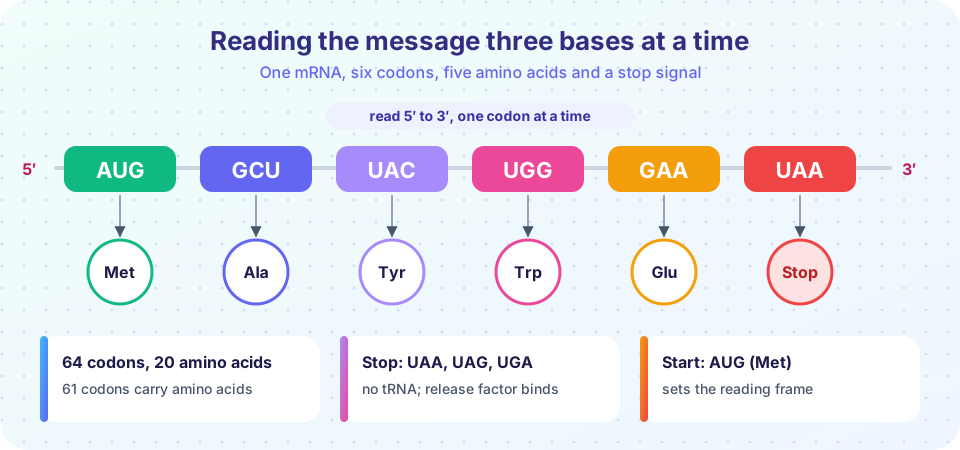
Of the 64 codons, 61 specify amino acids and three are stop codons: UAA, UAG and UGA. AUG does two jobs. In the right context it is the start codon, and everywhere else it codes for methionine.
The code is degenerate, not ambiguous
Twenty amino acids share 61 codons, so most amino acids have more than one codon. Each codon, however, means exactly one thing. That is why scientists call the code degenerate and not ambiguous.
| Codons per amino acid | Amino acids |
|---|---|
| 6 | Leucine, serine, arginine |
| 4 | Alanine, glycine, proline, threonine, valine |
| 3 | Isoleucine |
| 2 | Phenylalanine, tyrosine, histidine, glutamine, asparagine, lysine, aspartate, glutamate, cysteine |
| 1 | Methionine, tryptophan |
Check the total: 3 × 6 + 5 × 4 + 3 + 9 × 2 + 2 = 61.
The degeneracy is not random. Codons for the same amino acid usually share their first two bases and differ at the third. Crick's wobble hypothesis explains why: the pairing between the third codon base and the first anticodon base of the tRNA is looser. As a result a cell needs fewer than 61 different tRNAs. The arrangement also protects against damage: a change at the third position often leaves the amino acid the same. Codons for chemically similar amino acids (for example the hydrophobic ones with U in the middle) cluster together, so many errors cause only mild changes.
Reading frames
A string of RNA can be read in three different frames, depending on where you start counting. The start codon fixes the frame, and every later codon follows in steps of three.
5′ ...GCC ACC AUG GCU UAC UGG GAA UAA CGA... 3′
Here the frame begins at AUG. Starting one base later would give completely different codons. If one base is deleted after the AUG, all codons downstream shift, and the chain after the mistake is nonsense. This is a frameshift. A deletion of three bases removes one codon (or two amino acids if it spans codon boundaries) and keeps the frame, which is usually far less harmful.
Mutations in the coding sequence
Point mutations change one base. What they do to the protein depends on where they hit:
- Silent: the new codon codes for the same amino acid (for example GAA to GAG, both Glu).
- Missense: the codon codes for a different amino acid (GAA to GUA changes Glu to Val). Sickle-cell disease is a famous missense case; you will meet it in the final chapter.
- Nonsense: the codon becomes a stop codon (UAC to UAA), usually truncating the protein.
- Frameshift: one or two bases are inserted or deleted.
Always compare the codons before and after, not just the bases. A single base change may be silent in one position and disastrous in another.
Universality and its exceptions
The standard code is shared by bacteria, plants, animals and fungi, which is strong evidence that all life descends from a common ancestor and also what makes it possible to put a human gene into a bacterium. There are exceptions. Human mitochondria read UGA as tryptophan instead of stop, and in some proteins UGA, in a special context, codes for the 21st amino acid, selenocysteine. Some organisms use pyrrolysine as a 22nd. These are variations on a theme, not a different code.
Common misconceptions
"One codon, one amino acid, and one amino acid, one codon." Only the first half is true. Many amino acids have several codons.
"A silent mutation never matters." It does not change the amino acid, but it can change mRNA folding, translation speed or splicing, and a few silent changes cause disease.
"Stop codons code for a very short amino acid." They are not read by a tRNA at all; a release factor recognizes them.
Try it
The first example is a translator. It builds the standard codon table from one compact string (bases in the order U, C, A, G), finds the first AUG and translates until a stop codon.
Press Run (or Ctrl + Enter) to see the result here.
Program input · what you'd type while the program runs
Type the answers before you press Run, one per line. Each time the program reads a line (with input()), it gets the next line from this box.
The second example classifies point mutations for you. Change the mutation list to explore other cases.
Press Run (or Ctrl + Enter) to see the result here.
Program input · what you'd type while the program runs
Type the answers before you press Run, one per line. Each time the program reads a line (with input()), it gets the next line from this box.
The third example turns the table of degeneracy into a picture, so that you can see which amino acids have the most codons.
Press Run (or Ctrl + Enter) to see the result here.
Program input · what you'd type while the program runs
Type the answers before you press Run, one per line. Each time the program reads a line (with input()), it gets the next line from this box.
Check your understanding
Quick check · 5 questions
of 5 answered You scored / 5 · perfect!
-
1. How many of the 64 codons specify an amino acid?
Three codons (UAA, UAG, UGA) are stop codons, which leaves 61 sense codons. -
2. A base change turns GAA (Glu) into GAG (Glu). What kind of mutation is this?
The amino acid stays the same, so the mutation is silent. -
3. Why is a single-base deletion usually more damaging than a three-base deletion?
A one-base deletion shifts the frame, so all later codons are read differently. A three-base deletion keeps the frame. -
4. Which pair is both a start signal (in context) and the only codon for its amino acid?
AUG codes for methionine and also sets the start of the reading frame. -
5. Wobble pairing means that
The third codon position pairs more loosely with the anticodon, so one tRNA can read several related codons.
Summary
- The code uses 64 triplet codons: 61 for amino acids, 3 for stop.
- It is degenerate (several codons per amino acid) but unambiguous.
- The start codon sets the reading frame; indels not divisible by three shift it.
- Point mutations are silent, missense or nonsense; frameshifts are the most disruptive.
- The code is nearly universal, with a few known variations.
Track your progress
Create a free account to tick off lessons and pick up where you left off on any device.
of Molecular Biology lessons completed