


















Lesson 17 of 48 · DNA Replication and Repair
Chapter 3 Review: Replication and Repair
Review semiconservative replication, the fork enzymes, origins, telomeres and repair pathways with a summary picture, a pathway table, a simulation and a ten-question quiz.
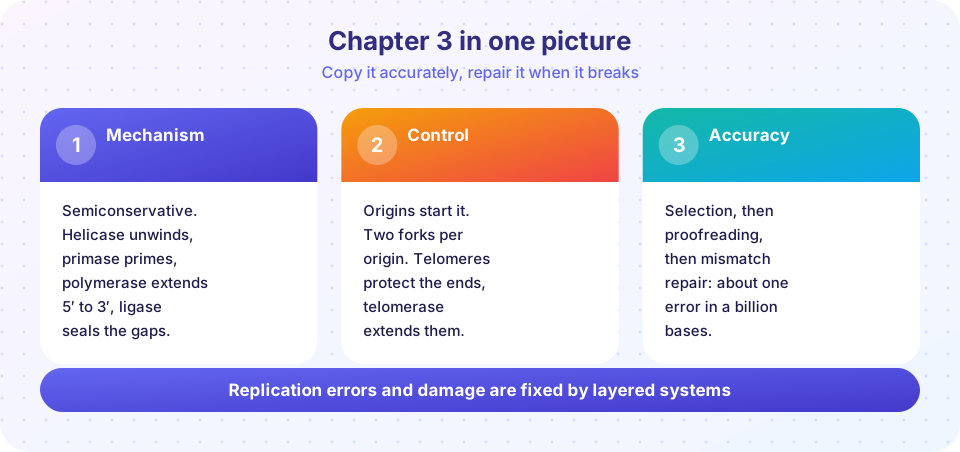
In this chapter you followed DNA through its life cycle: it is copied accurately at a fork using enzymes that unwind, prime, extend and seal, started at carefully controlled origins, protected at its ends by telomeres, and constantly checked and repaired. The unifying theme is that accuracy comes from layers, not from one perfect step.
What you will learn
- How to explain the whole replication process in order.
- How to match each kind of damage with its repair pathway.
- How to do the calculations of the chapter: timing, accuracy and telomere length.
Recap table
| Topic | Key facts |
|---|---|
| Model | Semiconservative (Meselson-Stahl) |
| Direction | New DNA is made 5′ to 3′; polymerase adds to a 3′ OH |
| Fork enzymes | Topoisomerase, helicase, SSB, primase, polymerase, sliding clamp, ligase |
| Strands | Leading continuous; lagging in Okazaki fragments |
| Bacterial origin | oriC, DnaA; one origin, two forks |
| Eukaryotic origins | License in G1 (ORC, MCM), fire in S |
| Telomeres | TTAGGG repeats, telomerase extends them |
| Proofreading | 3′ to 5′ exonuclease, ~100-fold |
| BER | Glycosylase, APE1, Pol β, ligase |
| NER | Remove ~24 to 32 nt around bulky lesions |
| MMR | MutS/MutL or MSH2/MLH1; uses strand discrimination |
| DSB repair | NHEJ (fast, error-prone) or HR (accurate, needs template) |
Key terms
Processivity: how many nucleotides a polymerase adds before letting go.
Licensing: marking an origin as ready in G1.
Senescence: a permanent stop of cell division.
Lesion: a site of DNA damage.
Fidelity: the accuracy of copying.
How the pieces connect
Replication creates new damage risks (mismatches, stalled forks) and meets existing damage (which can block the fork). Repair therefore works alongside replication: proofreading acts during copying, mismatch repair follows right behind the fork, and homologous recombination can restart collapsed forks. Telomeres and telomerase fix the end problem created by the lagging strand's need for primers. Everything returns to one basic fact from chapter 2: a strand can serve as the template for its partner because of the pairing rules.
Common misconceptions
"The leading and lagging strands are made in opposite directions." Both are made 5′ to 3′; the lagging strand is made in fragments that are laid down away from the fork.
"Repair only happens after a cell divides." Repair operates continuously, during and outside S phase.
"Mutations come only from outside causes like radiation." Many arise from normal chemistry and replication errors.
Try it
This simulation counts how many errors accumulate in a genome copy with and without repair layers. It draws random numbers from a Poisson distribution with the expected counts from the chapter, so results vary a little each run. It is a probability model, not a measurement.
Press Run (or Ctrl + Enter) to see the result here.
Program input · what you'd type while the program runs
Type the answers before you press Run, one per line. Each time the program reads a line (with input()), it gets the next line from this box.
Second, an Okazaki fragment counter for a stretch of DNA, in the browser console. Change the length and fragment size to see how the count changes.
Press Run (or Ctrl + Enter) to see the console output here.
No output.
Check your understanding
Quick check · 10 questions
of 10 answered You scored / 10 · perfect!
-
1. Which enzyme unwinds the DNA at the fork?
Helicase uses ATP to separate the strands. -
2. What does primase make?
Primase is an RNA polymerase that creates the short primer polymerase needs. -
3. Why is the lagging strand made in fragments?
Because synthesis must go 5' to 3' and this template faces the opposite way, synthesis proceeds in short pieces away from the fork. -
4. In eukaryotes, when are origins licensed?
Licensing occurs in G1 when kinase levels are low; firing occurs in S phase. -
5. What repeat sequence forms human telomeres?
Human telomeres are made of TTAGGG repeats. -
6. UV light mainly causes which kind of lesion?
UV fuses adjacent pyrimidines (usually thymines). -
7. Which pathway removes uracil from DNA?
A uracil glycosylase removes the base, starting BER. -
8. Which repair route needs the sister chromatid?
HR copies information from a homologous template, most often the sister chromatid. -
9. If selection gives 10^-5 errors, proofreading 100-fold, and mismatch repair 100-fold, what is the final error rate?
10^-5 divided by 100 is 10^-7, then divided by 100 again is 10^-9. -
10. Which enzyme extends telomeres?
Telomerase adds TTAGGG repeats using its RNA template.
Summary
- Replication is semiconservative and uses a coordinated set of enzymes at the fork.
- Origins are tightly controlled; telomeres and telomerase solve the problem at chromosome ends.
- Accuracy comes from selection, proofreading and mismatch repair, each cutting errors about 100-fold.
- Repair pathways are specialized: BER, NER, MMR, NHEJ and HR.
- Chapter 4 moves on to reading genes into RNA.
Track your progress
Create a free account to tick off lessons and pick up where you left off on any device.
of Molecular Biology lessons completed