


















Lesson 34 of 48 · Recombinant DNA and CRISPR
Cloning a Gene and the Polymerase Chain Reaction
Learn how restriction enzymes, ligase and plasmid vectors clone a gene, how blue-white screening works, and how PCR copies DNA with primers and Taq.
Suppose you want a bacterium to make a human protein, or you want a million copies of one gene to study. You need a way to move a piece of DNA into a host cell that will copy it for you. Molecular cloning does this with four ingredients: an enzyme that cuts DNA, an enzyme that joins it, a small circular vector and a host cell. The polymerase chain reaction, PCR, does something related in a tube: it amplifies one chosen region from a trace of DNA without any living cells. Together they are the basis of the modern lab.
What you will learn
- How restriction enzymes recognize and cut DNA, and what sticky ends are.
- What a plasmid vector contains and how clones are selected.
- How PCR works: primers, thermal cycling and exponential growth.
- How to estimate fragment sizes and primer melting temperatures.
Key terms
Restriction enzyme: a bacterial enzyme that cuts DNA at a specific recognition sequence.
Sticky end: a short single-stranded overhang left by a staggered cut, able to pair with a matching overhang.
Plasmid: a small circular DNA that replicates independently of the chromosome.
Selectable marker: a gene (often antibiotic resistance) that lets only cells carrying the vector grow.
Primer: a short DNA oligonucleotide that gives a polymerase a starting point.
Cutting DNA: restriction enzymes
Bacteria use restriction enzymes to chop up the DNA of invading viruses, and protect their own DNA by methylating it. Type II enzymes are the lab workhorses. Each recognizes a short sequence, usually four to eight base pairs, that is a palindrome: the sequence read 5′ to 3′ is the same on both strands. EcoRI recognizes GAATTC and cuts between G and A on each strand: G^AATTC. Because the cuts on the two strands are staggered, the result is two fragments with four-base single-stranded overhangs (AATT), called sticky ends. Others, such as SmaI (CCC^GGG), cut straight through and leave blunt ends.
| Enzyme | Site (5′ to 3′) | Ends | Source organism |
|---|---|---|---|
| EcoRI | G^AATTC | 5′ sticky | E. coli |
| BamHI | G^GATCC | 5′ sticky | Bacillus amyloliquefaciens |
| HindIII | A^AGCTT | 5′ sticky | Haemophilus influenzae |
| SmaI | CCC^GGG | blunt | Serratia marcescens |
| NotI | GC^GGCCGC | 5′ sticky | Nocardia otitidis |
How often will an enzyme cut? If all bases are equally likely, a given 4-base sequence occurs about once every 4⁴ = 256 bp, and a 6-base site once every 4⁶ = 4,096 bp. Real genomes are not random, but this estimate explains why 6-base cutters give fragments of a few kilobases and 8-base cutters like NotI cut rarely.
Joining DNA: ligase and vectors
Any two fragments cut with the same enzyme (or enzymes with compatible overhangs, such as BamHI and BglII) have complementary sticky ends. They pair by hydrogen bonds, and DNA ligase (T4 ligase uses ATP) seals the nicks by forming phosphodiester bonds. In the lab, the gene of interest (the insert) and a cut plasmid (the vector) are mixed with ligase. Cutting with two different enzymes gives each end a different overhang, which forces the insert in the right orientation.
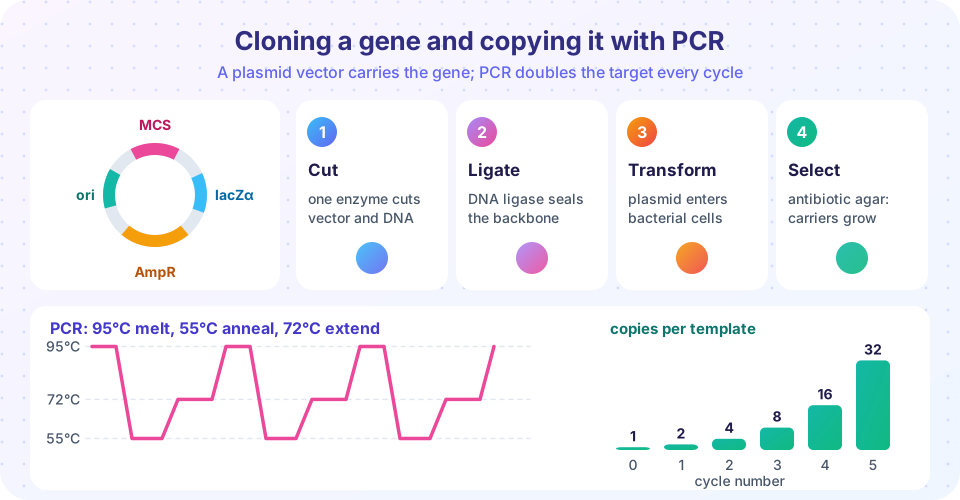
A good cloning vector has four features.
- An origin of replication (ori), which sets how many copies each cell makes.
- A selectable marker, such as ampicillin resistance (AmpR) or kanamycin resistance.
- A multiple cloning site (MCS): a short region with many unique restriction sites.
- For expression, a promoter (for example, a T7 or lac promoter) and a ribosome-binding site in front of the insert.
Transformation and selection
The recombinant plasmid is put into bacteria by transformation: cells made competent with calcium chloride are given a heat shock, or cells are given an electric pulse (electroporation). Only a small fraction of cells take up a plasmid, so cells are spread on agar with the antibiotic; only cells with a plasmid make colonies. But not every plasmid has an insert, since the vector can re-ligate to itself. Blue-white screening deals with that. The MCS sits inside the lacZα gene fragment. If no insert is present, the cell makes functional β-galactosidase, which turns the chromogenic substrate X-gal blue. An insert disrupts lacZα, so those colonies stay white. Further checks with a colony PCR or a diagnostic digest confirm which white colonies have the right insert.
For genes from eukaryotes you often start from mRNA. Reverse transcriptase makes cDNA (without introns), which can be expressed in bacteria. A genomic library is a collection of clones containing all fragments of an organism's DNA, and a cDNA library contains the expressed genes of a tissue.
PCR: copying DNA in a tube
PCR needs a template, two primers, a heat-stable DNA polymerase (Taq from Thermus aquaticus, a hot-spring bacterium), nucleotides and buffer. A thermal cycler repeats a cycle of three steps, usually 25 to 35 times:
- Denature at about 95 °C: the double strands melt apart.
- Anneal at roughly 50 to 65 °C: primers pair with the template at each end of the target.
- Extend at 72 °C: the polymerase extends each primer, copying the target.
The two primers face each other across the region and define its ends. After each cycle the number of target copies roughly doubles. In the ideal case n cycles give 2ⁿ copies: 30 cycles give about 10⁹ copies per template. In practice efficiency per cycle is below 100 percent, and the reaction eventually plateaus when reagents run low. Because PCR is so sensitive, a single contaminating molecule can give a false positive; labs use negative controls (no template) in every run.
Primer design matters. Typical primers are 18 to 25 nucleotides with 40 to 60 percent GC and a melting temperature (Tm) of about 55 to 65 °C. A rough formula for oligos of 14 or more bases is Tm ≈ 64.9 + 41 × (G + C − 16.4) / N. The annealing temperature is usually set a few degrees below the lower Tm of the pair. Primers should not pair with themselves or each other, or the product is mostly primer-dimers.
Variants include RT-PCR (starting from RNA with reverse transcriptase), quantitative PCR (qPCR, which measures fluorescence each cycle to find how much template there was) and high-fidelity polymerases with proofreading for cloning.
Common misconceptions
"Taq makes perfect copies." Taq has no proofreading, so it introduces occasional errors; for cloning, a proofreading polymerase is preferred.
"A restriction site cuts anywhere in the sequence." It cuts only where the recognition sequence occurs, and not if the site is methylated in a blocking way.
"White colonies always carry the right insert." Some contain a wrong or a rearranged insert, so you verify them.
Try it
The first example is a restriction digest simulator. It searches a sequence for sites, cuts after the marked base, and reports fragment lengths for a linear or circular DNA. The sequence is invented.
Press Run (or Ctrl + Enter) to see the result here.
Program input · what you'd type while the program runs
Type the answers before you press Run, one per line. Each time the program reads a line (with input()), it gets the next line from this box.
The second example compares PCR yield for different efficiencies and plots it on a log scale. It uses the formula (1 + E)^n, where E is the efficiency per cycle between 0 and 1.
Press Run (or Ctrl + Enter) to see the result here.
Program input · what you'd type while the program runs
Type the answers before you press Run, one per line. Each time the program reads a line (with input()), it gets the next line from this box.
The third example designs primers for a target region. It takes the first 20 bases for the forward primer, the reverse complement of the last 20 for the reverse primer, then reports GC content, an approximate Tm and the product size. The target sequence is invented (its ends were chosen so that the primers have sensible GC content).
Press Run (or Ctrl + Enter) to see the result here.
Program input · what you'd type while the program runs
Type the answers before you press Run, one per line. Each time the program reads a line (with input()), it gets the next line from this box.
Check your understanding
Quick check · 5 questions
of 5 answered You scored / 5 · perfect!
-
1. EcoRI cuts the sequence GAATTC between G and A on each strand. The result is
The staggered cuts leave AATT single-stranded overhangs on each fragment. -
2. About how often does a six-base restriction site occur in random DNA?
4^6 = 4,096, so on average once per 4 kb. -
3. In blue-white screening, white colonies usually mean
An insert in the MCS breaks lacZα, so no blue product is made. Cells without any plasmid do not grow on the antibiotic plate. -
4. Which PCR step uses about 72 °C?
Taq extends the primers at about 72 °C. -
5. With 100 percent efficiency, how many copies per template exist after 10 cycles?
2^10 = 1,024.
Summary
- Restriction enzymes cut at palindromic sites, leaving sticky or blunt ends; ligase joins compatible ends.
- A vector needs an origin, a selectable marker and a cloning site; transformation puts it in bacteria and selection finds them.
- Blue-white screening and diagnostic digests help identify correct clones.
- PCR copies a target with two primers and a heat-stable polymerase, doubling it per cycle in the ideal case.
- Primer design (length, GC, Tm) and controls decide success.
Track your progress
Create a free account to tick off lessons and pick up where you left off on any device.
of Molecular Biology lessons completed