


















Lesson 37 of 48 · Recombinant DNA and CRISPR
Chapter 7 Review: Recombinant DNA and CRISPR
Review restriction enzymes, vectors, PCR, gels and CRISPR with a one-page picture, a recap table, cloning arithmetic tools and a ten-question quiz.
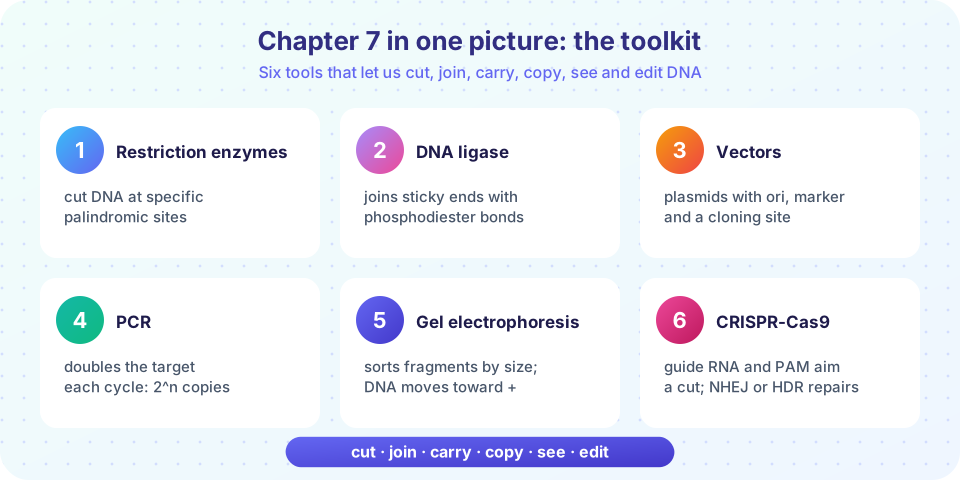
A good molecular biologist thinks in two ways at once: biologically (what will the cell do?) and arithmetically (how big will the bands be, how much insert do I need?). This review practices both. First the picture, then the recap table, then two calculators that you will use in real cloning projects, then the quiz.
What you will learn
- How to connect the tools into one cloning experiment.
- How to compute the size of a recombinant plasmid and how much insert to add to a ligation.
Recap table
| Tool | What it does | Key numbers or facts |
|---|---|---|
| Restriction enzyme | Cuts at a palindromic site | 6-base site: about once per 4,096 bp; EcoRI G^AATTC |
| DNA ligase | Joins compatible ends | T4 ligase uses ATP; seals phosphodiester bonds |
| Vector | Carries and copies an insert | ori, selectable marker, MCS (promoter for expression) |
| Transformation, selection | Introduces the plasmid; finds carriers | Antibiotic plates; blue-white screening |
| PCR | Copies a region in a tube | 95, 55 and 72 °C cycle; 2^n copies in the ideal case |
| Gel electrophoresis | Sorts fragments by size | DNA moves to the anode; distance linear in log size |
| Southern blot, STR | Finds a sequence; identifies people | Probe hybridization; repeat counts at many loci |
| CRISPR-Cas9 | Cuts a chosen site | 20-base guide, NGG PAM, cut 3 bp upstream; NHEJ or HDR |
Common misconceptions
"A bigger insert always gives a better clone." Large inserts lower transformation efficiency and can be unstable; vectors have size limits.
"A ligation works best with a huge excess of insert." Too much insert gives concatemers; ratios of about 3 insert ends per vector end are a common starting point.
"PCR and cloning are the same." PCR copies in a tube; cloning copies inside living cells and can also express the gene.
Try it
The first example does the arithmetic of a cloning plan. You cut a vector with two enzymes and replace the small fragment between them with an insert. It reports the final plasmid size and the expected sizes when you check the clone with a diagnostic digest. All sizes are invented.
Press Run (or Ctrl + Enter) to see the result here.
Program input · what you'd type while the program runs
Type the answers before you press Run, one per line. Each time the program reads a line (with input()), it gets the next line from this box.
The second example computes how many nanograms of insert to add for a chosen molar ratio. The mass of DNA is proportional to its length, so a short insert needs less mass than the vector for the same number of molecules.
Press Run (or Ctrl + Enter) to see the result here.
Program input · what you'd type while the program runs
Type the answers before you press Run, one per line. Each time the program reads a line (with input()), it gets the next line from this box.
Check your understanding
Quick check · 10 questions
of 10 answered You scored / 10 · perfect!
-
1. A plasmid of 4,000 bp has one EcoRI site. After cutting and running on a gel, you see
One cut opens the circle into one linear molecule of the same length. -
2. What is the main purpose of the antibiotic resistance gene in a vector?
Only cells with the plasmid survive on the antibiotic plate. -
3. Which enzyme seals the nick between the insert and the vector?
DNA ligase forms phosphodiester bonds between the ends. -
4. How many copies per template after 20 ideal PCR cycles?
2^20 = 1,048,576 in the ideal case. -
5. A gel shows the ladder bands at 3,000 and 1,000 bp, and an unknown band between them, closer to 1,000. Its size is most likely
Distance is linear in log size, so a band between 3,000 and 1,000 bp has a size between them, here nearer the lower value. -
6. The cut made by SpCas9 lies about
The cut is blunt and sits 3 bp from the PAM within the target. -
7. Which pathway needs a donor template?
Homology-directed repair copies sequence from a template. -
8. A 20-base guide has a perfect match, but there is no NGG next to the target. Cas9 will
The PAM is required for binding and unwinding. -
9. Why are white colonies in blue-white screening interesting?
An insert in the MCS breaks lacZα, so no blue product forms. -
10. Which of these is NOT a limitation of CRISPR editing in patients?
Programmability by guide RNA is the strength of the system; delivery and off-targets are the limits.
Summary
- The toolkit: cut (restriction enzymes), join (ligase), carry (vectors), copy (cells or PCR), see (gels) and edit (CRISPR).
- Cloning arithmetic uses sizes of backbone and insert, and molar ratios for ligation.
- Gels give sizes by comparison with a ladder on a log scale.
- CRISPR needs a guide and a PAM; repair pathway decides the edit.
Track your progress
Create a free account to tick off lessons and pick up where you left off on any device.
of Molecular Biology lessons completed