


















Lesson 18 of 48 · Transcription
Chapter 4 Overview: Transcription, DNA into RNA
Preview transcription: template and coding strands, RNA polymerase, promoters, the transcription bubble, speed, and a transcriber widget that builds RNA from a template.
Replication copies the whole genome once per cell cycle. Transcription is different: it copies one gene at a time, as often as the cell needs. A liver cell might make thousands of copies of an albumin mRNA and none at all of an eye pigment gene. Transcription is therefore the first and most important control point in gene expression.
The enzyme at the center is RNA polymerase, which reads a DNA template and builds a complementary RNA chain, 5′ to 3′, without needing a primer. This chapter covers how it finds a gene, how it moves, how it stops and how the RNA is processed before it is used.
What you will learn
- The difference between the template strand and the coding strand.
- The three stages of transcription: initiation, elongation and termination.
- How the transcription bubble moves and how fast transcription runs.
- What each lesson in this chapter covers.
Key terms
Template strand: the DNA strand read by RNA polymerase.
Coding (non-template) strand: the strand whose sequence matches the RNA, with T in place of U.
Promoter: a DNA sequence where RNA polymerase binds to start transcription.
Transcription start site: the first DNA base copied into RNA, numbered +1.
Upstream / downstream: toward the 5′ side or 3′ side of the coding strand.
The chapter at a glance
Three stages
Two cell plans
After transcription
Bacteria skip these steps.
Lessons in this chapter
- Bacterial Transcription: sigma factors, promoters and terminators.
- Eukaryotic Transcription: three polymerases, general transcription factors and enhancers.
- RNA Processing and Splicing: capping, splicing and polyadenylation.
- Chapter 4 Review: a picture summary and a quiz.
Template and coding strands
The two DNA strands play different roles. RNA polymerase reads the template strand in the 3′ to 5′ direction and builds RNA 5′ to 3′, so the RNA is complementary to the template and has the same sequence as the other strand, the coding strand, except that RNA contains U where DNA has T. This is why gene sequences are usually written as the coding strand: you can read off the mRNA, and then the protein, directly.
Example: if the coding strand is 5′-ATGGCTTAA-3′, the template strand is 3′-TACCGAATT-5′. The RNA made is 5′-AUGGCUUAA-3′.
Which strand is the template varies from gene to gene. In a chromosome, some genes use one strand as template and some use the other, depending on which way the promoter points.
The three stages
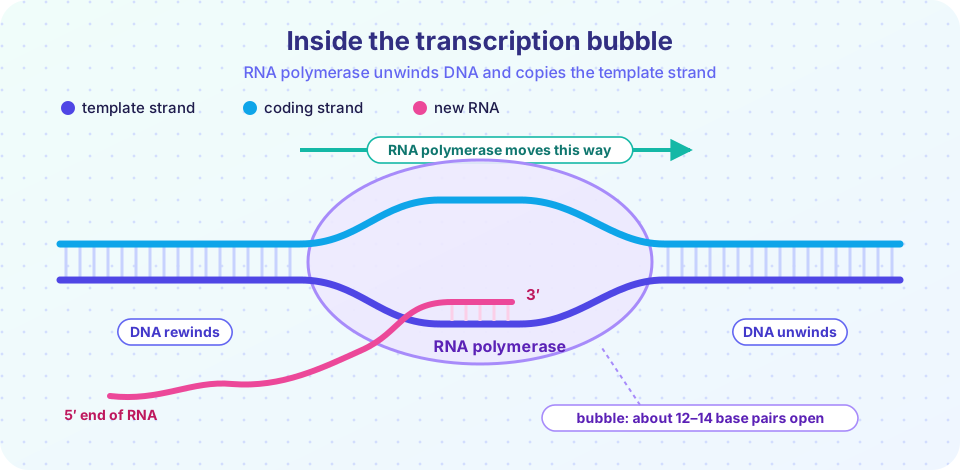
Initiation. RNA polymerase, helped by other proteins, recognizes the promoter, unwinds about 10 to 15 base pairs of DNA to form the bubble, and begins to make RNA. In bacteria it needs a sigma factor; in eukaryotes it needs a set of general transcription factors.
Elongation. The enzyme moves along the template, unwinding DNA ahead and rewinding it behind. Inside the bubble, about eight or nine nucleotides of the growing RNA remain paired with the template in a short RNA-DNA hybrid; the rest of the RNA exits through a channel in the enzyme. Bacterial RNA polymerase adds roughly 40 to 80 nucleotides per second; eukaryotic polymerase II averages around 20 to 70 per second (about 1 to 4 kilobases per minute), depending on the gene and conditions.
Termination. Signals in the DNA or accessory proteins cause the enzyme to release the RNA and dissociate.
Because RNA polymerase does not proofread as efficiently as DNA polymerase, it makes about one error per 10,000 to 100,000 nucleotides. That is acceptable: RNA is temporary and many copies are made.
Common misconceptions
"The template strand has the same sequence as the RNA." It is complementary to the RNA. The coding strand has the same sequence (with T for U).
"The same strand is the template for every gene." The template can be either strand, depending on the gene.
"RNA polymerase needs a primer." Unlike DNA polymerase, it can start a chain from scratch.
Try it
How long does it take to transcribe a gene? The calculator uses a typical elongation speed. The giant dystrophin gene in humans spans about 2.2 million base pairs, so even at a steady speed it takes hours. The numbers are estimates, and real transcription includes pauses.
Press Run (or Ctrl + Enter) to see the result here.
Program input · what you'd type while the program runs
Type the answers before you press Run, one per line. Each time the program reads a line (with input()), it gets the next line from this box.
Now a transcriber. Enter the coding strand of a gene and the widget shows the template strand and the RNA. It is a pairing calculator, not a model of the enzyme.
Check your understanding
Quick check · 4 questions
of 4 answered You scored / 4 · perfect!
-
1. RNA polymerase reads the template strand in which direction?
It reads 3' to 5' and builds RNA 5' to 3'. -
2. The coding strand reads 5'-ATGGCT-3'. What is the RNA?
The RNA matches the coding strand with U in place of T. -
3. What is a promoter?
Promoters are DNA sites that direct RNA polymerase to the start of a gene. -
4. Does RNA polymerase need a primer?
RNA polymerase can initiate synthesis without a primer.
Summary
- Transcription copies one gene at a time; RNA polymerase reads the template strand 3′ to 5′ and builds RNA 5′ to 3′ without a primer.
- The RNA matches the coding strand with U for T.
- The stages are initiation at a promoter, elongation through a moving bubble and termination.
- Eukaryotic RNA is processed (cap, splice, tail) before it is used.
Next: Bacterial Transcription
Track your progress
Create a free account to tick off lessons and pick up where you left off on any device.
of Molecular Biology lessons completed