


















Lesson 46 of 46 · Projects and Practice
Further study: where to go after materials science
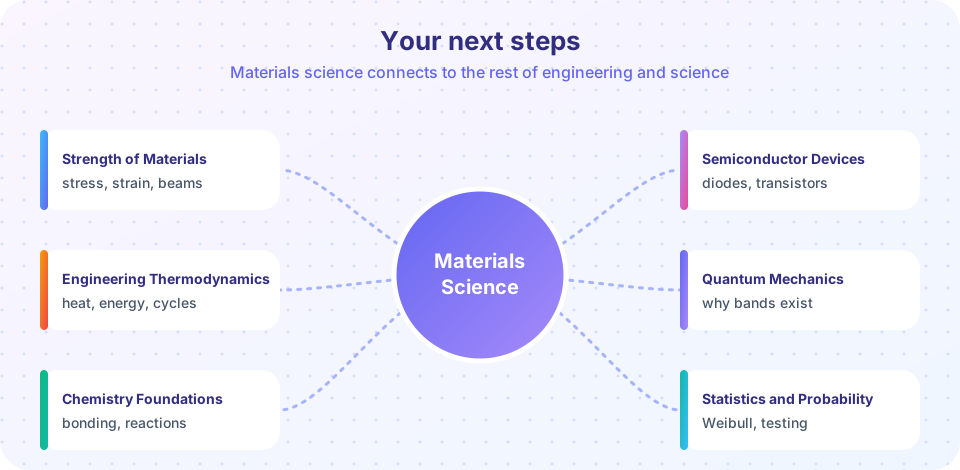
Plan your next steps after this course: advanced topics in materials science and connected tracks on strength of materials, thermodynamics, semiconductors, chemistry and statistics.
You have covered phase diagrams, metals and alloys, ceramics, polymers, composites and functional properties. That is a solid foundation, but materials science is a wide field. This page maps out what to learn next, both inside the subject and in neighboring tracks on this site.
What you will learn
- Identify the advanced topics that build on this course.
- Choose related tracks that deepen the physics and engineering side.
- Plan a practical project to apply your knowledge.
Key terms
Microstructure engineering: designing grain size, phases and defects to get target properties.
Characterization: measuring structure and properties (microscopy, diffraction, mechanical and electrical testing).
Additive manufacturing: building parts layer by layer, which creates new microstructures.
Computational materials science: simulating atoms and microstructure to predict properties.
Deeper topics in the field
- Defects and strengthening: dislocation theory, work hardening, grain-boundary strengthening and creep, which explain why alloys are strong and how they fail slowly at high temperature.
- Diffusion and kinetics: Fick's laws, nucleation and growth, and the physics behind the TTT diagrams you used.
- Characterization: optical and electron microscopy, X-ray diffraction, hardness and tensile testing.
- Corrosion: electrochemistry of metal degradation and how to prevent it.
- Advanced materials: nanomaterials, biomaterials, batteries and energy materials, magnetic and superconducting materials, and 2D materials such as graphene.
- Processing: powder metallurgy, casting, welding, polymer extrusion and 3D printing.
Connected tracks on this site
- Strength of Materials turns the stress-strain behavior you studied into beam, shaft and column design.
- Engineering Thermodynamics gives the energy and free-energy framework behind phase diagrams.
- Semiconductor Devices builds on bands and doping to explain diodes, transistors and solar cells.
- Chemistry Foundations deepens bonding, periodic trends and reactions.
- Quantum Mechanics explains why energy bands and gaps exist.
- Statistics and Probability supports testing, Weibull analysis and quality control.
Return to the Materials Science track page at any time to review earlier chapters.
A project to try
Pick an everyday object (a bicycle frame, a kettle, a phone case, a cooking pan) and write a one-page "materials report" on it: what the functional requirements are, which classes of materials could do the job, what performance index you would use, which processing route gives the needed structure, and one way it could fail. Doing this a few times builds the habit of thinking in processing, structure, properties and performance.
Common misconceptions
"Materials science is only about metals." It spans metals, ceramics, polymers, composites, semiconductors and biological materials.
"I need to memorize the tables." What matters is understanding the structure-property links so you can estimate and look up the rest.
Try it
Press Run (or Ctrl + Enter) to see the result here.
Program input · what you'd type while the program runs
Type the answers before you press Run, one per line. Each time the program reads a line (with input()), it gets the next line from this box.
Press Run (or Ctrl + Enter) to see the console output here.
No output.
Check your understanding
Quick check · 4 questions
of 4 answered You scored / 4 · perfect!
-
1. Which topic would best explain why energy bands exist?
Band theory follows from quantum mechanics of electrons in a periodic potential. -
2. Which track helps you turn material properties into beam and shaft designs?
Strength of materials covers stress analysis and design. -
3. What does Weibull analysis of test data estimate?
The slope is the Weibull modulus m and the intercept gives σ₀. -
4. A materials report on a pan should include:
The processing-structure-properties-performance chain is the habit to build.
Summary
- Deepen the subject through defects, diffusion, characterization, corrosion and advanced materials.
- Connect to Strength of Materials, Thermodynamics, Semiconductor Devices, Chemistry, Quantum Mechanics and Statistics.
- Practice with a materials report on an everyday object.
Back to the Materials Science track page
Track your progress
Create a free account to tick off lessons and pick up where you left off on any device.
of Materials Science lessons completed