


















Lesson 36 of 46 · Electrical, Thermal and Optical Properties
Chapter overview: electrical, thermal and optical properties
A tour of functional properties: why resistivity spans 24 orders of magnitude, how electrons and atomic vibrations carry current and heat, and how light and magnetism interact with matter.
Strength is only one reason to pick a material. The wire in a charger must conduct electricity, a heat sink must conduct heat, a window must pass light, a transformer core must respond to a magnetic field. These are functional properties, and they too come from structure: how electrons occupy energy levels and how atoms vibrate.
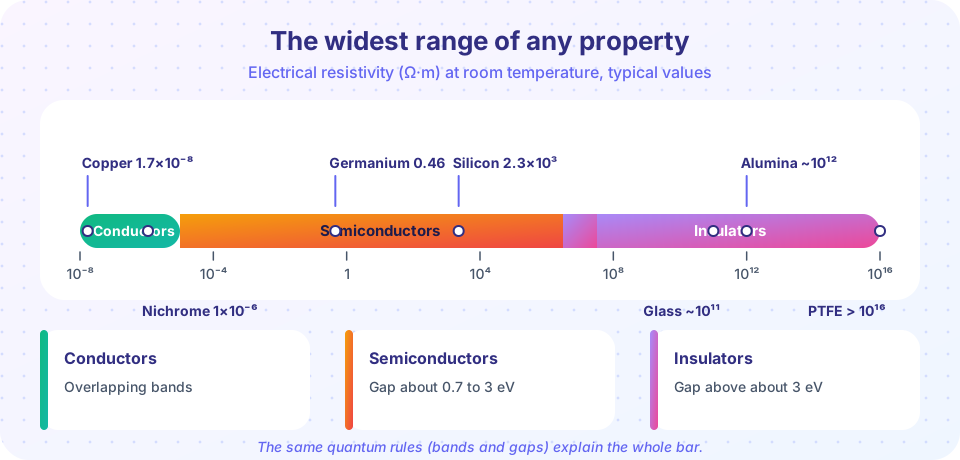
This chapter links the structure you have studied to the electrical, thermal, optical and magnetic behavior of materials. Electrical resistivity is a good place to start, because no other property varies so much: from copper to Teflon the difference is more than 20 orders of magnitude.
What you will learn
- Compare resistivities of conductors, semiconductors and insulators.
- See how a single idea, energy bands, ties together electrical and optical behavior.
- Know what each lesson in the chapter covers.
Key terms
Resistivity (ρ): a material property in Ω·m; resistance of a wire is R = ρL/A.
Conductivity (σ): the reciprocal, σ = 1/ρ, in S/m.
Band gap (Eg): the energy range between the filled valence band and the empty conduction band.
Phonon: a quantum of atomic vibration; carries heat in insulators.
The unifying idea: bands
In an isolated atom, electrons occupy sharp energy levels. In a solid, the levels of countless atoms merge into bands, separated by gaps where no electron states exist. Whether a material conducts depends on how the bands are filled. If a band is only partly full, electrons can move into nearby empty states and carry current: a metal. If the highest filled band is completely full and the next is separated by a large gap, electrons cannot move: an insulator. A small gap gives a semiconductor, where heat or light can lift a few electrons across. Optical properties follow from the same gap: light with photon energy above Eg can be absorbed, below it cannot.
Four property families
Two carriers of heat
What is in the chapter
- Electrical conduction and semiconductors: Ohm's law, resistivity, temperature effects, intrinsic and doped semiconductors.
- Thermal properties: heat capacity, expansion, conductivity and thermal stress.
- Optical and magnetic properties: refraction, absorption, color, and magnetic behavior.
- Chapter review.
Try it
Press Run (or Ctrl + Enter) to see the result here.
Program input · what you'd type while the program runs
Type the answers before you press Run, one per line. Each time the program reads a line (with input()), it gets the next line from this box.
Press Run (or Ctrl + Enter) to see the console output here.
No output.
Check your understanding
Quick check · 4 questions
of 4 answered You scored / 4 · perfect!
-
1. What is the relation between resistivity and conductivity?
Conductivity is the reciprocal of resistivity. -
2. Which material has an energy gap that is small enough for thermal excitation at room temperature?
Silicon has Eg = 1.12 eV: a few electrons are thermally excited, making it a semiconductor. -
3. Which carriers dominate heat conduction in a good electrical insulator such as alumina?
Without free electrons, heat is carried by vibrations of the lattice. -
4. A wire has resistivity 1.7×10⁻⁸ Ω·m, length 10 m and area 7.85×10⁻⁷ m². Its resistance is about
R = ρL/A = 1.7e-8 × 10 / 7.85e-7 ≈ 0.22 Ω.
Summary
- Resistivity spans about 24 orders of magnitude; band structure explains why.
- Partly filled bands conduct, a large gap insulates, a small gap gives a semiconductor.
- Heat is carried by electrons and phonons; optical absorption depends on the gap.
Track your progress
Create a free account to tick off lessons and pick up where you left off on any device.
of Materials Science lessons completed