


















Lesson 6 of 46 · Atomic Structure and Bonding
Chapter 2 Overview: Atomic Structure and Bonding
See why bonding between atoms explains melting point, stiffness, expansion and conductivity, and get a map of the four lessons in the bonding chapter.
Why does tungsten melt at 3422 °C while mercury is liquid at room temperature? Why is diamond hard and wax soft, copper a conductor and glass an insulator? The answer in every case begins with how atoms are held together. Bonds are the springs of the material world. Their strength decides melting points; their stiffness decides the elastic modulus; their asymmetry decides thermal expansion; and the way electrons are shared decides whether electricity flows. This chapter builds the picture from the electron up.
What you will learn
- Why bond type and strength correlate with melting point and stiffness.
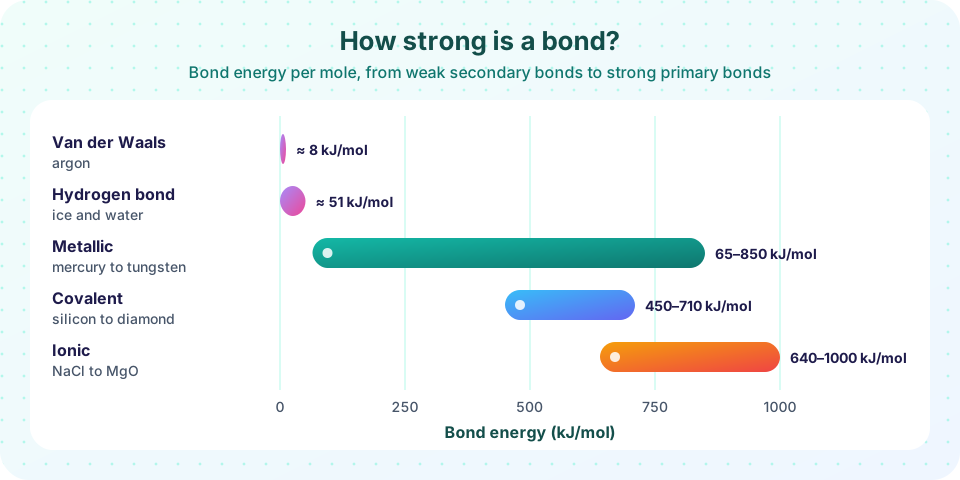
- The five kinds of bond and where they sit on the energy scale.
- How this chapter's four lessons fit together.
Key terms
Primary bond: a strong bond between atoms: ionic, covalent or metallic (roughly 60 to 1000 kJ/mol).
Secondary bond: a weak bond between molecules or chains, such as van der Waals or hydrogen bonds (roughly 8 to 50 kJ/mol).
Bond energy: the energy needed to separate the bonded atoms completely, per mole of bonds or per atom.
Valence electrons: the outer electrons that take part in bonding.
Five kinds of bond
Strength sets properties
Electrons decide
The big picture
Imagine two atoms approaching each other. At long range they attract (opposite charges, shared electrons or induced dipoles). At very short range their electron clouds and nuclei repel. The balance of the two forces fixes a spacing at which the energy is lowest. That minimum is the bond, and the depth of the energy well is the bond energy. Everything in this chapter is a refinement of that one picture.
Three consequences follow, and you will meet them in every later chapter:
- Melting point. To melt a solid you must give atoms enough thermal energy to loosen the bonds. Deep wells give high melting points. Tungsten (bond energy about 850 kJ/mol) melts at 3422 °C; argon (about 8 kJ/mol) melts at −189 °C.
- Stiffness. The elastic modulus measures how steeply the energy rises when atoms are pushed or pulled from their equilibrium spacing. Narrow, deep wells give stiff materials.
- Thermal expansion. Real wells are not symmetric: they rise steeply on the compressed side and gently on the stretched side, so as atoms vibrate more with temperature their average spacing grows.
The kind of bond also explains electrical behavior. In metals the valence electrons are free to move; in ionic and covalent solids they are tied to atoms, so these are usually insulators or semiconductors. The electrical chapter later in the course builds on this.
What each lesson covers
| Lesson | What it covers |
|---|---|
| Atoms and periodic trends | Electron configurations, valence electrons, and trends in ionization energy and electronegativity |
| Primary bonds | Ionic, covalent and metallic bonding, mixed character, and secondary bonds |
| Bond energy and properties | The energy well, force curve, stiffness, melting and thermal expansion |
| Chapter 2 review | One-page summary and ten review questions |
Common misconceptions
"A bond is a physical stick between atoms." A bond is an energy lowering from the way electrons and nuclei arrange themselves. The "stick" picture is only a convenient drawing.
"Stronger bonds always mean a stronger material." Bond strength sets the ideal strength and the melting point, but the real strength of a crystal is much lower because of defects (chapter 3).
"Ionic means conducting." Solid ionic compounds are insulators; they conduct only when molten or dissolved, because then the ions can move.
Try it
The plot below shows the rough link between bond energy and melting temperature for eight substances. The bond energies are typical values for the cohesive energy from isolated atoms (or ion pairs, for NaCl and MgO), and the melting points are standard values.
Press Run (or Ctrl + Enter) to see the result here.
Program input · what you'd type while the program runs
Type the answers before you press Run, one per line. Each time the program reads a line (with input()), it gets the next line from this box.
Now measure the trend. The program ranks the eight substances by bond energy and by melting point and computes the Spearman rank correlation (1 means identical order).
Press Run (or Ctrl + Enter) to see the console output here.
No output.
Check your understanding
Quick check · 4 questions
of 4 answered You scored / 4 · perfect!
-
1. Which property is most directly set by the depth of the bond energy well?
Deeper wells need more thermal energy to loosen, so melting points rise with bond energy. -
2. Which pair lists two primary bond types?
The primary bonds are ionic, covalent and metallic. -
3. Why does thermal expansion occur?
A lopsided well lets atoms spend more time at larger separations when they vibrate with more energy. -
4. Which bond is the weakest of these?
Van der Waals bonds, about 8 kJ/mol here, are far weaker than primary bonds.
Summary
- Bonding arises from the balance of attraction and repulsion; the energy minimum is the bond, its depth the bond energy.
- Bond strength correlates with melting point; the steepness of the well with stiffness; its asymmetry with thermal expansion.
- Primary bonds (ionic, covalent, metallic) are strong; secondary bonds are weak.
- Free electrons make metals conductors; localized electrons make ceramics and polymers insulators.
Track your progress
Create a free account to tick off lessons and pick up where you left off on any device.
of Materials Science lessons completed