


















Lesson 21 of 46 · Mechanical Properties
Chapter 4 Review: Mechanical Properties
Review stress-strain behavior, strengthening mechanisms, fracture, fatigue and creep with a recap table, a worked-problem tool and a ten-question quiz.
Chapter 4 turned the atomic picture into the numbers engineers use. From a single tensile test you can read stiffness, yield strength, tensile strength, ductility and toughness. From the dislocation picture you can explain why metals yield at low stress and how four strengthening mechanisms raise it. And from fracture mechanics, fatigue and creep you can see why parts break at loads far below those of the tensile test. Use this page to put the chapter together before moving on to phase diagrams and alloys.
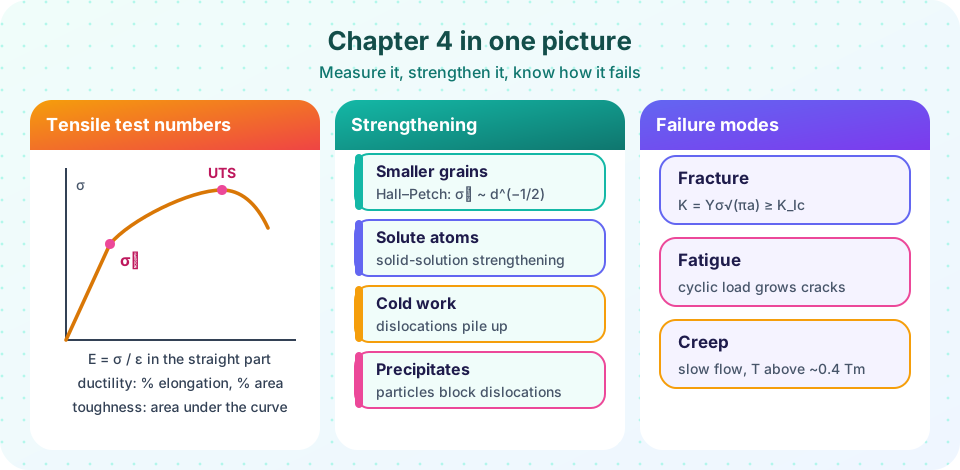
Recap table
| Lesson | Key ideas | Formulas and numbers to remember |
|---|---|---|
| Overview | Loading types; tensile test; five properties; curve shapes of the material classes | σ = F/A, ε = ΔL/L₀; 1 MPa = 1 N/mm² |
| Stress-strain behavior | Hooke's law, Poisson's ratio, 0.2 % yield, UTS, ductility, toughness, true values | σ = Eε; G = E/(2(1+ν)); σ_T = σ(1+ε), ε_T = ln(1+ε) |
| Plastic deformation and strengthening | Slip systems, Schmid's law, grain size, solid solution, strain hardening, precipitates, annealing, hardness | τ_R = σ cosφ cosλ, m ≤ 0.5; σ_y = σ₀ + kd^(−1/2); σ_T = Kε_T^n, necking at ε_T = n |
| Fracture, fatigue and creep | Ductile versus brittle; stress concentration; K_Ic; S-N curves; Paris law; creep stages |
K = Yσ√(πa); a_c = (1/π)(K_Ic/Yσ)²; da/dN = C(ΔK)^m; creep above 0.4 T_m |
Typical numbers worth remembering: Young's modulus of steel 205 GPa, aluminum 70 GPa, copper 117 GPa, nylon 3 GPa; Poisson's ratio of metals about 0.3; K_Ic of a high-strength steel about 50 MPa√m, alumina about 4, glass about 0.75.
Try it
The first tool is a "worked problem" calculator that chains several results of the chapter: from a measured force and elongation to stress, strain, modulus, true stress and a safety check against yield. Change the inputs and compare with your hand calculation.
Press Run (or Ctrl + Enter) to see the result here.
Program input · what you'd type while the program runs
Type the answers before you press Run, one per line. Each time the program reads a line (with input()), it gets the next line from this box.
The second tool checks a fracture-mechanics design. For a given toughness, stress and inspection limit it tells you whether a part is safe and how big a flaw it can tolerate.
Press Run (or Ctrl + Enter) to see the console output here.
No output.
Check your understanding
Quick check · 10 questions
of 10 answered You scored / 10 · perfect!
-
1. A bar of 12 mm diameter carries 30 kN. The stress is about
A = π(6)² = 113 mm²; 30 000 N / 113 mm² ≈ 265 MPa. -
2. Young's modulus is the slope of which part of the curve?
E = σ/ε in the linear elastic region. -
3. True stress at an engineering stress of 300 MPa and strain 0.10 (before necking) is
σ_T = σ(1 + ε) = 300 × 1.1 = 330 MPa. -
4. The maximum possible Schmid factor is
cos φ cos λ ≤ 0.5, reached at φ = λ = 45°. -
5. Which method strengthens a metal without reducing its toughness?
Finer grains raise yield strength and usually toughness. -
6. Necking begins when true strain equals
Considère's criterion for Hollomon hardening gives ε_T = n. -
7. A material's K_Ic is 30 MPa√m and the stress is 200 MPa (Y = 1). The critical flaw size is about
a_c = (30/200)² / π = 0.0225/3.14 = 7.2 mm. -
8. Which describes fatigue?
Fatigue is progressive crack growth under cyclic stress. -
9. At what homologous temperature does creep become significant in metals?
Creep is significant above roughly 0.4 of the melting temperature in kelvin. -
10. Which material has a clear endurance limit?
Steels show a flat part in the S-N curve; the others keep falling.
Summary
- A tensile test yields
E,σ_y, UTS, ductility and toughness; true stress and strain correct for shrinking area. - Dislocation glide on close-packed slip systems explains low yield strengths; Schmid's law gives the stress on a system.
- Strengthening works by obstructing dislocations: grain size, solutes, strain hardening, precipitates.
- Cracks and notches concentrate stress;
K = Yσ√(πa)againstK_Icsets the critical flaw size. - Fatigue (cyclic loads) and creep (hot, steady loads) cause failure below yield and need their own design rules.
Track your progress
Create a free account to tick off lessons and pick up where you left off on any device.
of Materials Science lessons completed