


















Lesson 34 of 46 · Ceramics, Polymers and Composites
Composites and the rule of mixtures
Understand fiber-reinforced composites, the rule of mixtures for stiffness and density, the critical fiber length, and why concrete, wood and carbon fiber all count as composites.
Nature builds composites everywhere: wood is stiff cellulose fibers in a lignin matrix, bone is hard mineral crystals in a tough protein network. Engineers copy the idea. Glass fibers in a polymer give a boat hull, carbon fibers in epoxy give a bicycle frame, steel rods in concrete give a bridge deck.
The idea is simple: put a strong, stiff, often brittle reinforcement inside a tougher matrix, and get a material better than either. This lesson explains how to predict a composite's stiffness and density, why fiber length matters, and where composites win and lose.
What you will learn
- Describe the roles of matrix and reinforcement.
- Use the rule of mixtures for density and for upper and lower stiffness bounds.
- Calculate the critical fiber length.
- Recognize particle, fiber and laminate composites.
Key terms
Matrix: the continuous phase that binds, shapes and protects the reinforcement and transfers load.
Reinforcement: the stiff, strong phase, usually fibers or particles.
Volume fraction (V): the fraction of the composite's volume taken by a phase; Vf + Vm = 1.
Anisotropic: with properties that depend on direction.
Laminate: layers (plies) stacked at chosen orientations.
Roles of the phases
Fibers carry most of the load. Fibers are strong because a thin fiber contains few flaws (the Griffith lesson from the previous page), but alone they cannot hold a shape. The matrix keeps fibers in place, transfers load into them through the interface, protects them from damage and stops cracks from running from one fiber to the next.
Common pairs: glass or carbon fibers in epoxy or polyester (polymer-matrix composites); silicon carbide fibers in a ceramic (for jet engines); aluminum reinforced with particles (metal matrix); sand and gravel in cement paste (concrete, a particle composite); layered plywood (laminate).
Rule of mixtures
Let the fiber and matrix volume fractions be Vf and Vm, with Vf + Vm = 1. The composite density is simply a weighted average: ρc = Vf ρf + Vm ρm.
For stiffness, the answer depends on how the load is applied:
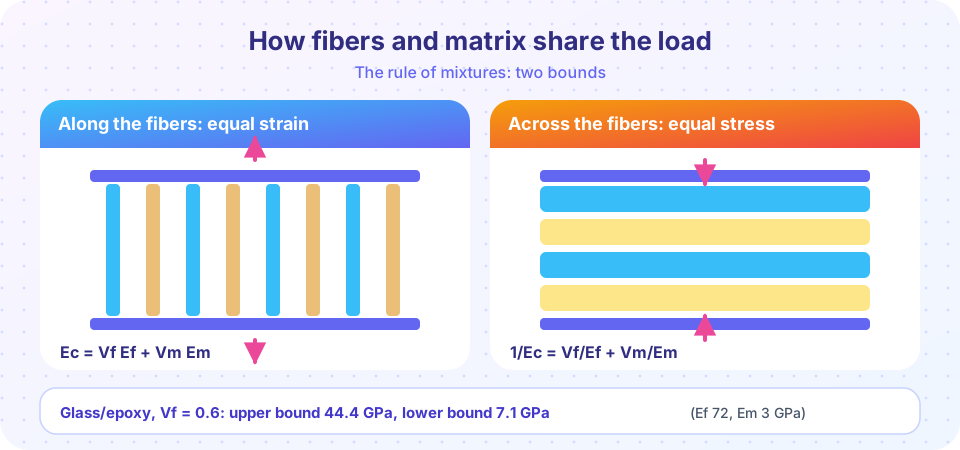
- Loaded along continuous aligned fibers (isostrain): fibers and matrix stretch by the same amount, so
Ec∥ = Vf Ef + Vm Em. This is the upper bound. - Loaded across the fibers (isostress): both carry the same stress, so strains add and
1/Ec⊥ = Vf/Ef + Vm/Em. This is the lower bound.
Worked example: glass fibers (Ef = 72 GPa, ρf = 2.54 g/cm³) in epoxy (Em = 3 GPa, ρm = 1.2 g/cm³), Vf = 0.6, Vm = 0.4.
- Along the fibers:
Ec∥ = 0.6 × 72 + 0.4 × 3 = 43.2 + 1.2 = 44.4 GPa. - Across:
1/Ec⊥ = 0.6/72 + 0.4/3 = 0.00833 + 0.1333 = 0.1417, soEc⊥ ≈ 7.1 GPa. - Density:
0.6 × 2.54 + 0.4 × 1.2 = 2.00 g/cm³.
The same material is six times stiffer along the fibers than across them. This anisotropy is the great opportunity and the great trap of composites: place fibers where the loads are, and orient plies accordingly. Real laminates mix 0°, ±45° and 90° plies. The two formulas are bounds: real measured stiffness across the fibers is usually above the isostress value because the phases are not perfectly in series.
How long must a fiber be?
Load passes from the matrix into a fiber through shear along its surface. A fiber that is too short never reaches its full stress. The critical length is
l_c = σ_f d / (2 τ_c)
where σ_f is the fiber strength, d its diameter and τ_c the shear strength of the interface (or of the matrix, whichever is weaker). For a 10 µm fiber with σ_f = 3,500 MPa and τ_c = 35 MPa, l_c = 3,500 × 10 / (2 × 35) = 500 µm = 0.5 mm. Fibers much longer than l_c are "continuous" in effect; shorter ones reinforce less. A fiber also needs to be thin: for a given l_c/d ratio a thin fiber reaches full strength over a shorter distance.
Strengths and weaknesses
Strengths: very high specific stiffness and strength, tailorable properties, good fatigue and corrosion resistance. Weaknesses: anisotropy, cost, difficult joining, damage that hides inside the laminate (delamination after an impact), and hard recycling. Because the fibers are brittle, composites do not yield like metals, so designers include larger safety margins and inspect carefully.
Common misconceptions
"A composite is just a mixture, so properties are the simple average." Only along the fibers; across them, the soft matrix controls stiffness.
"Carbon fiber is a single material." It is a fiber that becomes useful only inside a matrix, with properties that depend on layup, volume fraction and interface.
"Composites are always lighter and better." They win on specific properties in the right direction; for isotropic, cheap parts, steel or aluminum may be better.
Try it
Press Run (or Ctrl + Enter) to see the result here.
Program input · what you'd type while the program runs
Type the answers before you press Run, one per line. Each time the program reads a line (with input()), it gets the next line from this box.
Press Run (or Ctrl + Enter) to see the console output here.
No output.
Check your understanding
Quick check · 5 questions
of 5 answered You scored / 5 · perfect!
-
1. Which formula gives the upper bound on composite stiffness?
When fibers and matrix are strained equally (loading along continuous fibers) stiffnesses add by volume fraction. -
2. A composite has Vf = 0.5 with Ef = 200 GPa and Em = 4 GPa. What is the stiffness along the fibers?
0.5 × 200 + 0.5 × 4 = 100 + 2 = 102 GPa. -
3. Why is the transverse stiffness of a unidirectional composite much lower?
In the isostress model compliance adds, so the soft matrix dominates. -
4. What does the critical fiber length depend on?
l_c = σ_f d / (2 τ_c). -
5. Which is an example of a particle composite?
Concrete is sand and gravel particles in a cement matrix.
Summary
- Composites combine a stiff reinforcement and a tough matrix; properties depend on volume fractions and geometry.
- Density:
ρc = Vf ρf + Vm ρm. Stiffness bounds: Voigt (upper) along fibers, Reuss (lower) across. - Critical fiber length
l_c = σ_f d / (2 τ_c); fibers must be longer for full effect. - Composites are anisotropic and excellent in specific stiffness, but costly and harder to inspect.
Track your progress
Create a free account to tick off lessons and pick up where you left off on any device.
of Materials Science lessons completed