


















Lesson 5 of 46 · Getting Started
Chapter 1 Review: Getting Started
Review the four corners, five material classes, performance indices, units and length scales from chapter 1, with a recap table and a ten-question quiz.
Chapter 1 gave you the vocabulary and the habits of thought for the rest of the course: look for the link from processing to structure to properties to performance, know the five classes of materials, choose by performance index rather than by habit, and keep your units straight across ten orders of magnitude in size. This review puts the chapter on one page, gives you a sandbox to rank your own candidate materials, and tests the ideas with ten questions.
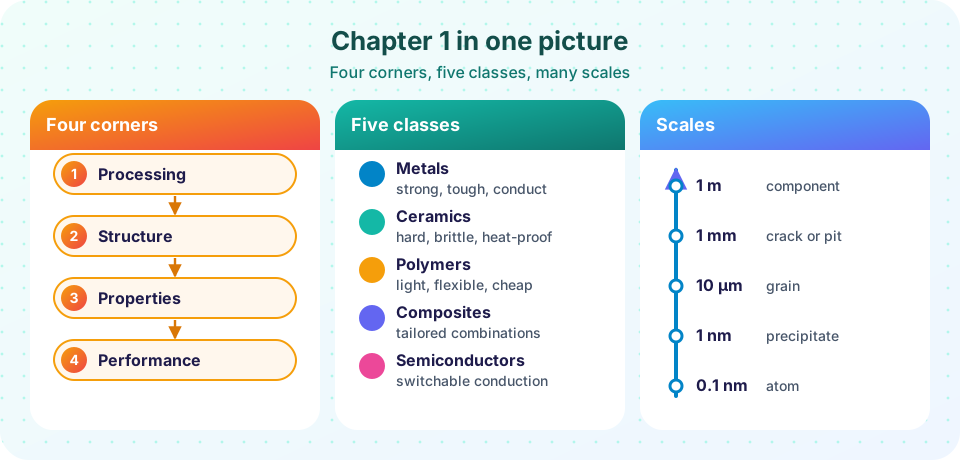
Recap table
| Lesson | Key ideas | Formulas and numbers to remember |
|---|---|---|
| What is materials science? | Processing, structure, properties, performance; five classes; diamond versus graphite; quenching and tempering | Same atoms can make very different materials |
| Choosing materials | Function, constraints, objective; property charts; performance indices | Rod E/ρ; beam E^(1/2)/ρ; strength-limited tie σ_y/ρ |
| Units and length scales | SI units; atoms per volume; instruments by scale | 1 MPa = 1 N/mm²; 1 eV/atom = 96.485 kJ/mol; n = ρ N_A / A |
Three habits will pay off throughout the course. First, ask "what is the structure?" whenever a property surprises you. Second, write the units on every number and convert before you calculate. Third, check whether an answer is the right order of magnitude: a steel modulus of 2 GPa or a polymer modulus of 200 GPa should ring an alarm.
Try it
Edit the candidate list and run the code to rank your own materials for the three selection problems of the chapter. Add a material you are curious about (use consistent units: g/cm³, GPa, MPa).
Press Run (or Ctrl + Enter) to see the console output here.
No output.
Check your understanding
Quick check · 10 questions
of 10 answered You scored / 10 · perfect!
-
1. Which sequence correctly orders the four corners from cause to effect?
Processing creates the structure; the structure gives the properties; the properties determine performance in service. -
2. A quenched steel is hard but brittle. Tempering it will
Reheating to a moderate temperature relaxes the martensite, trading hardness for toughness. -
3. Which class of material is usually brittle and heat-resistant?
Strong ionic and covalent bonds give ceramics high melting points and hardness, with little plasticity. -
4. For a stiffness-limited tie rod of minimum mass, which index is maximized?
Mass is S L² (ρ/E) for the rod. -
5. Why do steel, aluminum and titanium perform about equally for light, stiff tie rods?
All are close to 26 GPa per g/cm³ even though E and ρ differ individually. -
6. 1 MPa equals
A million pascals is a million newtons per square meter, which is one newton per square millimeter. -
7. 1 eV per atom corresponds to about
Multiply by Avogadro's number and the charge of the electron: 96.485 kJ/mol. -
8. Which instrument can resolve individual atoms?
Atomic resolution needs electrons in a TEM; SEM resolves about a nanometer and optical microscopes about 0.2 µm. -
9. What is the atoms-per-cm³ formula for an element?
Moles per cm³ is ρ/A; multiply by N_A to get atoms. -
10. Which statement about the exponent in
exp(−Q/RT)is right?Absolute temperature is required for physical exponentials and ratios.
Summary
- The four corners (processing, structure, properties, performance) organize all of materials science.
- Five classes (metals, ceramics, polymers, composites, semiconductors) have characteristic traits from their bonding.
- Selection is a method: function, constraints, objective, then a performance index.
- Keep units consistent: MPa with mm, GPa for moduli, kelvin in exponentials, eV or kJ/mol for bond energy.
- Structure matters at every scale, and different instruments reveal different scales.
Track your progress
Create a free account to tick off lessons and pick up where you left off on any device.
of Materials Science lessons completed