


















Lesson 39 of 46 · Electrical, Thermal and Optical Properties
Optical and magnetic properties
How materials reflect, absorb and transmit light, why band gap decides color and transparency, and how dia-, para- and ferromagnetism and hysteresis loops guide magnetic materials.
A window is transparent, a mirror is shiny, a ruby is red, a refrigerator magnet sticks and a paper clip sticks to the magnet. These everyday facts come from how electrons in the material respond to electromagnetic fields. Light is one kind of field; a static magnet is another.
This lesson shows how the energy band picture from the electrical lesson predicts transparency and color, how to compute reflection and absorption, and what separates the three kinds of magnetic behavior.
What you will learn
- Describe reflection, absorption and transmission with
R + A + T = 1. - Use
E = hc/λto decide whether a material absorbs a given wavelength. - Calculate reflectance from the refractive index and decay with Beer–Lambert.
- Explain color and why metals are shiny.
- Distinguish dia-, para- and ferromagnetism and read a hysteresis loop.
Key terms
Refractive index (n): the ratio of light speed in vacuum to that in the material, n = c/v.
Absorption coefficient (β): the fraction of intensity lost per unit path length.
Curie temperature: the temperature above which a ferromagnet becomes paramagnetic.
Coercivity (Hc): the reverse field needed to bring the magnetization to zero.
Remanence (Br): the flux density remaining after the field is removed.
Light meets matter
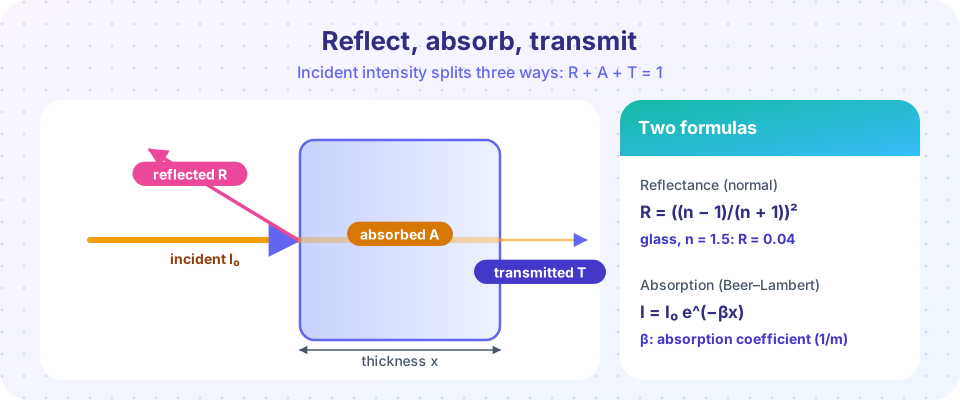
A beam hitting a material is split three ways: some is reflected at the surface, some is absorbed inside, and some is transmitted. Their fractions satisfy R + A + T = 1. A transparent material has low R and A; an opaque one transmits almost nothing.
For normal incidence on a smooth surface in air, the reflectance is R = ((n − 1) / (n + 1))². For glass, n = 1.5, so R = (0.5/2.5)² = 0.04: 4% reflected per surface (about 8% for a pane with two surfaces, which is why anti-reflection coatings matter for lenses). Diamond, with n = 2.42, reflects (1.42/3.42)² = 17%, which contributes to its sparkle.
Inside a medium, the intensity decays exponentially with distance, the Beer–Lambert law: I = I₀ exp(−β x). If β = 100 m⁻¹ a 1 cm layer transmits exp(−1) = 37%.
Band gap, color and transparency
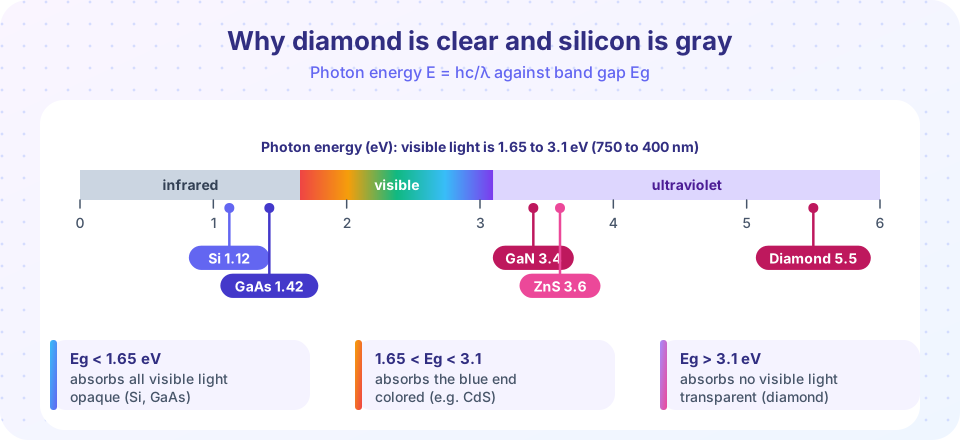
A photon of wavelength λ has energy E = hc/λ, which in convenient units is E (eV) = 1240 / λ (nm). Visible light spans roughly 400 nm (3.1 eV) to 750 nm (1.65 eV). A photon is absorbed if it has enough energy to lift an electron across the gap. Three cases:
- Eg < 1.65 eV (silicon 1.12, GaAs 1.42): absorbs all visible light, so the material is opaque. The gray, metallic look of silicon wafers is the result.
- 1.65 < Eg < 3.1 eV: absorbs the high-energy (blue) part of the spectrum and transmits the rest, so the material is colored (cadmium sulfide with Eg ≈ 2.4 eV is yellow-orange).
- Eg > 3.1 eV (diamond 5.5, ZnS 3.6, GaN 3.4, most oxides): no visible photon is absorbed, so a pure crystal is transparent.
Impurities add levels inside the gap and so add color: chromium ions in alumina make ruby red, and chromium in beryl gives emerald green. Real transparent ceramics and polycrystals also need low porosity and small grain-boundary scattering; a pure alumina powder is white, while sintered dense alumina can be translucent.
Metals have no gap: free electrons absorb photons of all visible energies and re-emit them immediately, which is why a polished metal reflects 90% or more of the light and appears shiny. Copper and gold reflect red and yellow better than blue, so they look colored. LEDs turn the idea around: electrons falling across a gap emit photons of energy near Eg, so GaN-based diodes are blue and the red LED uses a smaller-gap alloy.
Magnetism
All materials respond to a magnetic field, in one of three main ways.
- Diamagnetic (copper, water, bismuth): a very weak repulsion; the induced magnetization opposes the field.
- Paramagnetic (aluminum, platinum): a weak attraction; atoms with unpaired electrons tend to line up with the field, against thermal randomizing.
- Ferromagnetic (iron, cobalt, nickel and some alloys): a very strong attraction. Neighboring atomic moments line up spontaneously, within regions called domains. An applied field makes favorably oriented domains grow, until the sample is saturated.
Above the Curie temperature (nickel 358 °C, iron 770 °C, cobalt 1115 °C) thermal agitation destroys the alignment and the material becomes paramagnetic.
When you magnetize a ferromagnet and then reverse the field, the flux density B does not retrace its path; the lag is called hysteresis, and the loop area is energy lost as heat on every cycle.
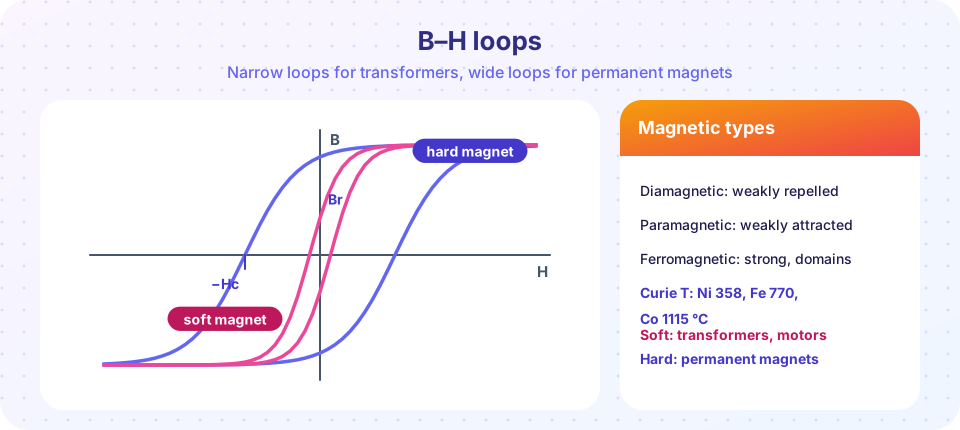
- Soft magnets (silicon-iron steel, soft ferrites) have narrow loops: easy to magnetize and demagnetize, low energy loss. They fill transformer cores and motors.
- Hard magnets (NdFeB, SmCo, AlNiCo, hard ferrites) have wide loops with high remanence and coercivity. They are permanent magnets.
Common misconceptions
"Transparent means no interaction with light." Transparent materials still reflect some light and slow it down (n > 1); they just do not absorb.
"Magnets attract all metals." Only ferromagnetic ones strongly; copper, aluminum and gold are barely affected.
"Heating a magnet makes it stronger." Heating weakens it and, above the Curie temperature, destroys ferromagnetism.
Try it
Press Run (or Ctrl + Enter) to see the result here.
Program input · what you'd type while the program runs
Type the answers before you press Run, one per line. Each time the program reads a line (with input()), it gets the next line from this box.
Press Run (or Ctrl + Enter) to see the result here.
Program input · what you'd type while the program runs
Type the answers before you press Run, one per line. Each time the program reads a line (with input()), it gets the next line from this box.
Check your understanding
Quick check · 5 questions
of 5 answered You scored / 5 · perfect!
-
1. Glass with n = 1.5 reflects what fraction of light at one surface (normal incidence)?
R = ((1.5 - 1)/(1.5 + 1))² = 0.04. -
2. A material has a band gap of 5.5 eV. It is most likely:
Visible photons (1.65–3.1 eV) have too little energy to cross the gap, so they are not absorbed. -
3. What wavelength corresponds to a photon of 2.0 eV?
λ = 1240 / 2.0 = 620 nm. -
4. Which pair of materials is a soft magnet and a hard magnet?
Silicon-iron is a soft transformer-core material with a narrow loop; NdFeB is a hard permanent magnet. -
5. A layer of absorption coefficient 100 m⁻¹ and thickness 1 cm transmits about:
I/I₀ = exp(−100 × 0.01) = exp(−1) ≈ 0.37.
Summary
R + A + T = 1;R = ((n−1)/(n+1))²;I = I₀ e^(−βx).- Band gap against photon energy (
E = 1240/λ) predicts opaque, colored or transparent behavior. - Metals reflect because free electrons respond to all visible frequencies.
- Magnetism: diamagnetic, paramagnetic, ferromagnetic; hysteresis separates soft from hard magnets; Curie temperature ends ferromagnetism.
Next: Chapter review: electrical, thermal and optical properties
Track your progress
Create a free account to tick off lessons and pick up where you left off on any device.
of Materials Science lessons completed