


















Lesson 2 of 46 · Getting Started
What Is Materials Science?
Learn the four corners of materials science, the five classes of materials, and how heat treating steel shows structure controlling properties and performance.
Take two pieces of iron-carbon alloy with the same chemical composition. Heat both to a bright orange glow. Cool one slowly in the furnace and plunge the other into water. The first stays soft enough to bend by hand; the second is hard enough to scratch glass and shatters if you drop it. Same atoms, different results. The only difference is how the atoms are arranged, and that arrangement was set by how the piece was processed. That small experiment contains the whole of materials science.
What you will learn
- The four linked ideas of the field: processing, structure, properties and performance.
- The five classes of engineering materials and a typical trait of each.
- Why the same chemistry can give very different materials.
- A short history of how new materials changed what people could build.
Key terms
Structure: how atoms are arranged, from the crystal lattice up to grains and phases.
Property: a measured response to a stimulus, such as stiffness to a force or conductivity to a voltage.
Performance: how well a finished part does its job in service, including cost, life and safety.
Composite: a material made of two or more distinct components that together do better than either alone.
The four corners
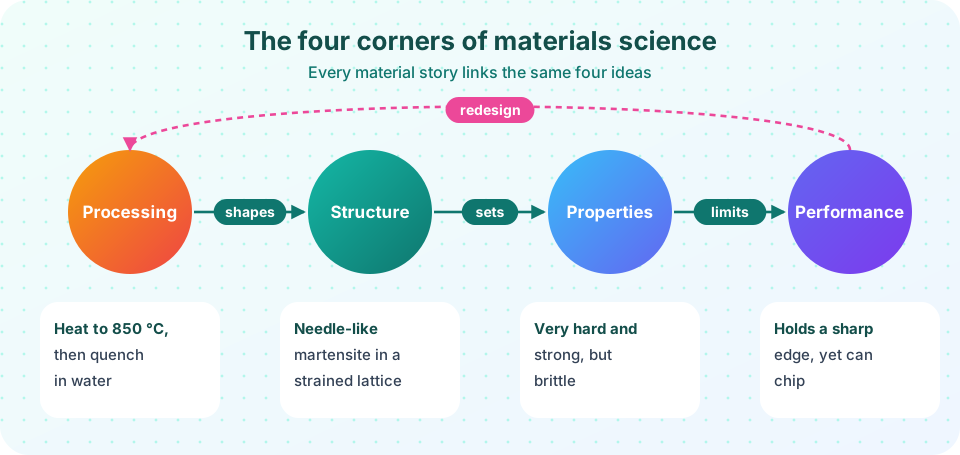
Materials scientists often draw a chain of four ideas. Processing is what you do to a material: melting, casting, rolling, heating, cooling, sintering powders, molding polymers. Processing produces a structure. The structure sets the properties. And the properties limit the performance of the part. The chain also runs backward. If a bridge cable fails in service, engineers ask which property fell short, which structure explains it, and which processing step to change.
The steel knife in the picture shows the chain. Heating the steel to about 850 °C turns it into a different crystal structure called austenite. Quenching in water is too fast for the atoms to return to their old arrangement, so carbon is trapped and the crystal becomes a strained, needle-like structure called martensite. Martensite is very hard and strong, which is a good property for holding an edge, but it is also brittle. That is why a freshly quenched blade can chip, and why bladesmiths then temper it: they reheat it to a moderate temperature (a few hundred degrees Celsius) so that the structure relaxes a little, trading some hardness for toughness.
Five classes of materials
Nearly everything in engineering falls into one of five groups, and each group has a typical personality that comes from its bonding (chapter 2).
| Class | Typical examples | Typical traits |
|---|---|---|
| Metals | steel, aluminum, copper, titanium | strong, tough, conduct electricity and heat, can be shaped by bending |
| Ceramics | alumina, silicon carbide, glass, concrete | hard, stiff, heat-resistant, brittle |
| Polymers | polyethylene, nylon, epoxy, rubber | light, flexible, easy to mold, soften when warm |
| Composites | carbon-fiber plastic, fiberglass, reinforced concrete | strong and light in chosen directions |
| Semiconductors | silicon, gallium arsenide | conductivity that can be switched and tuned |
These are tendencies, not laws. Some ceramics are tough, some polymers are stiff and strong (the fibers in a bulletproof vest are polymers), and some metals are brittle. The classes are useful because they tell you where to look first.
Same atoms, different materials
Carbon is the textbook case. Diamond and graphite are both pure carbon. In diamond each atom bonds to four neighbors in a rigid three-dimensional network, so diamond is the hardest natural material and an electrical insulator. In graphite each atom bonds strongly to three neighbors in flat sheets, and the sheets are held to one another by weak forces, so graphite is soft, slippery and conducts electricity along the sheets. The carbon is the same. The structure is different. So are the properties.
Press Run (or Ctrl + Enter) to see the result here.
Program input · what you'd type while the program runs
Type the answers before you press Run, one per line. Each time the program reads a line (with input()), it gets the next line from this box.
A short history
The ages of human history are named after materials: stone, bronze, iron. Copper smelting began several thousand years before the common era, bronze (copper with tin) about 3300 BCE, and iron working around 1200 BCE. In 1856 Henry Bessemer patented a way to turn molten iron into steel cheaply, which made railways, bridges and skyscrapers affordable. Leo Baekeland created Bakelite, the first fully synthetic plastic, in 1907. Wallace Carothers and his team at DuPont made nylon in the 1930s. The transistor was demonstrated at Bell Labs in 1947, and the silicon chips that followed are among the most carefully engineered materials ever made. Stephanie Kwolek invented the aramid fiber later sold as Kevlar in 1965. In 2019 the Nobel Prize in Chemistry honored John Goodenough, Stanley Whittingham and Akira Yoshino for lithium-ion batteries, which are materials stories from end to end.
Common misconceptions
"A material has one value for each property." Most properties depend on processing. Annealed copper is soft; cold-worked copper is much stronger, with the same chemistry.
"Stronger is always better." Strength usually trades against toughness, cost, weight and formability. The best material is the one that meets all requirements at the lowest cost.
"Brittle means weak." Glass fibers are very strong in tension. Brittle means the material fractures with little plastic deformation, not that it fails at low stress.
Try it
Drag the slider to choose a tempering temperature for a quenched high-carbon steel. The bars show the trend: as you temper at higher temperature, hardness falls and toughness rises. The numbers are rounded textbook values for a water-quenched steel with about 0.8 % carbon, meant to show the trade, not to be used for design.
Check your understanding
Quick check · 5 questions
of 5 answered You scored / 5 · perfect!
-
1. In the processing-structure-properties-performance chain, what does processing directly change?
Processing changes structure (grains, phases, defects, arrangement). Properties and performance follow from that structure. -
2. Why are diamond and graphite so different even though both are carbon?
Diamond has a 3D network of strong bonds; graphite has strongly bonded sheets held together weakly. -
3. Quenching a hot carbon steel in water produces
Fast cooling traps carbon and gives strained martensite. -
4. Which class is usually hard, heat-resistant and brittle?
Ionic and covalent bonding give ceramics high hardness and melting points but little ability to deform plastically. -
5. Which statement about 'brittle' is correct?
Brittle describes the way of failing (no yielding), not the stress at which it fails.
Summary
- Processing shapes structure, structure sets properties, and properties limit performance; the chain also runs backward in design and failure analysis.
- The five classes are metals, ceramics, polymers, composites and semiconductors, each with a typical personality caused by its bonding.
- The same atoms can make very different materials (diamond and graphite, soft and quenched steel).
- Strength, toughness, weight and cost trade against one another, so no material wins everywhere.
Track your progress
Create a free account to tick off lessons and pick up where you left off on any device.
of Materials Science lessons completed