


















Lesson 19 of 46 · Mechanical Properties
Plastic Deformation, Slip and Strengthening Mechanisms
Understand how dislocations carry slip, use Schmid's law, and compare the four strengthening mechanisms: grain size, solid solution, strain hardening and precipitation.
Chapter 2 gave an ideal bond strength; chapter 3 introduced dislocations. This lesson puts them together to explain the central fact of metallurgy: real metals yield at stresses thousands of times below the ideal strength, and engineers can raise those yield stresses enormously by putting obstacles in the way of dislocations. Every strengthening method, from cold-rolling a sheet to age-hardening an aircraft alloy, is a way of making dislocation motion harder.
What you will learn
- Why metals yield at a tiny fraction of their ideal shear strength.
- What slip systems are and how Schmid's law gives the stress on them.
- The four main strengthening mechanisms and what each costs in ductility.
- How cold work, recovery, recrystallization and annealing connect.
- How hardness tests work and what they estimate.
Key terms
Slip system: a combination of a slip plane (usually close-packed) and a slip direction (also close-packed) on which dislocations move.
Critical resolved shear stress (CRSS) τ_c: the shear stress on the slip system needed to start slip.
Strain hardening (work hardening): increase in strength caused by plastic deformation itself.
Cold work: plastic deformation below the recrystallization temperature, measured as %CW = (A₀ − A_d)/A₀ × 100.
Why slip is easy: dislocations
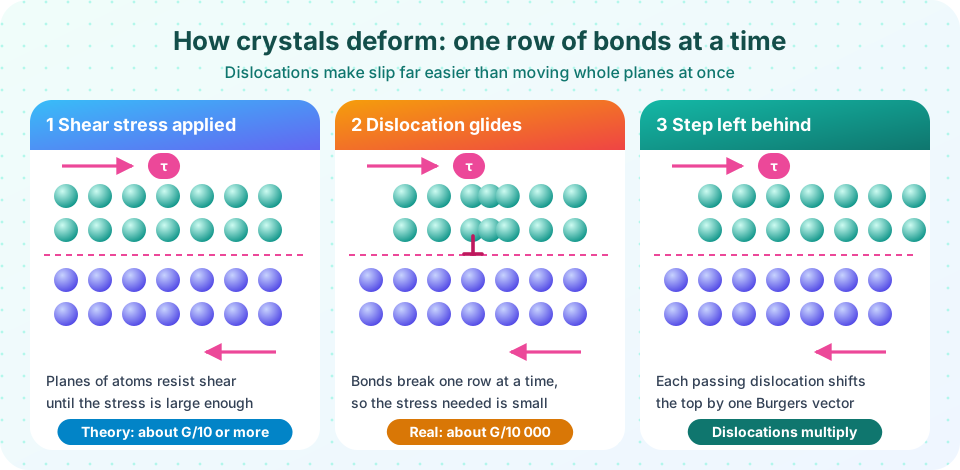
Imagine shearing a perfect crystal by sliding one entire plane of atoms over its neighbor. Every bond across the plane must stretch and break at the same time. Frenkel estimated in 1926 that this needs a shear stress of the order of τ_th ≈ G/2π, and more careful calculations give about G/10 to G/30. For copper (G = 48 GPa) this is several GPa. Measured critical shear stresses of pure single crystals are only about 0.5 to 1 MPa, some ten thousand times smaller. The resolution is the dislocation (Taylor, Orowan and Polanyi, 1934). A dislocation moves across the slip plane much as a caterpillar moves along the ground, or a ruck in a carpet along the floor: only a few atoms move at a time, and each needs only a small shift. When a dislocation exits the crystal, the part of the crystal above has shifted by one Burgers vector, leaving a step at the surface. Millions of dislocations make up a visible plastic strain.
Slip systems and Schmid's law
Dislocations glide most easily on the planes with the largest spacing, which are the close-packed planes, and along the close-packed directions in them (shortest Burgers vector). The combination is the slip system:
| Structure | Slip system | Number of systems |
|---|---|---|
| FCC | <110> |
4 planes × 3 directions = 12 |
| BCC | <111> (also |
12 on |
| HCP | basal <11-20> (also prismatic and pyramidal at higher stress) |
3 on the basal plane |
FCC has many systems with a low CRSS, so FCC metals (Al, Cu, Ni, Au) are very ductile at all temperatures. BCC metals have many systems but their CRSS rises steeply at low temperature, which is why steels can become brittle in the cold. HCP metals at room temperature have few easy systems, so zinc and magnesium are less ductile.
Slip happens when the shear stress resolved onto the slip system reaches the CRSS. If a tensile stress σ acts along an axis, φ is the angle between the axis and the slip-plane normal, and λ the angle between the axis and the slip direction, the resolved shear stress is
τ_R = σ cos φ cos λ,
known as Schmid's law. The factor m = cos φ cos λ is the Schmid factor; its largest possible value is 0.5, when φ = λ = 45°. The crystal yields when τ_R = τ_c, at σ_y = τ_c / m. A single crystal therefore yields at different stresses in different orientations: it is easiest to deform when a slip system lies at 45° to the axis. A polycrystal has randomly oriented grains, and because neighboring grains must deform together without leaving gaps, each needs at least five independent slip systems (the von Mises criterion). That is why HCP metals with few systems are less ductile in polycrystalline form.
Press Run (or Ctrl + Enter) to see the result here.
Program input · what you'd type while the program runs
Type the answers before you press Run, one per line. Each time the program reads a line (with input()), it gets the next line from this box.
Four ways to strengthen metals
Because plastic flow means moving dislocations, strengthening means obstructing them. All four methods trade some ductility and toughness for strength, except grain refinement, which often improves both.
1. Grain-size reduction. Grain boundaries stop dislocations, which pile up behind them. Smaller grains give a higher yield strength by the Hall-Petch relation σ_y = σ₀ + k d^(−1/2) (chapter 3). Steels with grains refined from 50 to 5 µm can gain over 100 MPa in yield strength while keeping toughness. It is the only common method that raises both strength and toughness.
2. Solid-solution strengthening. Solute atoms that differ in size from the host (brass, which is copper with zinc, or steel with carbon and nitrogen in interstitial positions) create local strain fields that repel or attract dislocations and make them move more slowly. Adding 30 % zinc raises the tensile strength of annealed copper by roughly half. Larger size mismatch gives larger strengthening, and solutes also lower electrical conductivity, a cost when conductivity matters.
3. Strain hardening. Plastic deformation multiplies dislocations (from 10¹⁰ to 10¹⁵ m⁻² or more), and the growing crowd of dislocations tangle and block each other. The result is described by Taylor's relation, τ = τ₀ + α G b √ρ_d, with α about 0.2 to 0.5: strength grows with the square root of dislocation density. In the tensile test, strain hardening is why the curve rises beyond yield. In manufacturing it is used on purpose: cold-rolled sheet, drawn wire and cold-forged bolts are strengthened by deformation, at the expense of ductility. If a copper wire is drawn from 2.0 mm to 1.6 mm diameter, the area ratio is (1.6/2.0)² = 0.64, so %CW = 36 %.
For many metals the true stress-strain curve in the plastic region follows the Hollomon equation σ_T = K ε_T^n, where n, the strain-hardening exponent, is 0.1 to 0.5. Necking begins at the strain where dσ_T/dε_T = σ_T, which gives ε_T = n (the Considère criterion). A high n means more uniform deformation before necking, which helps in sheet forming.
Press Run (or Ctrl + Enter) to see the result here.
Program input · what you'd type while the program runs
Type the answers before you press Run, one per line. Each time the program reads a line (with input()), it gets the next line from this box.
4. Precipitation (age) hardening. If an alloy is heated until a second element dissolves, quenched, and then held at a moderate temperature, fine particles of a second phase (precipitates, a few nanometers across) form. Dislocations must either cut through the particles or bow around them (Orowan looping, with extra stress Δτ ≈ G b / L, where L is the particle spacing). Aluminum-copper alloys (the 2000 series), 6000-series aluminum and nickel superalloys all use this. Peak strength is reached at an optimum particle size; "overaged" material with coarse particles is softer. We return to this in chapter 6.
Recovery, recrystallization and grain growth
Cold-worked metal is strong but hard and stores energy. On heating, three stages follow. Recovery reduces dislocation density a little and restores conductivity with little change in strength. Recrystallization, typically at 0.3 to 0.5 of the melting temperature in kelvin, forms new strain-free grains, dropping the strength to near its annealed value and restoring ductility. Grain growth at higher temperature or longer times makes the grains coarser, which lowers strength again. Annealing is the heat treatment that exploits these stages to soften and restore ductility after cold work; for example, a copper wire can be drawn, annealed and drawn again.
Hardness
Hardness is resistance to local plastic deformation, measured by pressing an indenter into the surface. In the Brinell test a hardened steel or carbide ball (usually 10 mm diameter) is pressed with a force, often 3000 kgf for steel, and the diameter of the dent gives HB = 2F / (πD (D − √(D² − d²))) with F in kgf and D, d in mm. The Vickers test uses a diamond pyramid with a 136° angle between faces, and the Rockwell test measures the depth of penetration (HRC uses a diamond cone and 150 kgf). Hardness correlates with yield and tensile strength because both reflect resistance to plastic flow: for many steels σ_TS ≈ 3.45 × HB MPa.
Press Run (or Ctrl + Enter) to see the console output here.
No output.
Common misconceptions
"Strengthening a metal means making the bonds stronger." The bonds do not change. Strengthening works by obstructing dislocations.
"Strain hardening means the metal gets harder by getting hot." It is deformation that hardens it; heating does the opposite (recovery and recrystallization soften it).
"More strength is always an improvement." Strengthening by cold work, solutes and precipitates reduces ductility and toughness, so the engineer chooses the right balance.
Check your understanding
Quick check · 5 questions
of 5 answered You scored / 5 · perfect!
-
1. Why do real metals yield at stresses far below the theoretical shear strength?
Dislocation glide needs only a small stress compared with shearing a whole plane. -
2. What is the maximum value of the Schmid factor?
cos φ cos λ is largest, 0.5, at φ = λ = 45°. -
3. Which strengthening method generally improves toughness as well as strength?
Finer grains increase yield strength via Hall-Petch and usually raise toughness. -
4. A wire is drawn from 4.0 mm to 3.0 mm diameter. The percent cold work is about
Area ratio (3/4)² = 0.5625, so %CW = (1 − 0.5625) × 100 = 43.75 %. -
5. Which stage of annealing replaces deformed grains with strain-free grains?
Recrystallization forms new strain-free grains and restores ductility.
Summary
- Dislocation glide makes real yield stresses far lower than the ideal shear strength.
- Slip occurs on close-packed systems (
<110>in FCC); Schmid's lawτ_R = σ cos φ cos λgives the stress on a system, withm ≤ 0.5. - Four strengthening mechanisms obstruct dislocations: grain boundaries, solute atoms, other dislocations (strain hardening) and precipitates.
- Strain hardening follows
σ_T = K ε_T^n, and necking starts atε_T = n. - Annealing (recovery, recrystallization, grain growth) reverses cold work; hardness tests give quick strength estimates.
Track your progress
Create a free account to tick off lessons and pick up where you left off on any device.
of Materials Science lessons completed