


















Lesson 41 of 46 · Projects and Practice
Project: choosing a material with performance indices
Pick the best material for a light, stiff or strong beam using performance indices: set function, constraint, objective and free variable, then rank candidates in Python.
"Which material should I use?" is the central question of engineering design, and the answer is rarely "the strongest one." A cheap steel bar and a carbon-fiber bar can both carry the same load, but one weighs five times more. The right answer depends on what you are trying to optimize.
In this project you will learn the method developed by Michael Ashby for turning a design problem into a single number, a performance index, then use it to rank real materials. You will do the algebra once by hand and then let Python do the ranking.
What you will learn
- Break a design problem into function, constraint, objective and free variables.
- Derive the indices
E^½/ρ(stiff beam) andσy^⅔/ρ(strong beam). - Rank candidate materials in Python and include cost.
- Explain why the ranking changes when the objective changes.
Key terms
Function: what the part must do (carry a load, conduct heat, contain pressure).
Constraint: a requirement that must be met (stiff enough, strong enough, must not melt).
Objective: the quantity to minimize or maximize (mass, cost, energy).
Free variable: a dimension you may choose (thickness, radius).
Performance index: a combination of material properties that measures how well a material meets the objective.
The method on one example
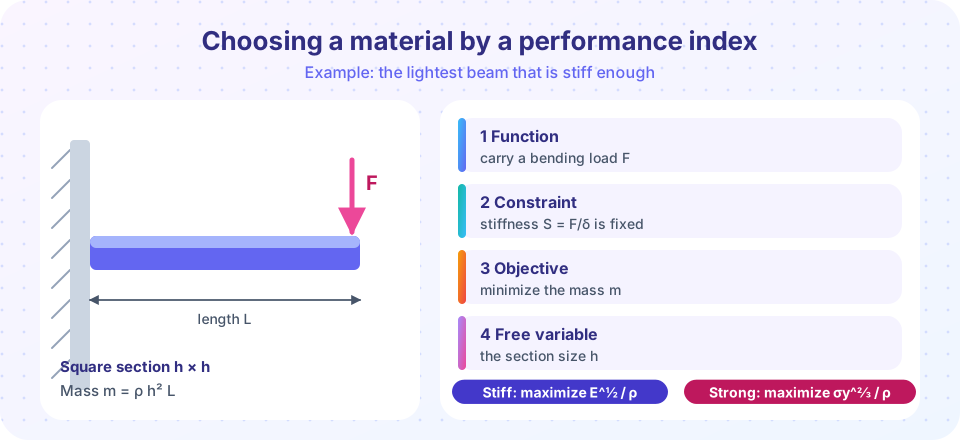
A cantilever beam of length L is fixed at one end and loaded with a force F at the tip. Its section is a square of side h. We want the lightest beam that is stiff enough.
- Function: carry a bending load.
- Constraint: the stiffness S = F/δ must be at least a given value. For a cantilever S = 3EI/L³ with I = h⁴/12, so
S = E h⁴ / (4 L³). - Objective: minimize the mass
m = ρ h² L. - Free variable: the section size h.
Eliminate h with the constraint: h = (4 S L³ / E)^(1/4). Substitute into the mass:
m = ρ L (4 S L³)^(1/2) E^(−1/2) = (4 S)^(1/2) L^(5/2) · ρ / E^(1/2)
Everything except ρ / E^(1/2) is fixed by the design. So the lightest stiff beam uses the material with the largest M = E^(1/2) / ρ.
If instead the beam must be strong (not yield), the constraint is σ = 6 F L / h³ ≤ σy, so h = (6 F L / σy)^(1/3) and m = ρ h² L ∝ ρ / σy^(2/3). The index is M = σy^(2/3) / ρ.
Notice that different objectives give different indices; for a light tie rod loaded in tension the index is E/ρ (stiffness) or σy/ρ (strength). For a stiff panel it is E^(1/3)/ρ. The cube root, square root and unity exponents come from how the free variable enters the stiffness formula.
Rank candidates
Press Run (or Ctrl + Enter) to see the result here.
Program input · what you'd type while the program runs
Type the answers before you press Run, one per line. Each time the program reads a line (with input()), it gets the next line from this box.
Press Run (or Ctrl + Enter) to see the result here.
Program input · what you'd type while the program runs
Type the answers before you press Run, one per line. Each time the program reads a line (with input()), it gets the next line from this box.
Extending the method
Real selection adds more: several constraints at once (the part must be stiff and strong and below a cost), limits on temperature, corrosion, availability and manufacturability. Ashby charts plot material families on log axes and use straight guide lines of slope 1/2, 2/3 or 1 to show where an index is constant, so the best choices stand out visually. Software tools automate it. But the thinking is the same: write the objective as a function of material properties, eliminate the free variable through the constraint, and rank.
Common misconceptions
"The strongest material is the best choice." Strength per weight, stiffness per weight, strength per cost: each objective gives a different winner.
"A performance index ranks materials for every part." It is derived for one geometry and one loading mode; change them and the index changes.
"Properties are fixed numbers." They depend on processing, temperature and direction (for composites and wood).
Check your understanding
Quick check · 4 questions
of 4 answered You scored / 4 · perfect!
-
1. For the lightest stiff cantilever beam with a square section, which index is maximized?
Eliminating h from S = E h⁴/(4L³) gives m ∝ ρ/E^(1/2). -
2. What is the free variable in the beam example?
We choose h freely; the constraint then fixes it. -
3. For a light strong beam the index is:
From σ = 6FL/h³ ≤ σy and m = ρh²L. -
4. Why can one material win for stiffness and another for strength?
E^½/ρ and σy^⅔/ρ weight stiffness and strength differently, so rankings can differ.
Summary
- Selection = function, constraint, objective, free variable; combine them into a performance index.
- Light stiff beam: maximize
E^½/ρ; light strong beam: maximizeσy^⅔/ρ. - Rankings depend on geometry, loading and objective; add cost and other limits for real decisions.
Next: Failure case studies
Track your progress
Create a free account to tick off lessons and pick up where you left off on any device.
of Materials Science lessons completed