


















Lesson 12 of 46 · Crystal Structures and Defects
Unit Cells and Atomic Packing
Work out atoms per cell, coordination number, cell edge and atomic packing factor for SC, BCC, FCC and HCP crystals, plus interstitial sites and iron polymorphism.
Most metals crystallize in just three arrangements: body-centered cubic (BCC), face-centered cubic (FCC) and hexagonal close-packed (HCP). Each one packs spheres a little differently, and those differences change how metals deform, how much carbon they dissolve and how they respond to heat. Treating atoms as hard spheres that touch is a crude model, but it gives surprisingly useful numbers: how many atoms belong to a cell, how many neighbors each atom has, how much space is filled, and how big the gaps are.
What you will learn
- How to count atoms per cell and find the coordination number.
- How to relate the cell edge
ato the atomic radiusRin SC, BCC, FCC and HCP. - How to compute the atomic packing factor (APF) and what it means.
- How big the interstitial holes are, and why steel's carbon prefers FCC iron.
- What polymorphism and allotropy are.
Key terms
Coordination number (CN): the number of nearest neighbors of an atom.
Atomic packing factor (APF): the fraction of the cell volume occupied by atoms, APF = (n · 4πR³/3) / V_cell.
Close-packed: arranged so that spheres fill space as efficiently as possible, APF = 0.74.
Polymorphism / allotropy: the ability of a material (or an element) to exist in more than one crystal structure.
Counting atoms in a cell
Atoms at the corners and faces of a cell are shared with neighbors. A corner atom is shared by 8 cells, so it contributes 1/8. A face atom is shared by 2 cells (1/2), an atom on an edge by 4 cells (1/4), and an atom inside the cell belongs entirely to it.
- Simple cubic (SC): 8 corners × 1/8 = 1 atom.
- BCC: 8 × 1/8 + 1 center = 2 atoms.
- FCC: 8 × 1/8 + 6 faces × 1/2 = 4 atoms.
- HCP (hexagonal prism): 12 corners × 1/6 + 2 faces × 1/2 + 3 inside = 6 atoms.
Use the tool at the end of this lesson to see the counts add up.
Where the atoms touch
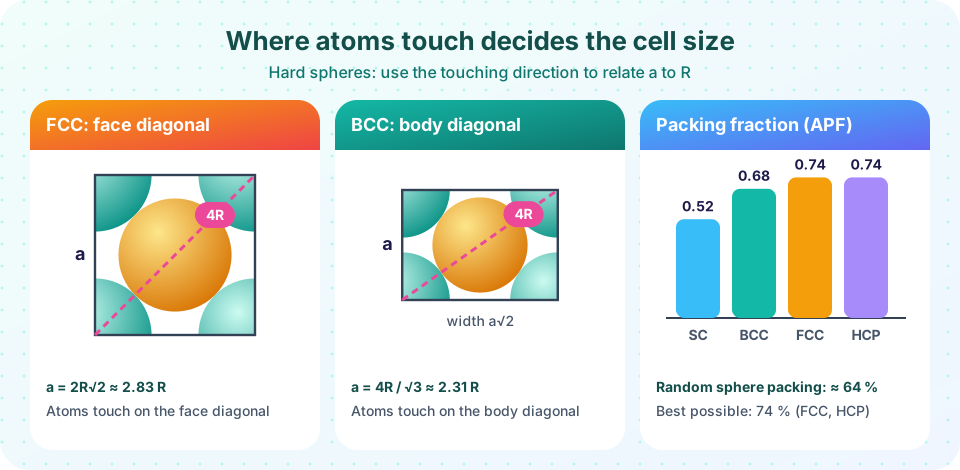
In each structure, atoms touch along one particular line, and that line fixes a in terms of R.
- SC: atoms touch along the cell edge, so
a = 2R. Each atom has 6 neighbors. The APF is1 · (4πR³/3) / (2R)³ = π/6 = 0.52. Simple cubic is rare (polonium is the only common element with it) because so much space is empty. - BCC: atoms touch along the body diagonal, whose length is
a√3 = 4R, soa = 4R/√3 ≈ 2.31R. Each atom has 8 neighbors.APF = 2(4πR³/3) / a³ = √3π/8 = 0.68. Iron at room temperature, chromium, tungsten, molybdenum and vanadium are BCC. - FCC: atoms touch along the face diagonal, of length
a√2 = 4R, soa = 2R√2 ≈ 2.83R. Each atom has 12 neighbors.APF = 4(4πR³/3) / a³ = π/(3√2) = 0.74. Aluminum, copper, nickel, silver, gold and lead are FCC. - HCP: each atom has 12 neighbors, the same as FCC. The cell edge in the hexagonal plane is
a = 2R, and the heightcis about 1.633a for ideal packing (c/a = √(8/3)). The APF is again 0.74. Magnesium, zinc, cobalt and the room-temperature phases of titanium and zirconium are HCP.
Why 0.74? Johannes Kepler conjectured in 1611, and Thomas Hales proved (the proof was published in 2005), that no arrangement of equal spheres is denser than FCC or HCP. Random packing of spheres, like ball bearings poured into a jar, reaches only about 0.64.
Stacking layers
FCC and HCP are both made of the same close-packed layer: spheres in a triangular arrangement, each touching six others. A second layer sits in the dimples of the first; call the positions A and B. The third layer can go in two places. Put it directly above the first layer (ABAB… stacking) and you get HCP. Put it in the remaining dimples (ABCABC…) and you get FCC, with close-packed planes lying perpendicular to the body diagonals of the cube. The structures have the same density but different symmetry, and that is why FCC metals are usually more ductile than HCP metals: FCC has four sets of close-packed planes, while HCP has only one.
Holes between atoms
Even in close-packed structures 26 % of the volume is empty, in the form of holes. Small atoms such as carbon, nitrogen, hydrogen and boron can sit in them and form interstitial solid solutions. Two kinds of hole matter. A tetrahedral hole is surrounded by four atoms. An octahedral hole is surrounded by six. For hard spheres of radius R the largest sphere that fits is:
| Structure | Octahedral hole | Tetrahedral hole |
|---|---|---|
| FCC and HCP | 0.414 R |
0.225 R |
| BCC | 0.155 R |
0.291 R |
BCC has the lower packing factor, yet its holes are smaller than FCC's largest hole because the empty space is spread out in many small gaps. Carbon has an atomic radius of about 0.077 nm, bigger than any hole in iron, so it always distorts the lattice. The fit is far worse in BCC iron (the largest hole is about 0.036 nm for R = 0.124 nm) than in FCC iron (about 0.054 nm for R = 0.129 nm). This is why FCC iron (austenite) can dissolve up to about 2.1 % carbon by weight while BCC iron (ferrite) dissolves at most 0.02 %. That difference underlies the entire heat treatment of steel in chapters 5 and 6.
Polymorphism
Many elements change their crystal structure with temperature or pressure. Iron is BCC below 912 °C (α iron, ferrite), FCC from 912 to 1394 °C (γ iron, austenite) and BCC again from 1394 °C up to melting at 1538 °C (δ iron). Titanium is HCP up to 882 °C and BCC above. Tin is a metallic tetragonal solid at room temperature but turns into a brittle cubic form, gray tin, below 13.2 °C. Carbon is graphite or diamond depending on pressure. Because FCC is denser than BCC, iron shrinks slightly when it changes from BCC to FCC on heating, a change you can see on a dilatometer curve.
Press Run (or Ctrl + Enter) to see the result here.
Program input · what you'd type while the program runs
Type the answers before you press Run, one per line. Each time the program reads a line (with input()), it gets the next line from this box.
The second demonstration counts atoms per cell. Choose a structure and see how corner, face and body atoms contribute, and how the cell edge and packing factor follow from the radius you enter.
Common misconceptions
"Corner atoms belong to the cell." Only an eighth of each corner atom is inside. The count 1 for SC, 2 for BCC, 4 for FCC comes from sharing.
"BCC must be less dense than any FCC metal." Packing fraction is lower in BCC (0.68 against 0.74), but density also depends on atomic mass and size: tungsten, BCC, is among the densest metals.
"HCP and FCC are different packings." They are two stackings of the same close-packed layer and have the same packing factor and coordination number.
Check your understanding
Quick check · 5 questions
of 5 answered You scored / 5 · perfect!
-
1. How many atoms are in the FCC unit cell?
8 corners × 1/8 plus 6 faces × 1/2 gives 4. -
2. In BCC, atoms touch along
The body diagonal has length a√3 = 4R. -
3. What is the packing factor of FCC?
APF(FCC) = π/(3√2) ≈ 0.74. -
4. Why can austenite (FCC iron) dissolve far more carbon than ferrite (BCC iron)?
The octahedral hole of FCC iron (0.414R) is larger than any hole of BCC iron (0.291R at most). -
5. Which stacking sequence produces HCP?
HCP repeats A, B, A, B; FCC repeats A, B, C.
Summary
- Atoms per cell: SC 1, BCC 2, FCC 4, HCP 6; coordination numbers 6, 8, 12 and 12.
- Cell edge from touching atoms:
a = 2R(SC),4R/√3(BCC),2R√2(FCC). - Packing factors: 0.52, 0.68, 0.74, 0.74; close packing is the densest possible.
- FCC and HCP differ only in stacking (ABC versus AB); iron changes between BCC and FCC on heating.
- Interstitial holes are small and set how much carbon a crystal can hold.
Track your progress
Create a free account to tick off lessons and pick up where you left off on any device.
of Materials Science lessons completed