


















Lesson 33 of 46 · Ceramics, Polymers and Composites
Polymer structure and behavior
Learn how polymer chain structure, crystallinity and crosslinking control stiffness; understand Tg, Tm, viscoelastic creep and relaxation, and rubber elasticity.
A polymer is a molecule so long that it behaves like a piece of cooked spaghetti. A chain of polyethylene can contain tens of thousands of carbon atoms. Whether a bag made from it is stiff or floppy, whether a cup deforms in hot water, whether a tire grips: all of it follows from how these chains are arranged and how freely they can move.
This lesson covers chain structure, the three families of polymer behavior, the glass transition that governs everyday performance, and the time-dependent response called viscoelasticity.
What you will learn
- Define monomer, degree of polymerization and molecular weight.
- Distinguish thermoplastics, thermosets and elastomers.
- Explain the glass transition and melting temperature.
- Describe viscoelastic creep and stress relaxation with the Maxwell model.
- Estimate the modulus of a rubber from crosslink density.
Key terms
Monomer / mer: the small repeating unit, such as −CH₂−CH₂− in polyethylene.
Degree of polymerization (DP): the average number of mers per chain, DP = Mn / m₀.
Glass transition (Tg): the temperature range where an amorphous polymer changes from a hard glass to a soft rubber.
Crystallinity: the fraction of the material in ordered chain-folded regions.
Viscoelastic: showing both elastic and viscous (time-dependent) behavior.
Chains and molecular weight
A polymer is built by joining monomers. Polyethylene's mer, C₂H₄, has a molar mass m₀ of about 28.05 g/mol. If the number-average molecular weight is 280,000 g/mol, the degree of polymerization is 280,000 / 28.05 ≈ 10,000. Real samples contain chains of many lengths, so we quote averages. Longer chains tangle more, giving higher strength and melt viscosity; a polymer with very short chains is a wax.
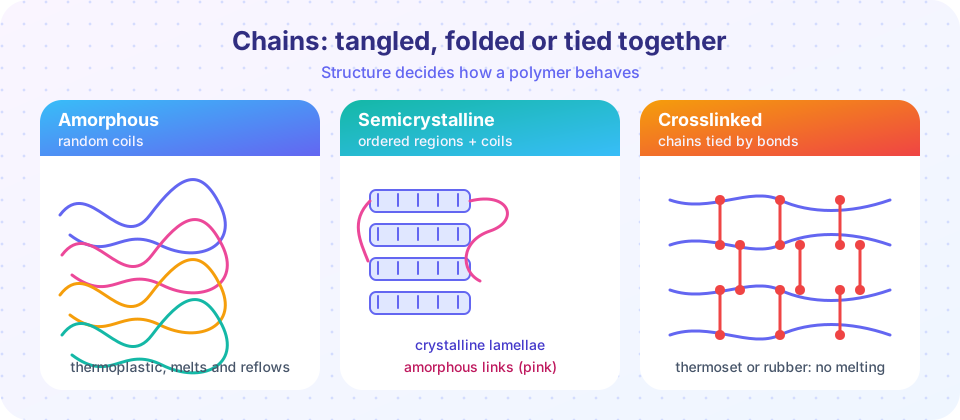
Chain architecture matters too. Linear chains (high-density polyethylene, HDPE) pack closely and crystallize. Branched chains (low-density polyethylene, LDPE) cannot pack as well, so LDPE is less crystalline, softer and more transparent. Bulky side groups, as in polystyrene, hinder both crystallization and chain rotation.
Three families
- Thermoplastics (polyethylene, polystyrene, nylon, PET): separate chains held by weak bonds. Heating softens or melts them, so they can be molded again and recycled.
- Thermosets (epoxy, phenolic, vulcanized rubber in heavy crosslinks): a rigid 3D network of covalent crosslinks. They do not melt; heating eventually decomposes them.
- Elastomers (natural rubber, silicone): lightly crosslinked, with chains that coil freely at room temperature, so they stretch a lot and spring back.
The glass transition
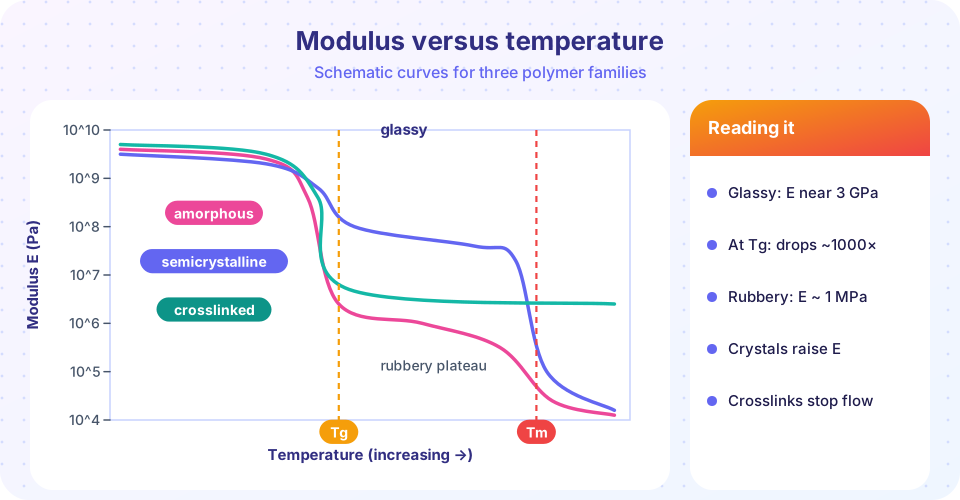
Cool an amorphous polymer and the chains slow down. At Tg the segments of chains cannot move on the experimental time scale: the polymer becomes hard and glassy, with a modulus near 3 GPa. Above Tg it is rubbery or leathery, with a modulus around 1 MPa, a drop of about three orders of magnitude. Approximate Tg values: polystyrene and PMMA around 100 °C, PET near 70 °C, polyethylene far below room temperature, natural rubber around −70 °C. That is why a polystyrene cup is rigid at room temperature but a rubber band stretches.
Semicrystalline polymers also have a melting temperature Tm, where crystals dissolve; between Tg and Tm the crystals act like crosslinks, so the material stays stiff. Crosslinked polymers keep a rubbery plateau without flow.
Viscoelasticity: solid and liquid at once
Pull on a polymer and it stretches instantly (elastic) and continues to stretch slowly (viscous). Hold the strain and the stress decays. Two simple descriptions:
- Stress relaxation (Maxwell model: spring in series with a dashpot):
σ(t) = σ₀ exp(−t/τ), with relaxation timeτ = η/E. - Creep (Kelvin–Voigt model: spring and dashpot in parallel): strain grows toward a limit,
ε(t) = (σ₀/E)(1 − exp(−t/τ)).
The practical lesson: polymers creep under constant load, especially near or above Tg, so a plastic shelf bracket that holds a book today may sag next month. Rate and temperature change the response, which is why testing must report both.
Rubber elasticity
Stretching a rubber uncoils its chains, which lowers their entropy; the restoring force is mostly entropic. For lightly crosslinked rubber the shear modulus is G = ρRT / Mc, with density ρ, gas constant R, temperature T and Mc the average molar mass between crosslinks. With ρ = 920 kg/m³, T = 300 K and Mc = 10 kg/mol this gives G ≈ 0.23 MPa. A rubber under tension gets warmer when stretched and its stiffness rises with temperature, unlike a metal.
Common misconceptions
"Plastic" is one material. It is hundreds of polymers with Tg values from far below to far above room temperature and wildly different properties.
"Polymers are crystalline or amorphous." Most are partly both; the crystalline fraction varies with cooling rate and chain structure.
"Rubber is stiff when hot." Rubber stiffens slightly with temperature, but plastics soften as they pass Tg.
Try it
Press Run (or Ctrl + Enter) to see the result here.
Program input · what you'd type while the program runs
Type the answers before you press Run, one per line. Each time the program reads a line (with input()), it gets the next line from this box.
Press Run (or Ctrl + Enter) to see the console output here.
No output.
Check your understanding
Quick check · 5 questions
of 5 answered You scored / 5 · perfect!
-
1. Polyethylene has a mer mass of 28.05 g/mol and Mn = 280,000 g/mol. What is the degree of polymerization?
DP = 280,000 / 28.05 ≈ 9,980, close to 10,000. -
2. Which polymer family can be melted and remolded?
Thermoplastics are chains with weak bonds between them; heat lets them flow again. -
3. What happens to modulus at Tg of an amorphous polymer?
The polymer changes from glassy (about 3 GPa) to rubbery (about 1 MPa). -
4. In a Maxwell model, what fraction of the initial stress remains after t = τ at constant strain?
σ/σ₀ = exp(−1) ≈ 0.37. -
5. Which makes LDPE softer than HDPE?
Branches prevent close packing, giving lower crystallinity, density and stiffness.
Summary
- Polymers are long chains;
DP = Mn / m₀; architecture controls packing and crystallinity. - Thermoplastics melt, thermosets are crosslinked networks, elastomers are lightly crosslinked and stretchy.
- At Tg modulus falls roughly a thousandfold; semicrystalline polymers also have Tm.
- Viscoelastic behavior: creep and stress relaxation, with time constant τ.
- Rubber stiffness is entropic:
G = ρRT / Mc.
Track your progress
Create a free account to tick off lessons and pick up where you left off on any device.
of Materials Science lessons completed